


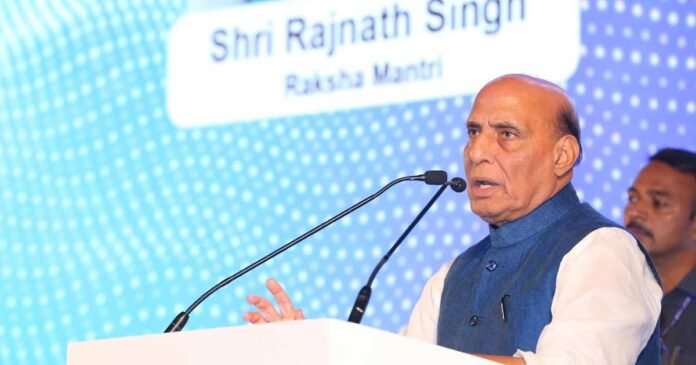
New Delhi: In the wake of threats from across the border the Defence Minister Rajnath Singh in a strong message said that “the defence forces have been handed both freedom and resources to respond decisively to threats, including striking adversaries inside their own territory.”
Speaking at a function here on September 7, he stated that efforts were made by the adversary to undermine India’s security by all ill means including misleading the youth in Jammu & Kashmir, funding anti-India activities, spreading violence and terrorism, and attempting to create divisions within society. He asserted that the Government, under the leadership of Prime Minister Narendra Modi, has foiled these nefarious designs and responded on all fronts by bringing misguided youth back into the mainstream, undertaking rehabilitation & de-radicalisation efforts, and creating employment and business opportunities.

The Minister said Jammu and Kashmir has witnessed unprecedented progress since the abrogation of Article 370, as new avenues and opportunities have been opened up for the youth. He emphasised that India adopted the strategy of eliminating terrorism through decisive military action such as Surgical Strikes, Balakot Airstrike and Operation Sindoor, which targeted terrorists and their handlers. “The suspension of the Indus Waters Treaty sent a clear message that blood and water cannot flow together”, he said.
Singh pointed out that attempts by the adversaries to sow discord among Indians have also been successfully thwarted. Referring to the attacks that targeted places of worship during Operation Sindoor, he stated that the people of India rejected such conspiracies and demonstrated unity and social harmony.
While he reiterated that India believes in peace and it does not desire war or seek to occupy the territory of any nation, he stressed that there is a clear distinction between peace and weakness. “Peace born of the fear of war is to be condemned, while war fought for the sake of peace is worthy of reverence. We’ve made it clear that if any country promotes terrorism against India, there will be no dialogue; instead, our defence forces will deliver a befitting response,” he said.
On the rapidly evolving nature of warfare, Singh stated that space and cyber space, alongside land, air and sea, have emerged as new domains of conflict, with technologies such as Artificial Intelligence, drones, autonomous systems and precision weapons transforming the battlefield. The Government is focusing on making its defence strategy and security apparatus future-ready, he said, adding that the objective is to make India a nation that develops advanced technologies indigenously.

Stating that India’s defence policy has moved beyond reactive to being pro-active, the Minister stated that it was due to Prime Minister Modi’s diplomacy and leadership that India became a member of the Missile Technology Control Regime in 2016, which facilitated efforts to extend the range of the BRAHMOS missile, which proved pivotal during Operation Sindoor.
On the transformation of the defence sector, Singh stressed that the Government has worked towards enhancing border security, modernising the defence forces, boosting indigenous production and revamping ordnance factories. These efforts have made the nation self-reliant and self-confident in defence, he said, underlining that defence production, which stood at around Rs 40,000 crore before 2014, has risen to approximately Rs 1.80 lakh crore, with defence exports growing 56-fold to over Rs 38,000 crore.

The Minister emphasised that India has moved from an import-dependent approach to one focused on indigenous defence manufacturing and Aatmanirbharta. “Today, our defence forces possess the indigenous Air Defence Control System ‘Akashteer’ and the next-generation air defence missile ‘Akash’. We have the Pinaka Rocket Launcher, the air-to-air missile ‘Astra’, indigenous helicopters like ‘Prachand’ and ‘Dhruv’, the ‘Tejas’ fighter aircraft, the ‘Arjun’ tank, and modern drone and counter-drone systems. Furthermore, India’s first indigenous aircraft carrier, INS Vikrant, has been inducted into the Indian Navy. We’re now producing a wide range of defence equipment while pursuing the development of sixth-generation fighter aircraft. Our aim is to export defence equipment worth Rs 50,000 crore by 2029,” he said.
Singh also highlighted the turnaround of the defence manufacturing ecosystem, stating that all 16 Defence Public Sector Undertakings (DPSUs) are now operating without losses and are increasing investments in research and development and exploring new export opportunities. “Over the last 12 years, India’s defence budget has risen from Rs 2.5 lakh crore to approximately Rs 8 lakh crore, and every rupee is being utilised to strengthen India’s security with complete transparency and accountability,” he added.
The Minister pointed out that India’s security, territorial integrity and cultural identity have strengthened in the last 12 years. “India has emerged as a civilisational leader through initiatives such as International Yoga Day, revival of Nalanda University, International Solar Alliance and Global Biofuels Alliance. We’re strengthening the voice of developing nations through initiatives such as the Voice of Global South Summit and MAHASAGAR (Mutual and Holistic Advancement for Security and Growth Across Regions). India has emerged as a reliable ‘First Responder’ to crises in neighbouring countries,” he added.
Underscoring the link between economic and national security, Singh said a strong economy is essential for developing modern military capabilities and maintaining strategic autonomy. He emphasised that despite global economic uncertainties, India is marching ahead with a growth rate of 7.8% while strengthening supply chains, promoting self-reliance in critical sectors and expanding indigenous manufacturing. He cited the development of India’s semiconductor ecosystem and the Production Linked Incentive scheme as examples of efforts to build economic resilience.
“Amidst geopolitical uncertainties, many nations are being compelled to choose sides or are forced to align with specific blocs. However, India is moving forward with independent agency and strategic autonomy by focusing on its own priorities, which is why, today, when we speak, the world listens,” he said.






