



China has perfected the art of strategic incrementalism. A patrol here, a road there, a new map, a renamed mountain, a temporary transgression, a new administrative claim — and each action appears too small to justify a major response. Yet, accumulated over time, these actions seek to alter perceptions, create new facts and test the adversary’s political will.
India has experienced this pattern repeatedly: Doklam in 2017, Galwan in 2020, Yangtse in 2022 and continuing friction along the Line of Actual Control. Alongside physical pressure has come cartographic aggression. Beijing has repeatedly issued lists of Chinese names for places in Arunachal Pradesh, including about 30 locations in 2024, while insisting on its claim over the state. India has rightly rejected these exercises as incapable of altering either the reality on the ground or the legal position.

The question, therefore, is not whether India should respond. It must. The more important question is how.
India cannot afford a strategy in which every Chinese provocation is answered only at the point of provocation. That would allow Beijing to determine the geography, tempo and escalation ladder of the contest. Nor should India seek confrontation for its own sake.
India needs something more sophisticated:
China should not be punished for being powerful. It should be made to pay a predictable price for using that power coercively. That requires moving from retaliation to cost imposition.

China’s Strategy of Incremental Coercion
The India–China boundary remains unresolved, but the two countries have not lacked an agreed framework for managing it. The 1993 and 1996 agreements established principles for maintaining peace and tranquillity and managing military forces along the LAC. The 2005 agreement explicitly required both sides to respect and observe the LAC pending a final settlement.
India’s own stated position after the Galwan crisis was clear: the LAC must be respected, neither side should unilaterally alter the status quo, and existing agreements must be honoured in their entirety. The strategic problem is that China’s grey-zone methods often seek to remain below the threshold at which conventional military retaliation becomes justified. This is precisely where India needs to change the equation.

A Chinese patrol in Arunachal Pradesh should be met first by superior Indian ground preparedness. But repeated coercion should also have consequences for the wider bilateral ties. A Chinese cartographic assertion need not produce military mobilisation. It should produce a stronger documentary, diplomatic and international response
China must learn that a border provocation does not necessarily result in a border war — but it will produce consequences elsewhere in the strategic relationship. That is the essence of cost imposition.
Do Not Fight China Where it Chooses
China’s greatest strengths are concentrated in mass, industrial capacity, infrastructure, economic scale, technological investment and military resources.
India should therefore avoid the temptation of symmetrical competition everywhere. The objective should instead be:
Respond to Chinese pressure at the point of Chinese vulnerability, not necessarily at the point of provocation.
A Chinese patrol in Arunachal Pradesh should be met first by superior Indian ground preparedness. But repeated coercion should also have consequences for the wider bilateral relationship. A Chinese cartographic assertion need not produce military mobilisation. It should produce a stronger documentary, diplomatic and international response.
A serious violation of a bilateral understanding should trigger a review of the economic and diplomatic privileges that India extends to China. This is not escalation. It is strategic reciprocity.
China must lose the assumption that it can compartmentalise its behaviour: pressure India militarily while continuing to enjoy every other benefit of a normal relationship.
Identify the Dragon’s Vulnerabilities
China is powerful, but power is never without dependencies. Its principal strategic vulnerabilities lie in five areas.
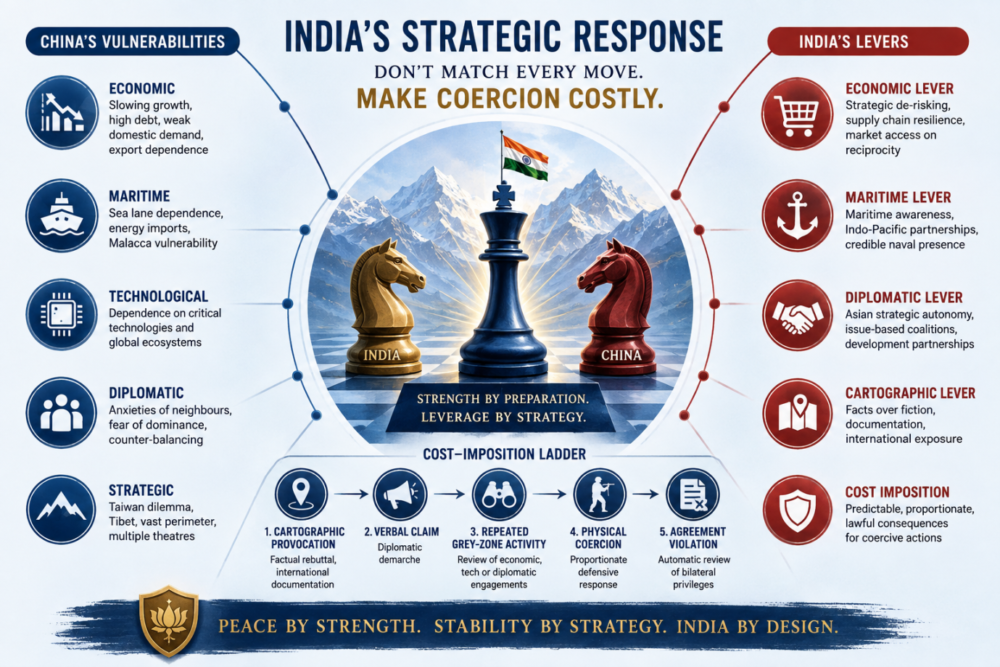
- Economy. China’s growth model faces structural pressures from weak domestic demand, the prolonged property-sector adjustment, high debt, ageing and declining returns on investment. The IMF projects growth of 4.5 per cent in 2026 and warns that these structural pressures could continue to weigh on medium-term growth.
- External Markets. Weak domestic demand increases the importance of exports. But China’s enormous manufacturing surplus increasingly generates trade friction abroad. The more China relies on exports to compensate for domestic weakness, the more exposed it becomes to diversification and trade barriers elsewhere.
- Maritime Dependence. China’s economy remains deeply connected to sea-borne trade and energy flows. The Malacca dilemma has driven Beijing for years to diversify routes, energy sources and overland connectivity, but the Indian Ocean remains strategically important.
- Diplomatic Vulnerability. Many Asian states want Chinese investment and trade without Chinese domination. China’s growing assertiveness has consequently encouraged balancing behaviour among several of its neighbours.
The most intelligent economic response to China is strategic de-risking. India should progressively reduce critical dependence on Chinese supply chains in sectors such as telecommunications, electronics, power equipment, critical minerals, batteries, industrial machinery, digital infrastructure and other strategically sensitive technologies
- Strategic Geography. China must simultaneously manage the Pacific, Taiwan, the Himalayas, Central Asia, the Indian Ocean and a vast continental periphery.
India does not have to attack these vulnerabilities. It has to build leverage around them.
India’s Economic Lever: Strategic De-risking
The most intelligent economic response to China is neither indiscriminate boycott nor unrestricted dependence. It is strategic de-risking.
India should progressively reduce critical dependence on Chinese supply chains in sectors such as telecommunications, electronics, power equipment, critical minerals, batteries, industrial machinery, digital infrastructure and other strategically sensitive technologies.
At the same time, India should make its own market increasingly attractive to alternative global suppliers. The objective is not to shut China out of India. It is to ensure that China cannot use India’s dependence upon Chinese goods and technologies as strategic leverage.
Investment screening, trusted-vendor policies, cyber-security requirements, transparent national-security procurement standards and diversification of critical supply chains can all serve this purpose. The principle should be simple: Access to India’s enormous market should be determined by transparent rules, security and reciprocity — not by political sentiment.
This distinction is vital. It keeps Indian policy defensible internationally while gradually reducing China’s economic leverage. China’s own economic vulnerabilities make this strategy potentially consequential. The IMF has warned that weak domestic demand, property-sector stress, debt and growing dependence on external demand are interacting pressures on the Chinese economy.
India should therefore become less dependent on China at exactly the time China becomes more dependent on access to large external markets.
India’s Maritime Lever: Geography as Deterrence
India possesses something China cannot manufacture: geography.
China’s commercial and energy lifelines extend through the Indian Ocean. The Andaman and Nicobar Islands lie close to the Western approaches to the Strait of Malacca, while India’s peninsula overlooks major routes connecting the Middle East with East Asia.
This does not mean India should contemplate blockade or interference with lawful commercial shipping. Such a policy would be strategically reckless and legally problematic.
The objective should be different. India should build overwhelming maritime domain awareness across the Indian Ocean through satellites, aircraft, unmanned systems, undersea surveillance, naval presence, logistics and partnerships. China should know that its Indian Ocean activity will be visible, trackable and strategically understood.
The message should be clear: The Indian Ocean is open to all, but strategically invisible to none. This is deterrence without provocation.
China’s energy lifelines extend through the Indian Ocean. India should build overwhelming maritime domain awareness through satellites, aircraft, unmanned systems, undersea surveillance, and naval presence. The message should be clear: The Indian Ocean is open to all, but strategically invisible to none. This is deterrence without provocation
It also gives India an asymmetric counterweight to China’s infrastructure and military capabilities north of the Himalayas. China’s growing Indian Ocean presence creates vulnerabilities of its own; assessments have noted the difficulty China would face in protecting its trade routes and maritime assets in a major conflict involving India.
India therefore need not mirror Chinese power. It can exploit the geography China cannot change.
India’s Diplomatic Lever: Build an Asian Balance
India should resist the temptation to construct an overtly anti-China bloc. That would give Beijing precisely the narrative it wants. Instead, India should champion Asian strategic autonomy.
Japan, Australia, Vietnam, Indonesia, ASEAN, South Korea, the Gulf states, Central Asia and Indian Ocean countries should not be asked to choose India against China. They should be offered another proposition: You do not have to choose a side. You have the right to choose your own strategic space.
India can contribute to that space through infrastructure, technology, connectivity, defence cooperation, maritime security, development partnerships and resilient supply chains. The goal is to make India a provider of strategic options.
Every additional option available to China’s neighbours reduces Beijing’s ability to turn economic dependence into political influence. This is how a multipolar Asia can emerge without becoming an anti-China coalition.
Cartographic Warfare: Defeat Fiction with Facts
China’s repeated renaming of places in Arunachal Pradesh deserves neither panic nor indifference. It should be treated as a form of information and cartographic warfare.
India should establish a permanent, authoritative digital repository documenting every disputed location with:
- Official Indian nomenclature.
- Historical references.
- Coordinates.
- Administrative records.
- Maps.
- Satellite imagery where appropriate.
- Evidence of civilian administration and development.
- Indian legal position.
Every Chinese renaming should automatically trigger a factual update. India should also consider a policy of cartographic reciprocity, but only where Indian nomenclature is supported by credible historical or legal evidence.
India should resist the temptation to construct an overtly anti-China bloc. Instead, India should champion Asian strategic autonomy. Every additional option available to China’s neighbours reduces Beijing’s ability to turn economic dependence into political influence. This is how a multipolar Asia can emerge without becoming an anti-China coalition
The objective is not to imitate China’s cartographic fiction. It is to ensure that Beijing does not become the only author of the map in the international imagination.
China may rename a village. It cannot rename reality.
From Retaliation to a Cost-Imposition Doctrine
India now needs a predictable framework. Not an emotional response. Not an improvised response. A doctrine. It could operate along five graduated levels:
- Cartographic provocation: factual rebuttal, international documentation and diplomatic demarche.
- Verbal or political escalation: calibrated diplomatic response.
- Repeated grey-zone activity: review of selected economic, technological or diplomatic engagements.
- Physical coercion along the LAC: proportionate and firm defensive action.
- Serious violation of bilateral agreements: automatic review of the wider bilateral relationship.
The principle should be:
No arbitrary punishment. No collective retaliation. No unnecessary escalation. Only transparent, proportionate and legally defensible consequences.
This would also strengthen India’s negotiating position. If China knows beforehand what follows a particular category of behaviour, Beijing has a choice. It can stop. That is deterrence.
The Grand Strategy: Make Coercion Unprofitable
India’s objective should not be to hurt China. It should be to change China’s strategic calculation.
At present, Beijing can sometimes calculate that a border provocation delivers tactical advantage while the wider costs remain manageable. India must change that equation. Every road China builds towards a contested area should encounter a better Indian road on the other side. Every new Chinese surveillance capability should meet superior Indian awareness. Every cartographic assertion should produce stronger international documentation. Every attempt to create economic dependence should accelerate Indian diversification. Every act of coercion should strengthen India’s partnerships. Every violation of an understanding should reduce the strategic benefits of normal bilateral engagement. And every responsible Chinese action should produce the opposite result.
India and China are too large, too powerful and too geographically intertwined to live in permanent confrontation. Recent diplomatic efforts have again emphasised that peace and tranquillity along the border remain critical to the broader relationship. The choice before India is calibrated strength
That final condition matters.
A good deterrent strategy must always leave the adversary a path back to stability. India and China are too large, too powerful and too geographically intertwined to live in permanent confrontation. Recent diplomatic efforts have again emphasised that peace and tranquillity along the border remain critical to the broader relationship.
The choice before India is therefore not between submission and confrontation. There is a third path: calibrated strength.
India should defend every inch of its territory, contest every attempt to alter facts on the ground and reject every cartographic fiction. But it should do so with the confidence of a rising power — not the anxiety of a besieged one.
The strategic equation should become brutally simple:
China provokes. India does not panic.
China escalates. India does not overreact.
China crosses a defined threshold. China encounters a defined cost.
And if China behaves responsibly, the cost disappears. That is the essence of mature deterrence.
China’s strength should never determine India’s response. China’s vulnerabilities should.
India does not need to defeat the Dragon. It needs to make coercion increasingly unprofitable.
And perhaps that is the most powerful form of strategic restraint: not the absence of power, but the disciplined ability to apply power exactly where it changes the adversary’s calculation.

Lt Gen Rajeev Chaudhry
The writer is a social observer and writes on contemporary national and international issues, strategic implications of infrastructure development towards national power, geo-moral dimension of international relations and leadership nuances in changing social construct.





