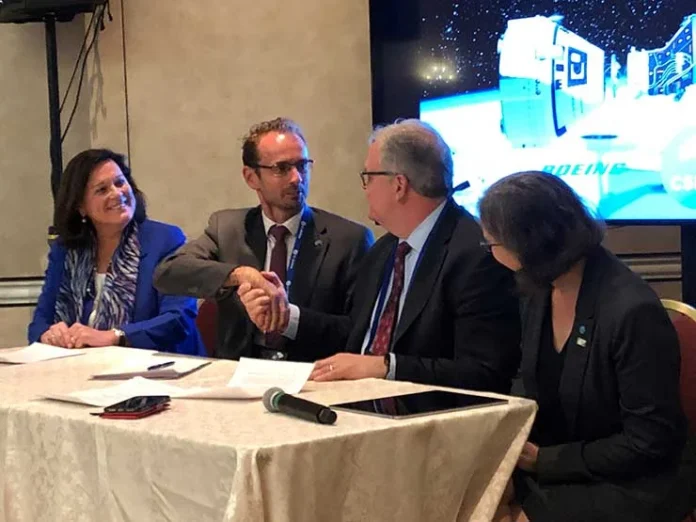
COLORADO SPRINGS, COLORADO. Boeing and the Australian Space Agency have signed a Statement of Strategic Intent to help advance the agency’s goals to expand Australia’s domestic space industry.
By 2030, Australia would like to grow the space market segment from AU$3.9 billion to AU$12 billion and double space industry employment from about 10,000 today to 20,000.

The agreement features Boeing support for investments in R&D, innovation, STEM education and government programs aligned with the Australian Space Agency’s priorities.
“Expanding our relationship with the Australian Space Agency is a significant step for Boeing and a reaffirmation of our longtime teaming with Australia in space,” said Jim Chilton, Boeing senior vice president, Space and Launch. “It means a lot that we’ve signed this agreement during a year when the world celebrates the 50th anniversary of the Apollo 11 mission to the moon, when both Boeing and Australia played important roles in that historic achievement. We see great opportunity ahead for all of us as Australia continues to grow its space industry and national capabilities.”
Boeing has a long history of space-related projects in Australia, including:
- Launch of four new space R&D projects with Boeing’s research partner of 30 years, the Commonwealth Science and Industrial Research Organisation (CSIRO).
- Use of Boeing-built Wideband Global SATCOM (WGS) and IS-22 satellites by the Australian Defence Force.
- Boeing Defence Australia is the prime contractor for the Australian Defence Force’s Project LAND 2072 Phase 2B Currawong Battlespace Communications System, which will include Australian-developed satellite communications terminals for accessing the WGS satellite network.
- Boeing Australia’s development of a virtual reality training system for the CST-100 Starliner, which will take passengers or a mix of crew and cargo on missions to low-Earth orbit.
- Boeing HorizonX Ventures’ investment in Adelaide-based Myriota, an Internet of Things (IoT) startup seeking to revolutionize satellite communications by providing low-cost access to high-value data in remote locations.
- A Boeing partnership with the University of Queensland, DST Group and the U.S. Air Force Research Laboratory on the successful Hypersonic International Flight Research Experimentation (HIFiRE) programme.
Dr. Megan Clark AC, head of the Australian Space Agency, said the signing of the statement was an example of how collaboration and engagement across countries is an important aspect of the growing space economy, both in Australia and internationally. “This Statement of Strategic Intent highlights Boeing’s existing collaboration with CSIRO, universities and industry in broad areas such as space debris monitoring, advanced manufacturing and fuel production in space, on-orbit imaging, VR and remote space craft operation,” Dr. Clark said. “This partnership opens the doors for Australian innovators to participate in the global supply chain of the space sector.”

Boeing’s STEM efforts in Australia span universities and non-profits in order to help develop the future engineers and leaders of Australia’s space industry. Boeing supports Space Squad, the Australian Youth Aerospace Association, the Australian Space Design Competition, and FIRST (For Inspiration & Recognition of Science and Technology) including its exciting robotics program “Mission Moon.”
The Australian Space Agency is responsible for whole-of-government coordination of civil space matters. The Agency will transform and grow a globally respected space industry, and to reach and inspire all Australians through seven National Civil Space Priorities – Position, navigation and timing; Earth observation; Communication technologies services; Leapfrog R&D; Space situational awareness; Robotics and automation; and Access to space. Through the Agency, Australia aims to significantly grow its market segment from 10,000 jobs and a market size of $3.9 billion to up to another 20,000 jobs and $12 billion by 2030.

Boeing is the world’s largest aerospace company and leading provider of commercial airplanes, defense, space and security systems, and global services.