


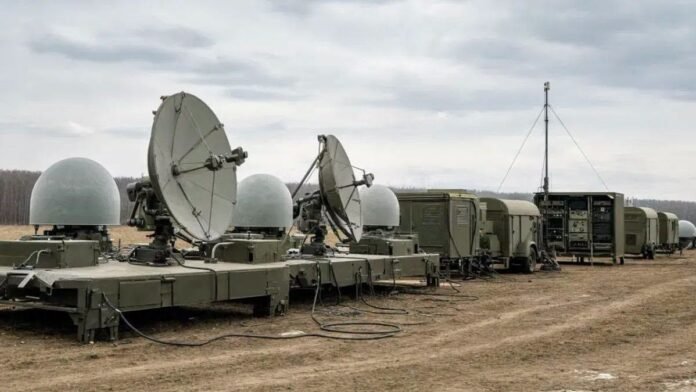
New Delhi: Russia has introduced a new electronic warfare system designed to interfere with Starlink communications by targeting satellites directly rather than attacking ground terminals.
The system, named Volna Kupol Garant, represents a departure from conventional electronic warfare methods. Instead of focusing on disrupting signals at the user end, it projects a narrow-beam high-frequency radio transmission aimed at the satellites themselves. According to Russian officials, this transmission overloads the receiving antennas aboard Starlink satellites. As a result, the satellites are temporarily unable to detect signals from ground terminals within the affected coverage area.

Dmitry Kuzyakin, general designer of the Centre for Integrated Unmanned Solutions, explained that Volna does not physically damage or destroy the spacecraft. Instead, during the period of “illumination,” the targeted satellite is blocked from serving ground terminals.
The disruption reportedly extends beyond the active transmission period. Once interference ceases, affected satellites require several additional minutes before their communications capability is fully restored. This lingering effect enhances the system’s tactical utility by prolonging denial of service even after the jamming signal is switched off.
Russian sources suggest that Volna Kupol Garant could be deployed to counter the increasing reliance on Starlink in military operations. Starlink has been widely used in conflict zones to provide resilient communications, making it a high-value target for electronic warfare programs.
The development highlights Russia’s ongoing investment in advanced electronic warfare capabilities. By focusing on satellite-level disruption, Volna Kupol Garant introduces a new dimension to the contest over control of the electromagnetic spectrum. This system underscores the growing importance of space-based communications in modern warfare. It also raises questions about the resilience of commercial satellite constellations when confronted with state-backed electronic warfare technologies.







