


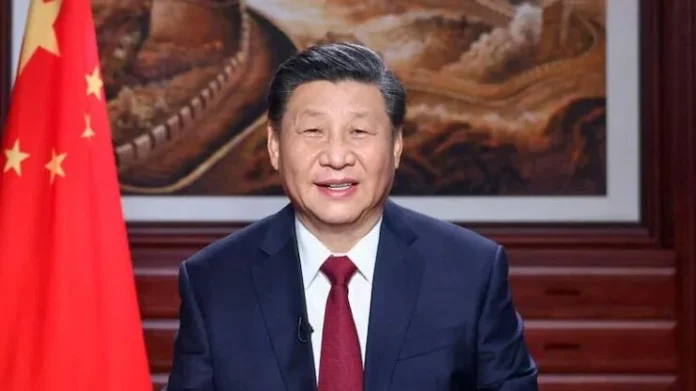
on July 1, 2026, Xi Jinping stood before the Great Hall of the People and vowed to defeat Taiwan independence separatist forces while pressing the People’s Liberation Army towards full modernisation ahead of its centenary next August.
The speech was unremarkable in tone; Xi has said versions of this before, but the timing sharpened its meaning. China now sits in the final stretch of the 2027 goal, the deadline Xi set in 2020 for the PLA to complete the modernisation needed to fight and prevail in a regional war.

The question worth asking is not whether Beijing has fixed 2027 as an invasion date. American intelligence assessed in March this year, that it has not. The better question is whether Chinese leaders believe time is working for them or against them, because that judgment, more than any single capability threshold, will shape when and whether Xi decides to gamble on Taiwan.
The conventional framing reduces this to a simple binary. A confident, rising China can afford patience; a fearful, declining China might lash out before its position erodes further. Both stories draw on real evidence and are incomplete.
China’s military trajectory continues to climb toward its 2027 goals, even as its demographic and economic foundations bend downward. Facing a domestic property crisis, structural deflation and a rapidly shrinking youth population, Beijing’s leadership may view the immediate future as its best opportunity to act against Taiwan, before its broader national power permanently erodes
The more dangerous scenario lies between them: a power whose military trajectory is still climbing even as its economic and demographic foundations are already bending downward. Call it the peaking power trap. It is the condition in which a leadership holds the most usable military advantage relative to its rival at precisely the moment its broader position is starting to erode, creating pressure to act while the window is open rather than wait for a strength that will not return.
Start with what argues for confidence. Since 2020, China has nearly tripled its inventory of precision strike ballistic and cruise missiles to roughly 3,500, according to the Pentagon’s most recent report to Congress.

It has fielded new landing platform designs and mobile bridge ships that would allow commercial ferries and roll-on/roll-off cargo vessels to put heavy armour ashore almost anywhere along Taiwan’s coastline, closing a gap that long constrained China’s amphibious options.
A new class of assault ship, the Type 076, capable of launching aircraft and drones, is due to enter service this year. Retired Admiral John Aquilino told Congress before leaving his post as head of Indo-Pacific Command that every indicator points to the PLA meeting Xi’s 2027 readiness target.

On the military ledger alone, the trend line runs firmly in Beijing’s favour, and a leadership that trusted only that ledger would have every reason to wait, since each year of modernisation arguably widens the gap with Taiwan and complicates American intervention.
Sceptics of the alarm are not wrong to urge caution. Some China watchers, including researchers at RAND, have argued that PLA modernisation is driven as much by regime stability and institutional prestige as by war planning, and that untested command structures and periodic corruption purges within the officer corps raise real doubts about combat readiness, regardless of hardware totals.
Xi himself reportedly told American officials in 2023 that no invasion date had been set, and this March’s intelligence assessment reaffirmed that Beijing still prefers coercion over invasion wherever coercion will do.
These are serious points, and they argue against treating 2027 as a fire alarm. They do not, however, argue against the deeper claim here. Whatever the true state of PLA readiness in any given year, the direction of travel on the economic and demographic side is now clear enough that Beijing’s leaders face a narrowing rather than a widening runway. Unresolved doubts about combat readiness are exactly the kind of problem a leadership under time pressure is tempted to paper over rather than wait out.
Since 2020, the PLA has tripled its precision-strike missile inventory and fielded advanced amphibious vessels like the Type 076. While this expanding hardware widens the capability gap with Taiwan, skeptics point out that institutional corruption purges, untested command structures and a clear preference for coercion over invasion raise ongoing doubts about actual combat readiness
But no leadership makes decisions based on a military ledger alone, and China’s broader trend lines tell a different story. Beijing cut its 2026 growth target to 4.5 to 5 per cent, the least ambitious goal since 1991, and even that figure understates the strain beneath the surface. A property crisis now in its fifth year continues to depress household wealth and confidence.
Deflationary pressure, chronic industrial overcapacity across sectors from steel to electric vehicles, and mounting local government debt are proving structural rather than cyclical, according to recent assessments by independent economists tracking the slowdown.
Consumption has not picked up the slack left by a slowing investment and export model. None of this threatens the regime tomorrow. All of it narrows the resources and political capital available for a costly, uncertain war a decade or two from now.
The demographic numbers are even starker. China’s fertility rate has fallen to roughly 1.01 children per woman, among the lowest ever recorded for a country of its size. United Nations-based projections suggest the population could shrink by nearly 60 million people between 2026 and 2035.
The cohort of young men who would crew an invasion fleet and sustain an occupation is shrinking years before the war planners’ preferred deadline arrives, and it will continue to shrink every year after.
A country that expects to have fewer young workers, fewer taxpayers and a heavier burden of elderly dependents in 2035 than it has today, is not a country for whom time is unambiguously an ally. If Chinese planners are rational, they know this as well as any outside analyst does.
The classic strategy of managing China as a patient, rising power is obsolete against a state fearing its own ceiling. To counter a leadership tempted to act while its military leverage peaks, Washington, Tokyo and Taipei must front-load deterrence by hardening first-island-chain basing, building munitions stockpiles and presenting unambiguous political commitments
Put the two pictures together, and the strategic logic looks less like patience and more like urgency dressed as patience. A leadership that expects its military advantage to plateau while its economic and demographic base erodes has a rational incentive to treat the next several years, not the next several decades, as its best opportunity.
The 21st Party Congress, following the 2027 centenary, only sharpens this incentive. Xi is expected to seek another term at that gathering, and a leader who has tied his legitimacy so explicitly to reunification has domestic reasons to want visible progress banked before he asks the party to renew his mandate.
None of this means an invasion is imminent or scheduled. It means the calculus that would make one attractive is becoming more, not less, coherent with each passing year of demographic and economic bad news.
This has direct implications for how Washington, Tokyo and Taipei should approach deterrence timing. The comfortable assumption in past cycles of the Taiwan debate was that a rising China could be managed by extending the horizon, steadily building capability and trusting that Beijing’s caution would hold so long as the balance of power had not tipped decisively.
A peaking power does not behave that way. It does not wait for certainty. It watches its best option depreciate in real time and asks whether the cost of moving now is lower than the cost of moving later. Deterrence built for a patient, rising China is not calibrated for a China that fears its own ceiling.
India belongs in this calculus too, even though Taiwan lies far from the Himalayas. Beijing’s own military writings have long worried about a two-front problem, the risk that a rival exploits PLA commitments in the Taiwan Strait to press an advantage along the Line of Actual Control.
Indian strategists have begun openly debating whether a future Taiwan contingency is a moment to correct the status quo in eastern Ladakh rather than watch from the sidelines. The disengagement agreements of recent years eased patrolling frictions at Depsang and Demchok, but they did not resolve the deeper mismatch in infrastructure, armour and force posture along the frontier.
Beijing remains vulnerable to a two-front dilemma along the Line of Actual Control with India, during a Taiwan contingency. By closing infrastructure, armour and air-defence gaps in the Himalayas, India retains significant leverage, ensuring Chinese planners cannot assume a quiet western border while managing a major conflict in the Pacific
China has every reason to want a quiet Western Front while it manages Taiwan, Washington, and its own economy at once. That gives New Delhi real, if underappreciated, leverage. The pace at which India closes its own capability gaps in the mountains, from all-weather roads to armour and air defence suited to altitude, shapes how confident Beijing can be that a Taiwan crisis will not open a second one it did not choose.
A peaking power trying to minimise the number of fronts it must fight is, in that narrow sense, a power India can help deter simply by remaining an unresolved problem on its other border.
The practical answer is to front-load, not back-load, the capabilities and political signals meant to deter Beijing. Munitions stockpiles, hardened basing across the first island chain and clearer public commitments from Washington and Tokyo all matter more now, while China’s military edge is still accumulating and its economic constraints are tightening, than they will in a hypothetical later decade when either trend might have resolved itself.
Time is not simply on China’s side or against it. It is compressing and a narrowing window concentrates minds in Beijing in ways a comfortable one never would. Policymakers who keep treating the Taiwan question as a slow-moving contest of patience may be answering question Chinese planners no longer need to ask themselves, because for them the clock is already ticking.

The writer, a PVSM, AVSM, VSM has had an illustrious career spanning nearly four decades. A distinguished Armoured Corps officer, he has served in various prestigious staff and command appointments including Commander Independent Armoured Brigade, ADG PP, GOC Armoured Division and GOC Strike 1. The officer retired as DG Mechanised Forces in December 2017 during which he was the architect to initiate process for reintroduction of Light Tank and Chairman on the study on C5ISR for Indian Army. Subsequently he was Consultant MoD/OFB from 2018 to 2020. He is also a reputed defence analyst, a motivational speaker and prolific writer on matters of military, defence technology and national security. The views expressed are personal and do not necessarily carry the views of Raksha Anirveda





