


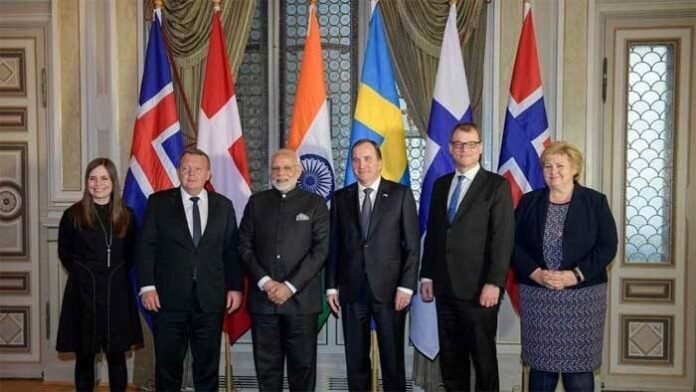
The global geopolitical architecture is currently undergoing a profound re-alignment, driven by protracted conflicts, maritime vulnerabilities, and shifting economic alliances. In this climate of uncertainty, Prime Minister Narendra Modi’s diplomatic engagement with the Nordic nations (Denmark, Finland, Iceland, Norway, and Sweden) represents a calculated shift in India’s foreign policy. Historically viewed through the narrow lens of environmental cooperation and welfare-state models, the Nordic region has now emerged as a critical pillar in India’s strategic calculations.
This commentary provides an analytical assessment of PM Modi’s visit, focusing on four interconnected pillars: mitigating maritime vulnerabilities in the Strait of Hormuz, constructing resilient and decoupled supply chains, enhancing comprehensive bilateral cooperation, and deepening critical facets of defence technology partnerships.

Mitigating the Strait of Hormuz Crisis: A Maritime Imperative
The Strait of Hormuz remains the world’s most critical maritime chokepoint, handling over one-fifth of global petroleum consumption. With escalating regional conflicts threatening to disrupt this vital artery, India—which relies on the Middle East for over 60 per cent of its crude oil imports—faces severe economic vulnerabilities. A prolonged crisis in Hormuz would trigger catastrophic inflationary pressures, derail fiscal deficits, and halt industrial growth.
During the summit, PM Modi reframed India’s maritime security challenges not merely as regional concerns, but as systemic risks to global commerce. The Nordic nations, particularly Norway and Denmark, possess disproportionate influence in global shipping and maritime logistics. Denmark’s maritime sector manages a significant portion of global container traffic, while Norway’s expertise in deep-sea navigation and maritime security is world-renowned.
India’s diplomatic manoeuvres focused on two distinct mitigating strategies:
Alternative Maritime Corridors: Discussions advanced the operationalization of the International North-South Transport Corridor (INSTC) and explored the Northern Sea Route (NSR) via the Arctic. By partnering with Norway and Iceland, India aims to secure alternative trade pathways that bypass traditional Middle Eastern chokepoints entirely.

By partnering with Norway and Denmark on alternative corridors like the International North-South Transport Corridor and the Northern Sea Route, India is building maritime domain awareness networks that could reroute merchant vessels in real-time, bypassing the Persian Gulf entirely
Shared Maritime Domain Awareness: India sought to integrate its Information Fusion Centre for the Indian Ocean Region (IFC-IOR) with Nordic maritime data networks. This enhances real-time tracking of merchant vessels, ensuring that Indian and Nordic-flagged ships can dynamically reroute in the event of a sudden blockade or kinetic flare-up in the Persian Gulf.
Architecting Resilient and Decoupled Supply Chains
The vulnerabilities of over-centralised manufacturing ecosystems became painfully clear during recent global supply shocks. India’s strategic imperative is clear: it must decouple critical industrial inputs from volatile or monopolistic geographies and build resilient, high-technology supply chains. The Nordic region, with its advanced technological base and commitment to democratic values, offers a perfect algorithmic fit for India’s “Make in India” and “Production Linked Incentive” (PLI) frameworks.

The bilateral dialogues moved past generic trade agreements to focus on specific, high-value verticals:
Semiconductor and Electronics Ecosystems
Finland and Sweden possess cutting-edge capabilities in semiconductor design, research, and telecommunications infrastructure. PM Modi’s engagements targeted the migration of microchip design houses and electronic component manufacturing to Indian soil, reducing reliance on East Asian supply monopolies.
Critical Minerals and Rare Earths
The green transition requires an uninterrupted supply of critical minerals like cobalt, lithium, and nickel. Norway’s recent discoveries of massive seabed mineral deposits and Sweden’s advanced Arctic mining operations were central to the talks. India sought long-term joint ventures to secure these raw materials, ensuring that India’s domestic electric vehicle (EV) and renewable energy industries are insulated from geopolitical extortion.
From Swedish semiconductor design to Norwegian critical minerals and Danish green hydrogen, the deals struck during this visit aim to secure India’s industrial future—through joint ventures that embed Nordic technology within India’s massive scaling capacity
Green Hydrogen and Clean Energy Tech
Denmark’s pioneering status in wind energy and green hydrogen technology was leveraged to establish localised manufacturing hubs in India. By anchoring Nordic technology within India’s massive scaling capacity, the partnership aims to create an export-oriented green energy supply chain serving the Global South.
Enhancing Bilateral Cooperation: The Nordic-Baltic Eight (NB8) Nexus
A key objective of PM Modi’s visit was to elevate India’s engagement from fragmented bilateral ties to an institutionalised multilateral partnership with the Nordic-Baltic framework. The India-Nordic Summit format serves as a powerful multiplier, allowing New Delhi to negotiate with a cohesive, technologically advanced bloc that commands significant financial and political capital within the European Union.
| Country | Core Strategic Synergy with India | Key Initiative / Focus Area |
| Denmark | Green Strategic Partnership | Wind energy expansion, urban water management, and maritime log |
| Norway | Sovereign Wealth & Blue Economy | Sovereign Wealth Fund investments in Indian infrastructure and deep-sea research. |
| Sweden | Industrial Innovation & Defence | Joint aerospace development, smart cities, and sustainable manufacturing. |
| Iceland | Geo-Thermal & Climate Science | Geothermal energy extraction in Ladakh and Arctic Council cooperation. |
| Finland | Digital Frontier Technologies | 6G communication networks, quantum computing, and vocational education. |
This enhanced bilateral cooperation is anchored by institutional capital. The entry of the Norwegian Sovereign Wealth Fund—the largest of its kind globally—and other Nordic pension funds into India’s National Investment and Infrastructure Fund (NIIF) provides the non-volatile, long-term capital required to fund India’s mega-infrastructure projects. Furthermore, by aligning on Arctic research, India cements its position as a legitimate stakeholder in the evolving geopolitics of the North Pole, balancing the aggressive footprint of other Asian powers in the Arctic Council.
Sweden’s Gripen fighter ecosystem, Finland’s Arctic warfare expertise, and NATO’s newest members’ cyber defence architectures are now on India’s radar—not as buyers, but as co-developers
Deepening Critical Facets of Defence Cooperation
Perhaps the most significant departure from traditional diplomacy during this visit was the overt focus on hard security and defence industrial co-development. Historically, India’s defence architecture relied heavily on legacy Soviet-era equipment or Western European aerospace giants. Today, the imperative to diversify and indigenise defence production has turned New Delhi’s attention toward the highly specialised defence ecosystems of Sweden and Finland.
The defence dialogues centred on shifting from a buyer-seller dynamic to a co-development model, focusing on three critical domains:
Aerospace and Sub-Surface Platforms
Sweden’s defence major Saab, with its Gripen fighter ecosystem and state-of-the-art Carl-Gustaf weapon systems, has been a long-term partner. PM Modi’s discussions focused on the complete transfer of technology (ToT) for air defence systems and the exploration of joint development for next-generation conventional submarines. This is crucial for maintaining the Indian Navy’s underwater combat edge in the Indian Ocean.
Arctic and Cold-Weather Warfare Technology
As India faces persistent, high-altitude challenges along its northern borders, the specialised expertise of the Finnish and Norwegian armed forces in sub-zero, mountainous terrain offers immense value. Cooperation agreements were updated to include the joint development of specialised cold-weather gear, high-altitude surveillance drones, and resilient communication systems capable of operating in extreme environments.
By institutionalising economic ties through pension funds and joint Arctic research, India is buying long-term stakes in a region that will define the geopolitics of the twenty-first century, balancing the aggressive footprint of other Asian powers in the Arctic Council
Cyber Defence and Electronic Warfare (EW)
The modern battlefield is increasingly defined by grey-zone warfare and cyber disruptions. Finland and Sweden, newly integrated into NATO’s security umbrella, possess world-class cyber defence architectures. The summit established secure channels for military-to-military intelligence sharing, joint cyber-drills, and the co-development of electronic countermeasure algorithms designed to protect critical infrastructure from state-sponsored cyber offensives.
The Geopolitical Realignment of India-Nordic Ties
PM Modi’s strategic engagement with the Nordic countries marks a transition from purely commercial diplomacy to a sophisticated geopolitical alignment. By tying together maritime security strategies for the Strait of Hormuz, constructing resilient technology supply chains, leveraging institutional economic synergies, and building advanced defence partnerships, India has successfully expanded its strategic depth. This multi-vector diplomacy ensures that New Delhi is well-positioned to navigate the turbulent global landscape, safeguarding both its economic sovereignty and national security interests.

–The writer is Assistant Professor, ICFAI School of Liberal Arts, ICFAI University, Jaipur. The views expressed are of the writer and do not necessarily reflect the views of Raksha Anirveda





