


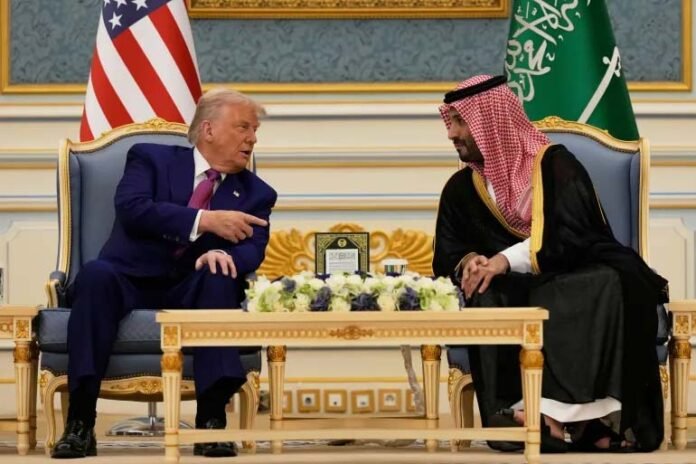
The proposed United States-Saudi Arabia civilian nuclear agreement has emerged at a particularly sensitive moment in West Asia. Even as Washington continues to press Iran to limit or relinquish its stockpile of enriched uranium following the recent Iran-Israel conflict, it is simultaneously negotiating a framework that could permit Saudi Arabia to enrich uranium on its own soil.
This apparent contradiction has transformed the proposed agreement from a bilateral energy initiative into a wider strategic issue with implications for regional security, nuclear non-proliferation and the future balance of power in the Gulf.

The potential deal departs from the “gold standard” set by the US-UAE agreement, where Abu Dhabi renounced uranium enrichment
The timing is significant. The recent conflict centred on Iran’s nuclear programme, yet Washington is now prepared to consider nuclear cooperation with Saudi Arabia under conditions that differ from earlier US agreements in the region.
Reports suggest that the proposed arrangement would permit uranium enrichment in Saudi Arabia, with American companies playing a leading role in building and operating enrichment facilities. This marks an important departure from the 2009 US-United Arab Emirates civilian nuclear agreement, widely regarded as the “gold standard”, under which Abu Dhabi voluntarily renounced uranium enrichment and reprocessing.
For Riyadh, civilian nuclear energy forms an important pillar of Crown Prince Mohammed bin Salman’s Vision 2030 programme to diversify the Saudi economy beyond oil.
Expanding into a nuclear power would reduce domestic dependence on crude oil for electricity generation, enabling the Kingdom to export larger quantities of oil while simultaneously developing advanced technological capabilities. Saudi Arabia also argues that indigenous uranium enrichment is essential for technological sovereignty and long-term energy security rather than permanent dependence on foreign fuel supplies.

The proposed agreement, however, extends beyond civilian energy. Washington reportedly views it as part of a broader strategic framework that includes deeper defence cooperation, long-term American influence in the Gulf and eventual Saudi normalisation with Israel under the Abraham Accords.
For Riyadh, nuclear power is vital for diversifying its economy away from oil and securing long-term energy independence
Saudi Arabia had appeared close to joining the Accords before the Hamas attacks of October 7, 2023 and the subsequent Gaza conflict stalled diplomatic momentum. Reviving that process remains an important American strategic objective.

The agreement nevertheless presents a difficult dilemma for the global nuclear non-proliferation regime. Saudi Arabia is a party to the Nuclear Non-Proliferation Treaty (NPT), which recognises the right of non-nuclear weapon states to pursue peaceful nuclear energy under International Atomic Energy Agency safeguards.
Yet, reports that Riyadh may not initially be required to adopt the IAEA Additional Protocol, which permits more intrusive inspections, are likely to attract scrutiny from non-proliferation experts.
The irony is equally striking. Washington has demanded that Iran significantly restrict its enrichment programme while appearing willing to accept enrichment on Saudi territory under a separate arrangement. Such contrasting approaches are likely to reinforce Tehran’s long-standing argument that American non-proliferation policy applies different standards to allies and adversaries.
Washington views the deal as a stepping stone towards deeper defence ties, countering Chinese and Russian influence and eventual Saudi-Israeli normalisation
Saudi Arabia’s own strategic calculations further complicate the issue. Crown Prince Mohammed bin Salman has previously stated that if Iran were to acquire a nuclear weapon, Saudi Arabia would pursue one as well.
Although Riyadh continues to emphasise peaceful nuclear development, that statement inevitably shapes regional perceptions. Israel remains concerned that even safeguarded domestic enrichment could provide Saudi Arabia with latent weapons capability and encourage similar demands from other regional states, gradually weakening the existing non-proliferation architecture.
For Washington, however, supporting a Saudi civilian nuclear programme serves several strategic objectives. It reinforces long-term American influence at a time when China and Russia are expanding their presence in the Gulf.
It further reduces the likelihood of Riyadh turning to alternative suppliers for sensitive nuclear technologies, and enables the United States to shape Saudi Arabia’s programme through safeguards, verification mechanisms and long-term institutional engagement. From Washington’s perspective, the agreement is therefore as much about geopolitics as about civilian nuclear cooperation.
Iran has viewed the proposed agreement with equal skepticism but for different reasons. Tehran argues that permitting Saudi Arabia to enrich uranium would alter the regional strategic balance and strengthen a principal rival under the cover of civilian nuclear cooperation.
Allowing Saudi enrichment while restricting Iran’s programme highlights inconsistencies in US policy and risks fueling a regional arms race
It is also likely to portray such an arrangement as evidence of inconsistency in American non-proliferation policy. At a time when negotiations over Iran’s own nuclear programme remain fragile, the proposed agreement could harden Tehran’s negotiating position by reinforcing its argument that similar nuclear activities are judged differently depending upon political alignment with Washington.
The implications extend beyond Saudi Arabia. If Washington accepts indigenous uranium enrichment under strict safeguards, other non-nuclear weapon states may eventually seek comparable rights, complicating the future of the global non-proliferation regime.
While the NPT permits peaceful nuclear activities, wider acceptance of sensitive fuel cycle capabilities would inevitably increase the number of states possessing latent nuclear weapons potential.
The challenge for policymakers will be to reconcile the legitimate right to peaceful nuclear technology with the equally important objective of preventing the spread of capabilities that could, under changed political circumstances, be diverted towards military purposes.
For India, the consequences are significant. Saudi Arabia remains one of India’s principal energy suppliers, an important economic partner and home to a large Indian diaspora.
The agreement could set a precedent for other nations to seek enrichment capabilities, complicating the future of the NPT and the global non-proliferation architecture
Stability in the Gulf directly affects India’s energy security, maritime trade and broader economic interests. At the same time, New Delhi has steadily expanded defence, maritime and counter-terrorism cooperation with both Saudi Arabia and the United States while maintaining balanced relations across West Asia.
Any restructuring of the regional security architecture will therefore require India to preserve this strategic balance, continue supporting nuclear non-proliferation and safeguard the stable regional environment upon which its long-term economic and strategic interests depend.
Whether the proposed agreement ultimately strengthens regional stability or accelerates a new phase of strategic competition will depend less on the nuclear technology itself than on the political conditions, verification mechanisms and legal safeguards that accompany it.
For India, whose interests are deeply intertwined with the Gulf, the priority will remain preserving regional stability, maintain strategic balance and strengthen a credible global nuclear non-proliferation order.

The writer commanded 15 Punjab in Lebanon under United Nations Flag, commanded 27 Sector as DIG in Churachandpur and was Brigadier Operational Logistics in HQ Western Command. He is currently an analyst on geopolitics, international and defence affairs. The views expressed are personal and do not necessarily carry the views of Raksha Anirveda





