


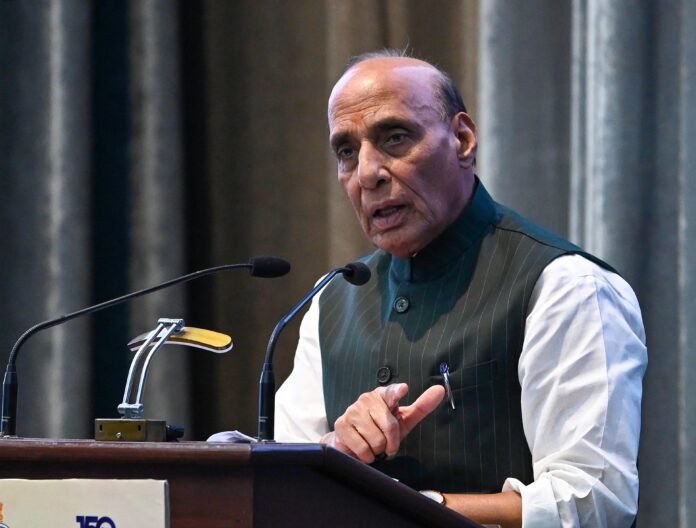
NEW DELHI. In a major push toward modernising India’s national security framework, Defence Minister Rajnath Singh has underlined the urgent necessity of deepening integration between the military and civilian components of the Ministry of Defence (MoD).
Speaking at the 85th Armed Forces Headquarters (AFHQ) Civilian Services Day celebrations in New Delhi, Singh asserted that as India’s armed forces advance toward greater jointness and theaterisation, the civilian bureaucracy must keep pace to ensure a cohesive defence ecosystem capable of countering complex, evolving threats.

Addressing senior defence leadership – including Minister of State for Defence Sanjay Seth, Chief of Defence Staff Gen NS Raja Subramani, Chief of the Army Staff Gen Dhiraj Seth, Chief of the Naval Staff Admiral Krishna Swaminathan and Defence Secretary Rajesh Kumar Singh – the Defence Minister emphasised that military and administrative reforms cannot proceed on isolated tracks.
Both arms of the defence establishment, he noted, are bound by the singular commitment of “Nation First”. When this overarching objective aligns, every organ of the state transforms into tangible national power.
Harnessing Complementary Core Strengths
Elaborating on the core benefits of civil-military synergy, Singh explained that uniformed personnel and civilian officers offer distinct yet complementary strengths. Military officers bring firsthand operational experience, command perspectives, tactical insights and an intimate grasp of contemporary warfare.
Conversely, officers of the AFHQ Civilian Services provide administrative continuity, policy expertise, deep institutional memory and a thorough mastery of governmental financial and administrative procedures.

“When these strengths combine, decision-making becomes more informed, balanced and effective,” Singh observed.
He highlighted that integrated structures require steady administrative backing across key verticals, including logistics, human resource management, procurement and long-term strategic planning.

To institutionalise this collaboration, the Defence Minister advocated for structured “cross-exposure” programmes. He called for joint training modules, cross-cadre developmental assignments and collaborative policy workshops. Such institutional mechanisms, he argued, would foster mutual trust and enable both sides to leverage each other’s domain expertise seamlessly.
Elevating Civilian Expertise to Cyber and Strategic Domains
Recognising the shift toward technology-driven, hybrid warfare, Singh urged the AFHQ Civilian Services to move beyond traditional administrative duties and routine service rule implementation. He encouraged the cadre to function as a strategic brain trust, actively contributing to geo-strategic thinking, policy research and technological innovation.
Specifically citing cyber warfare as a high-priority arena, Singh suggested that civilian officers utilise their specialised technical skills to build defence-specific common cyber tools and software solutions. He also proposed creating a dedicated forum to study Indian military history from a civilian perspective, generating novel strategic frameworks and policy insights for future security challenges.
Digital Transformations and Legacy of Service
Marking the foundation anniversary of the cadre – which traces its roots back to August 1, 1942 – the event featured the launch of several key administrative digital initiatives.
Singh unveiled the Internet-Based Accommodation Management System (IBAMS) on the rakshaawas portal, eHRMS integration with TULIP 2.0 for claim processing and full onboarding onto the SPARROW appraisal framework.
He also released the 34th edition of Samvad, the in-house journal featuring literary contributions from personnel across integrated headquarters and inter-service organisations.
Closing his address, Singh expressed confidence that an integrated, technology-empowered civil-military apparatus will serve as a cornerstone for India’s long-term defence readiness and national sovereignty.






