


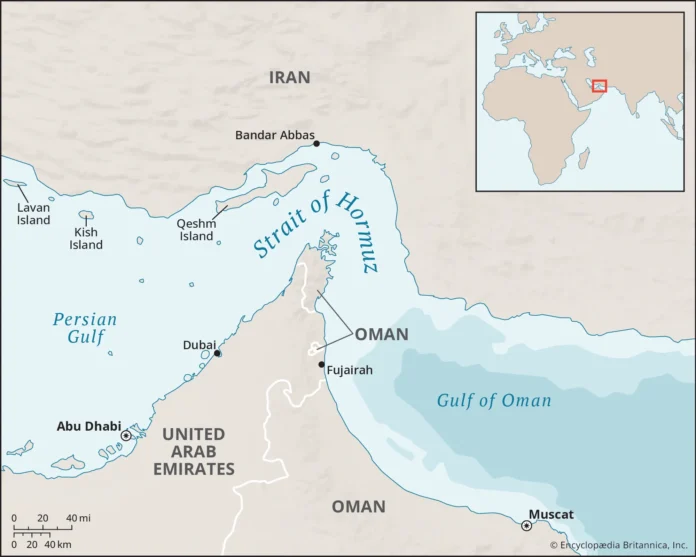
One of Trump’s stated objectives in his current conflict with Iran is restoring the Strait of Hormuz to its pre-war condition. Quitting the conflict, while permitting Iran to retain control of the strait, besides charging for vessels transiting, is not an option. The strait was free and open before Trump launched air strikes on Iran in conjunction with Israel, enhancing global oil and gas prices.
Iran remains defiant, its regime stable, refusing to negotiate, though exchanging messages with the US through mediators, all the while demanding control of the Hormuz Strait. It has already faced immense destruction, would face more if the war continues, but just holding on against US military power, would give it an upper hand in any future negotiations. While operations are on pause now, with hopes of reviving talks, the possibility of differences being bridged and normalcy restored remains low.

The US is running out of interceptors for Iranian missiles and is stuck in a war it should never have started. China and Russia continue to arm Iran, hoping to keep the US engaged in a fruitless conflict. Reports indicate that Russia is also providing Iran with electronic intelligence enhancing its capabilities to protect its military assets.
Iran refuses to relinquish control over the Strait of Hormuz, intending to charge transit fees to finance its war reconstruction. Despite opposing US air strikes and naval blockades, Tehran considers the vital waterway its ultimate bargaining chip, defying International Maritime Organisation (IMO) regulations against mandatory tolls
Post the last round of talks in Switzerland in June, Iran’s chief negotiator, Mohammad Bagher Ghalibaf said, ‘management of the Strait of Hormuz will never return to the way it was before the war.’ This is because Iran believes that income extracted from ships transiting the straits would pay for reconstruction of its infrastructure damaged in the conflict. The strait is also its final bargaining chip in any future negotiations and it is unlikely to let its control go.
Trump, on the contrary has been stating ‘We have total control of the Strait. We have a navy, there was a blockade, which was more effective than dropping bombs. We’re doing very well with respect to the Hormuz Strait.’ While the US blocks Iranian ships from exiting the strait, Iran blocks the rest of the world from using it.
In response to Iran targeting ships in Hormuz Strait, US targets military installations with airstrikes. Confusion over management of Hormuz flowed from vague wordings in the so-called Islamabad MoU, inked by both sides ending the conflict. The wordings are unclear on who has ultimate control over the waterways and routes which ships are expected to follow.

Subsequently, hoping to garner support, Iran sought to involve Oman in management of the strait. Both nations straddle the waterway. Oman, in its proposal suggested dividing shipping lanes equally and seeking a voluntary fee from transiting ships for navigation, environmental protection and search-and-rescue operations. This is in tune with what is being done in other global straits, including the Malacca Strait. Oman’s proposal was also backed by countries from the Gulf Cooperation Council.
As the US faces a declining supply of missile interceptors, foreign powers complicate the proxy war. Russia and China continue arming Iran, with Moscow supplying electronic intelligence to safeguard Iranian military installations and prolong US strategic entanglement
Iran rejected these proposals. It seeks all inbound traffic to be under its control alongside some designated outbound lanes. It also warned that strait would remain closed unless Oman accepted its proposals. Negotiations continue between the two countries.

Simultaneously, Reuters reported that Houthi’s are considering imposing fees on commercial ships transiting the Southern Red Sea, which is a marine gateway connected to the Gulf of Aden by the Bab el-Mandeb Strait. The Houthis have refuted the report. The waterway has Yemen, Saudi Arabia, Eritrea and Sudan on its coasts. The Houthis had recently blockaded the waterway for Saudi ships and targeted few of them. They had also mentioned that there would be no impact on Chinese vessels.
As per the International Maritime Organisation (IMO), of which both Iran and the US are members, no nation can charge for transiting an international waterway. The IMO spokesperson mentioned, ‘There is no legal basis through which to introduce mandatory tolls simply to transit through a strait.’ However, Iran is unwilling to adhere to these guidelines, largely due to damages in infrastructure caused by US strikes.
Meanwhile the Saudi defence ministry has announced the creation of an alliance involving 13-14 nations aimed at safeguarding freedom of navigation through Bab al-Mandeb Strait, Red Sea and the Gulf of Aden. It does not include Hormuz.
Amid rumours of Houthis imposing tolls in the Bab al-Mandeb Strait, Saudi Arabia announced a 13-to-14-nation coalition to protect Red Sea navigation. However, key regional players like the UAE and Oman are notably absent, while rumours persist of a potential Saudi offensive against the Houthis in Yemen
The announcement does not mention countries involved, but there are inputs that neither the UAE nor Oman are part of this group. There is also no mention on what would be the contribution of other member nations. The EU already has a naval protection mission operating in the Red Sea. It is unlikely that they would be a part of the Saudi-led grouping.
There are also unconfirmed reports that the Saudi’s are contemplating a land and sea offensive against the Houthis in Yemen. Would Pakistan be involved in this, is unknown, but if it does happen the conflict would expand. The Houthis are demanding that Saudi lift its blockade, before they lift theirs. While the Saudi’s are hesitant to enhance tensions with Iran, they are willing to partner the US in targeting Iranian proxies in Iraq and Yemen.
Over 1500 ships have been stuck in the Gulf since the Hormuz Strait was closed. Environmentalists have warned that with these ships remaining motionless, their hulls would have been encrusted with marine life, including microbes and algae to barnacles and other invertebrates, which could then be transported to other ports once shipping resumes. As per environmental scientists, these are invasive species which reduce biodiversity and cause local extinction of organisms they displace. These could also devastate fisheries.
Iran’s exploiting its domination of the Hormuz Strait, on which a large part of global shipping is dependent, as also targeting merchant vessels which refuse to adhere to its directions, is the commencement of a new front in conflicts. This is also now being witnessed in the Black Sea where Russia and Ukraine are targeting merchant shipping leaving each other’s ports. A number of seafarers, including Indians have been killed.
Targeting merchant vessels – mirrored in the Black Sea conflict – violates international norms and endangers seafarers, prompting diplomatic protests from nations like India. Unilateral waterway blockades threaten to spike global shipping, insurance and fuel costs, establishing a perilous precedent for future geopolitical conflicts
Indian External affairs Minister, S Jaishankar in his conversation with his Iranian counterpart, Seyed Abbas Araghchi, insisted that targeting of commercial vessels and seafarers must be avoided. The Ukrainian envoy to New Delhi was summoned for similar reasons.
Nations can only summon envoys when their seafarers are impacted or when their flagged carriers are struck. They cannot deploy their naval power in the region as it would imply participating in the conflict.
Even directions of global bodies responsible for freedom of navigation, including the IMO, are ignored. Further, both conflicts face trust deficit and hence their resolution is still some distance away. The fact remains that most global economies have been impacted but nations are powerless to act.
Broadening the scope of conflicts including blocking waterways and targeting merchant vessels will add to shipping costs as also delays including higher insurance. Nations will have to adopt multiple means to maintain current rates of fuel prices to cater for rising shipping costs, impacting economies.
This is where global pressure must be applied or else targeting of commercial vessels leading to loss of lives of innocent seafarers will become a new norm for future conflicts. Simultaneously, the world must stand as one to deny Iran the right to charge for use of Hormuz Strait.

The writer is a strategic analyst and a motivator. He can be reached at @kakar_harsha. The views expressed are of the writer and do not necessarily reflect the views of Raksha Anirveda





