


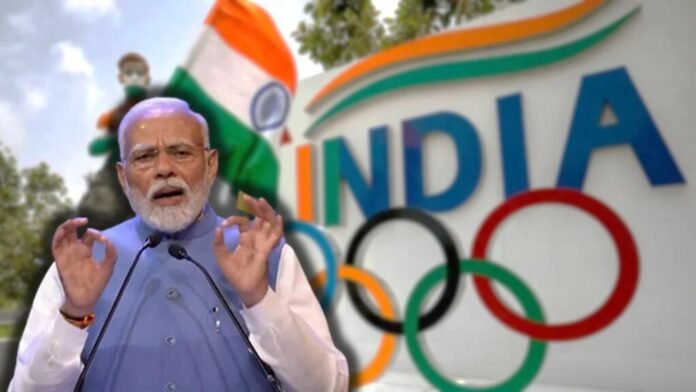
“It is the dream of 140 crore Indians,” Prime Minister Narendra Modi told the International Olympic Committee’s 141st session in Mumbai, making official what had long been rumoured in sporting circles, that India would bid to host the 2036 Olympic Games in Ahmedabad and Gandhinagar. It was a statement dressed as a sporting ambition, but its real content was geopolitical. Hosting the Olympics has never simply been about stadiums and stopwatches; it is one of the most concentrated instruments of soft power a nation can wield. The question for India is not whether it wants the Games, that much is settled, but whether it can build the sporting, administrative and diplomatic architecture to convert a hosting bid into lasting global influence.
The State of Play
India has submitted an Expression of Interest to host the 2036 Games and currently sits in the IOC’s “Continuous Dialogue” phase of what has been a halted bidding process. Ahmedabad and Gandhinagar are positioned as anchor cities, with reports suggesting events could be spread across Mumbai, Pune, Bhopal and Bhubaneswar under a multi-city model.

Gujarat has already committed enormous capital to the effort: roughly Rs 6,000 crore for the Sardar Vallabhbhai Patel Sports Enclave alone, alongside smaller complexes such as the Rs 800 crore Veer Savarkar Sports Complex. Home Minister Amit Shah has framed Ahmedabad’s trajectory as a staged ascent: the 2030 Commonwealth Games first, then the Olympics in 2036, with a dozen national and international events in between, to build operational muscle memory.
But the path has not been without friction. A July 2025 delegation to Lausanne, led by Gujarat sports minister Harsh Sanghavi and Indian Olympic Association president PT Usha, reportedly received a candid message from the IOC: India must first resolve governance issues within the IOA, a persistent doping problem and its historically modest Olympic medal performance before a hosting bid can be taken fully seriously. This is not a rejection it is a candid roadmap, and it should be read as one.
Sports Diplomacy Is Bigger Than the Bid
It would be a mistake to treat the Olympic bid as the whole of India’s sports diplomacy strategy. Hosting rights are the visible peak of a much larger structure that India has been building for a decade Khelo India, the Target Olympic Podium Scheme (TOPS) and a wave of private investment in sporting leagues from the IPL to the Pro Kabaddi League and the Indian Super League. What is significant is how this domestic sporting ecosystem has begun to translate into diplomatic capital abroad.
Cricket diplomacy remains India’s most proven soft-power instrument. The Board of Control for Cricket in India effectively sets the commercial terms for global cricket, and India routinely uses cricketing ties to warm relations with neighbours and partners alike, from hosting World Cup matches to sending teams on politically resonant tours.

India has formally entered the IOC’s “Continuous Dialogue” phase, using Gujarat as the primary hub alongside a multi-city hosting model. However, feedback from Lausanne makes clear that securing the Games hinges on resolving IOA governance disputes, curbing rampant doping and improving on-field athletic results
Yoga diplomacy, institutionalised through the International Day of Yoga at the United Nations, has quietly built cultural affinity for India, across more than 190 countries with negligible cost. Hosting diplomacy: the 2023 ICC Men’s Cricket World Cup, the Indian Premier League’s growing international footprint, and Ahmedabad’s own track record hosting the World Cup final and marquee concerts has demonstrated organisational capacity that the country can now point to when courting the IOC.
According to Ahmedabad’s own bid materials, the city has cited its handling of the 2023 ICC World Cup final and large-scale events as direct evidence of its readiness for the Commonwealth Games and, eventually, the Olympics.

What Leverage Looks Like in Practice
If India wants the 2036 bid to function as genuine sports diplomacy rather than a domestic infrastructure project with an international audience, several things need to happen in parallel.
First, fix governance before the world is watching. The IOC’s candour in Lausanne was, in effect, a nuanced private warning rather than a public embarrassment. Cleaning up IOA governance, strengthening India’s National Anti-Doping Agency, and demonstrating credible, sustained improvement in doping enforcement will do more for India’s bid than any stadium renderings. Soft power built on visible institutional integrity travels further, than soft power built on spectacle alone.
The Olympic push builds upon a decade of domestic sporting architecture, including Khelo India, TOPS and flourishing private leagues. Coupled with established diplomatic assets like cricket, yoga and major event management, India is leveraging an expanded soft-power repertoire on the global stage
Second, use the bid period itself as a diplomatic tool. Reports indicate France has already become the first nation to formally pledge support for India’s Olympic bid. Every such endorsement is a data point in a broader coalition-building exercise that mirrors how India has built support for permanent UN Security Council reform or WTO positions through patient, bilateral accumulation of goodwill rather than one dramatic push. Each Olympic-adjacent visit, from IOC evaluation teams to fellow bidding nations, is an opportunity to advance unrelated bilateral files: trade negotiations, technology partnerships and education exchanges.
Third, treat the Global South as a natural constituency. India has spent the last several years positioning itself as the Voice of the Global South, hosting a dedicated Global South summit alongside its G20 presidency. An Olympics hosted outside the traditional axis of Europe, North America and East Asia would be a powerful symbol for developing nations that have rarely seen the Games come to their part of the world. India can and should frame its bid explicitly in these terms not as a nationalist showcase, but as evidence that global sporting infrastructure need not remain concentrated among a handful of wealthy nations.
Fourth, build the athlete pipeline the diplomacy will eventually need to justify. Sports diplomacy hosted on a foundation of poor medal performance rings hollow. Union Sports Minister Mansukh Mandaviya has pointed to a rise in the sports budget from Rs 800 crore in 2014 to Rs 4,000 crore in 2025, and disciplines that were once obscure in India – athletics, badminton, wrestling, boxing, shooting and hockey, now command television ratings and public attention. Sustaining and accelerating that trajectory between now and 2036 is not a side project to the bid; it is the substantive credibility on which the entire diplomatic exercise rests.
The Infrastructure-Diplomacy Feedback Loop
There is also an underappreciated economic-diplomacy dimension to the bid. The scale of investment already committed thousands of crores across sports enclaves, athlete villages, transport upgrades and urban redevelopment in Ahmedabad and Gandhinagar alone creates a natural draw for foreign direct investment and construction partnerships well before a single torch is lit.
Countries with expertise in large-event infrastructure, from stadium design to transit systems to broadcast technology, have every incentive to deepen commercial ties with India in the run-up to 2036, and India can use procurement and partnership decisions strategically to reward and deepen relationships with friendly nations.
To convert ambition into influence, India is rallying international support – mirroring its UNSC strategy – while positioning itself as a voice for the developing world. Hosting the Games outside traditional Western and East Asian axes serves as a powerful symbol of decentralising global sports infrastructure
This is precisely the model Gulf states and East Asian hosts have used around their own mega-events: the bid period itself becomes a magnet for the kind of high-value technical and financial partnerships that outlast the Games by decades. Japan’s expertise in transit systems, South Korea’s experience with broadcast infrastructure, and Gulf sovereign wealth interest in hospitality and real estate could all be folded into a coherent Olympic-linked investment strategy rather than treated as incidental contracts.
Learning from the Commonwealth Games Dress Rehearsal
The decision to pursue the 2030 Commonwealth Games in Ahmedabad before the Olympics is itself a diplomatically astute sequencing choice. It gives India a lower-stakes, still-substantial international event to rehearse logistics, security cooperation and cross-border broadcast relationships with a smaller but still significant set of partner nations across the Commonwealth.
Gujarat’s bid documents point to a packed lead-up calendar the Asian Aquatics Championships in 2025, Asian Weightlifting Championships in 2026 and the World Police and Fire Games in 2029, each of which offers a discrete opportunity to build the operational relationships and international goodwill that a 2036 Olympic bid will eventually depend on. Treating these as a diplomatic ladder rather than a series of disconnected events is what will separate a well-sequenced bid from a rushed one.
The Multi-City Question
The reported multi-city model anchoring the Games in Ahmedabad and Gandhinagar while spreading select events to Mumbai, Pune, Bhopal, Bhubaneswar and even coastal venues such as Goa and the Andaman and Nicobar Islands for water sports is itself a form of internal diplomacy.
Spreading events across secondary hubs like Mumbai, Pune, Bhopal and coastal regions distributes economic gains and broadens national buy-in. This decentralised framework presents a diverse, modern India to the world while converting a state-level initiative into a unified national project
It distributes the economic and reputational benefits of hosting beyond a single state, builds broader domestic political buy-in, and showcases India’s geographic and cultural diversity to a global broadcast audience in a way a single-city Games could not. Handled well, this model turns the Olympics into a genuinely national project rather than a Gujarat-specific one, which matters both for domestic legitimacy and for the international narrative India wants to tell about itself.
The Games as Means, Not An End
The temptation in any Olympic bid is to treat the hosting decision as the finish line. For India, it should be understood instead, as an accelerant for a broader sports diplomacy strategy already underway, one that uses cricket, yoga, event-hosting credibility and Global South solidarity as complementary instruments.
The IOC’s candid feedback on governance and doping is not an obstacle to that strategy; it is the checklist. If India treats 2036 preparation as an opportunity to build institutions worth trusting, not just venues worth photographing, the Olympics could become the moment India’s sporting rise and its diplomatic rise are finally told as a single story.

The writer is an independent researcher. The views expressed are of the writer and do not necessarily reflect the views of Raksha Anirveda





