


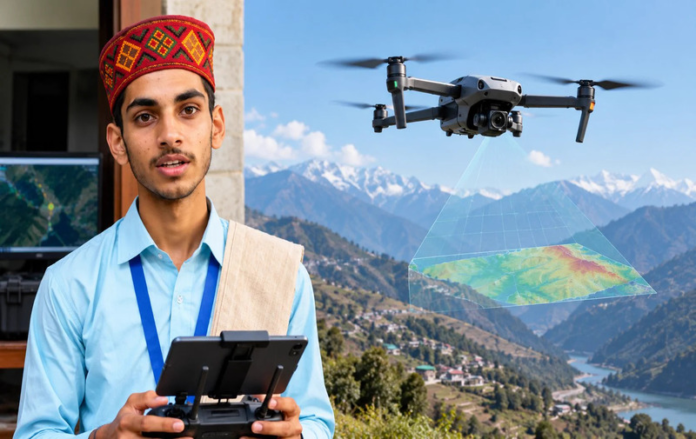
In the high-altitude border regions of India — places like the snow-bound stretches of Siachen and the contested heights around Galwan — surveillance is a constant, high-stakes challenge. Electronic warfare, GPS disruption, and radar detection by adversaries can render conventional drones unreliable or useless. When the Indian Army faces such operational gaps, solutions have traditionally come from large defence public sector units, established research labs, or well-funded private players.
That pattern was disrupted by Sarvesh Sharma, a fifth-semester computer engineering student at Government Polytechnic College, Hamirpur, Himachal Pradesh. The son of a daily-wage labourer from Bahanvi village in Hamirpur district, Sharma turned a low-cost homemade prototype into a formal Ministry of Defence project under the Innovations for Defence Excellence (iDEX) framework and the Defence Innovation Organisation (DIO).

Sarvesh Sharma, a fifth-semester computer engineering student at Government Polytechnic College, Hamirpur, Himachal Pradesh, is the son of a daily-wage labourer from Bahanvi village in Hamirpur district
The government approved a ₹3.5 crore grant for the development of the indigenous Rudra Edge T-1 (Spectra) drone, intended for border surveillance with design goals of reduced radar detectability and resistance to electronic jamming. Development is now underway at an incubation facility linked to IIT Roorkee, with a 20-month target.
The Unlikely Beginning
Sarvesh’s path did not begin in a well-equipped defence laboratory. His father works as a daily-wage labourer; his mother is a homemaker. He studied at a government school and enrolled in a polytechnic college rather than an elite engineering institution. Resources were limited.
His breakthrough started with participation in the national-level Open Cardboard Drone Competition organised by IIT Jodhpur and the Konark Corps (XII Corps), one of the two corps of the Pune-based Southern Command. Roughly 50 teams from institutions across India competed. Sharma’s team finished fourth and won a ₹10 lakh cash prize. Discussions at the event about the Indian Army’s difficulties with high-altitude border surveillance sparked a clearer idea.
He then invested approximately ₹87,000 of his own money (and prize resources) to build a working prototype. This was not a polished military product but a student-driven demonstration of core concepts aimed at the very problems of detection and jamming that complicate operations in extreme environments. He submitted a formal proposal under the DIO and iDEX programmes. In September 2026, the proposal was approved, unlocking the ₹3.5 crore grant and structured support.

Sarvesh Sharma’s breakthrough started with participation in the national-level Open Cardboard Drone Competition organised by IIT Jodhpur and the Konark Corps (XII Corps), one of the two corps of the Pune-based Southern Command
The drone, named Rudra Edge T-1 (Spectra), is being designed specifically for high-altitude border surveillance. Reported goals include the ability to operate with lower probability of enemy radar detection and greater resilience against electronic jamming systems. Claims circulating about the near-impossibility of hacking or guaranteed performance in sub-zero conditions reflect design aspirations; actual performance will be established only through rigorous development, testing, and trials over the coming months.
How iDEX Makes “Unlikely” Possible
iDEX, launched in 2018 and implemented by the Defence Innovation Organisation (a not-for-profit entity founded by HAL and BEL under the Department of Defence Production), was created precisely to open defence innovation beyond traditional players. Its model is problem-driven: the Armed Forces, DPSUs, and other agencies identify specific operational gaps. These become open challenges. Startups, MSMEs, individual innovators, academic institutions, and R&D bodies can apply.

Selected winners receive milestone-based grants (standard SPARK grants up to ₹1.5 crore; higher amounts available under iDEX Prime for more mature or capital-intensive projects). They also gain access to mentorship, partner incubators, testing facilities, and a pathway towards potential induction under defence procurement procedures. Intellectual property typically remains with the innovator, which is a deliberate design choice to attract talent.
Turning the Rudra Edge T-1 into a reliable, deployable system will require engineering maturity, extensive testing in realistic high-altitude conditions, certification, and eventual user acceptance
Crucially, iDEX explicitly includes individual innovators. Applicants from polytechnic colleges, government institutions, or modest backgrounds are not filtered out by pedigree. Evaluation focuses on technical promise, understanding of the problem, and the viability of the proposed approach. Once selected, individual innovators usually formalise a startup before the grant agreement is signed. Funding is released in tranches tied to milestones, ensuring accountability while providing the runway needed for serious development.
This structure is what allowed a computer engineering student from a Himachal village, working with limited personal funds, to move from a cardboard-drone competition to a multi-crore defence project supported by IIT Roorkee laboratories and professional mentorship. Without an open, challenge-based, grant-supported pathway that values ideas over institutional prestige, such a transition would have been far more difficult — if not impossible.
Broader Significance
Stories like Sarvesh’s illustrate a quiet but important shift in India’s defence ecosystem. Talent is not confined to metropolitan engineering campuses or large corporate R&D centres. Operational problems faced by soldiers on the borders can be addressed by young people who understand those constraints and bring fresh perspectives. iDEX acts as the bridge: it lowers the barrier to entry, supplies capital and infrastructure that individual innovators rarely possess, and creates a route from prototype to potential induction.
Sarvesh Sharma’s journey shows that iDEX can work in the most unlikely of circumstances. When a clear operational need meets determined individual ingenuity and an open institutional pathway, geography, family pedigree, and college prestige become secondary
It also reinforces the larger Aatmanirbhar Bharat goal in defence. Indigenous solutions developed under real operational requirements reduce dependence on foreign systems that may themselves be vulnerable to the very jamming and detection techniques adversaries employ.
Of course, a grant is only the beginning. Turning the Rudra Edge T-1 into a reliable, deployable system will require engineering maturity, extensive testing in realistic high-altitude conditions, certification, and eventual user acceptance. Not every promising prototype succeeds. Yet the fact that a polytechnic student from a labourer’s family could reach this stage at all demonstrates that the system is functioning as intended: identifying capability, funding it, and giving it institutional support.
Sarvesh Sharma’s journey shows that iDEX can work in the most unlikely of circumstances. When a clear operational need meets determined individual ingenuity and an open institutional pathway, geography, family pedigree, and college prestige become secondary. What matters is the idea, the will to build it, and a framework ready to amplify both

The writer is a defence journalist specialising in military affairs, security policy and defence technology. He reports extensively on operation strategies, defence manufacturing initiatives and geopolitical developments across the Indo-Pacific region. The views expressed are personal and do not necessarily carry the views of Raksha Anirveda





