


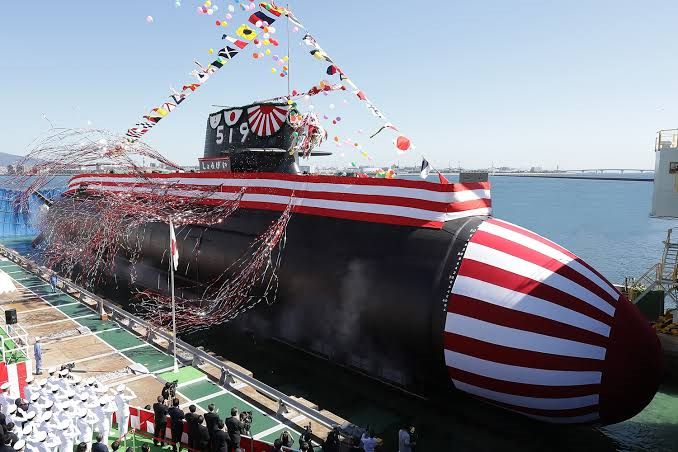
Kobe, Japan. Mitsubishi Heavy Industries (MHI) held a naming and launching ceremony for the submarine Shogei at its shipyard in Kobe, Hyogo Prefecture. The vessel is the seventh Taigei-class submarine built for the Japan Maritime Self-Defence Force (JMSDF). It is scheduled to enter service in March 2028, following further outfitting and testing.
Some reports describe the submarine as weighing 3,300 tons, but Jiji Press give its standard displacement as about 3,000 tons. The distinction matters: the sources reporting the launch do not support 3,300 tons as its standard displacement. Shogei is 84 metres long, about 9 metres wide and designed for a crew of 70, according to Jiji Press. Naval News gives its beam as 9.1 metres.

Shogei carries the hull number SS-519 and is conventionally powered, not nuclear-powered. Its diesel-electric system uses lithium-ion batteries for submerged operations. Reportedly the boat will use higher-output Kawasaki 12V 25/31 diesel engines, as do recent submarines in the class. The reported construction cost is 80.5 billion yen.
The battery system is a defining feature of the Taigei class. Submarines use stored electricity while underwater and run diesel engines to recharge batteries, which requires them to take in air through a snorkel near the surface. Lithium-ion batteries can store more energy than traditional lead-acid batteries, allowing improved submerged endurance and high-speed operation on battery power. They do not, however, give a conventional submarine the sustained submerged speed and range of a nuclear-powered boat.
The class succeeds Japan’s Sōryū-class submarines and is designed to improve detection and reduce noise. Shogei features improved detection capabilities and a quieter hull structure compared with earlier designs. Taigei-class boats have six 533-millimetre torpedo tubes; the class can use Type 18 torpedoes and launch UGM-84L Harpoon Block II anti-ship missiles.
The launch comes as Tokyo considers the design of its next generation of submarines and discusses the role of propulsion, weapons and long-range strike capabilities. Japan’s Acquisition, Technology & Logistics Agency awarded MHI a contract in July 2026 for research on an optimised design for a future submarine with vertical launch systems. That study is scheduled to run through fiscal 2029; it is a design-research project, not evidence that Japan has decided to build a nuclear-powered submarine.

The nuclear question remains under discussion. Defence Minister Shinjiro Koizumi said in September that Japan would not rule out nuclear propulsion as the government considers revisions to national security documents. The report also notes potential trade-offs, including higher cost, the need for specialised expertise and design implications. Japan has not announced so far a decision to adopt nuclear-powered submarines.
The debate reflects differing operational strengths. Diesel-electric boats can be quieter during certain patrol conditions and are generally less costly than nuclear-powered submarines. Nuclear propulsion, by contrast, can support sustained high speeds and long periods underwater without surfacing to recharge. Japan’s choice will depend on the missions, risks and costs it expects its future fleet to address.

For now, Shogei represents continuity in Japan’s submarine programme: a domestically built, diesel-electric attack submarine intended to strengthen the JMSDF’s undersea fleet. Its launch is an important construction milestone, but the boat will not be operational until after outfitting, trials and its planned 2028 delivery.






