


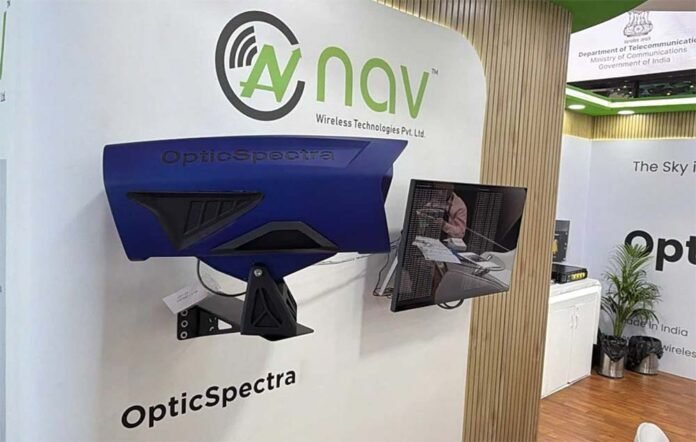
New Delhi. Nav Wireless Technologies Pvt Ltd, known as NavTech, has introduced OpticSpectra 40G at India Mobile Congress (IMC) 2026, presenting it as a way to move optical-network speeds across a wireless link. The company says the system can deliver data rates of up to 40 gigabits per second using Free Space Optical (FSO) communication. It is demonstrating the technology at the four-day event, running from October 7–10 at Yashobhoomi in New Delhi.
Unlike fibre, which carries data through physical cable, FSO sends information between endpoints using narrow beams of light. The approach could help connect locations where laying fibre is difficult, slow or impractical, while avoiding the need for a cable along the entire route. NavTech is targeting telecom and defence networks, including high-capacity backhaul and fibre-extension links. The company describes the system as a complement to fibre, radio-frequency and satellite communications, rather than a replacement for those established network layers.

The 40Gbps figure is the company’s stated system capacity; the published announcement does not detail the conditions under which that rate is achieved, the link distance, availability targets, equipment footprint, pricing or commercial deployment schedule. Those metrics will matter to operators and government users assessing whether the technology can perform reliably in their specific network environments.
FSO’s wireless flexibility comes with practical considerations. A free-space optical link requires a clear path between its endpoints, and performance can be affected by atmospheric conditions and alignment. As a result, prospective users will need to evaluate the technology against local weather, site geometry and service-availability requirements, as well as how it could integrate with existing network infrastructure.
NavTech’s announcement positions the system for situations where fibre expansion poses a challenge, but does not provide product-specific information on these operational factors.
NavTech said OpticSpectra 40G is part of its broader OpticSpectra platform, which is being developed for different bandwidth, distance and specialised connectivity needs. The company also works on free-space optical communication, visible-light communication and other photonic communication solutions. Its stated goal is to develop optical technologies in India for domestic and international markets and take them toward commercial applications.

At IMC, the company is staging a live demonstration for telecom operators, government and defence representatives, infrastructure firms, technology partners and international delegations. The demonstration is intended to show the system operating and illustrate a potential role for optical wireless links in future network architectures. The event’s official website describes IMC 2026 as taking place under the theme “Scale Without Boundaries” and bringing together technology and telecom stakeholders.
Hardik Soni, NavTech’s founder and chief technology officer, called the 40Gbps capability a technology milestone and said the company aims to extend optical-network capacity wirelessly to settings where fibre is difficult to install or rapid deployment is needed.

Puneet Chawla, a former chairman and managing director of RailTel and an adviser to C-DOT, described high-capacity optical wireless communication as a possible complement to existing fibre and radio-frequency networks. Both comments appeared in the company-provided announcement.
The unveiling adds an Indian-developed system to a broader communications landscape in which operators balance capacity, reach, deployment time and resilience. Whether OpticSpectra 40G moves from demonstration to network use will depend on technical performance, field testing and deployment economics.
For now, NavTech is presenting its system as another potential tool for extending high-capacity connectivity where conventional cabling is constrained.






