

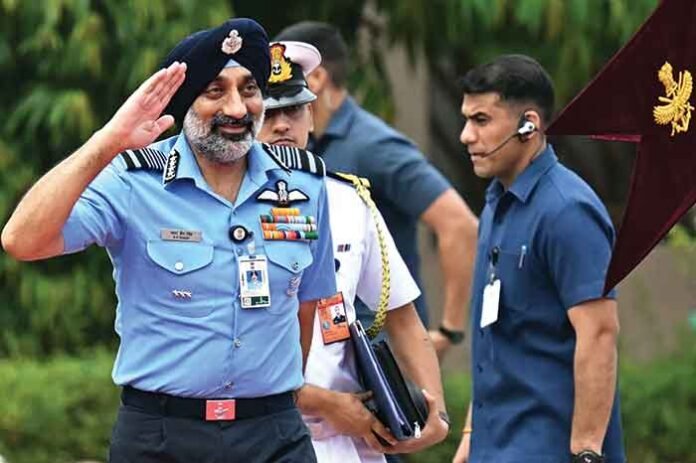
Speaking at his annual press conference at New Delhi on October 3, 2026, Indian Air Force Chief Air Chief Marshal AP Singh has said “If there are delays in the AMCA fifth-generation fighter programme, we may have to look at other options. Russia has offered the Su-57, but no decision has been taken yet. We would like to increase the number of aircraft in our inventory”. The Air Chief has categorically stated that the IAF requires an influx of 36-40 new fighter jets annually (roughly two entire squadrons) per year just to arrest any further dip in current numbers.
The IAF is experiencing a critical operational shortfall, currently fielding only 29 active fighter squadrons against a sanctioned requirement of 42 squadrons. This leaves the force with a deficiency of 13 squadrons, translated to a gap of nearly 200-250 combat fighter aircraft, which is heavily straining the IAF’s mandated capability to effectively manage a simultaneous two-front conflict involving China and Pakistan.

This depletion is a result of retiring obsolete legacy platforms like the MiG-21 alongside persistent production bottlenecks and delivery delays from indigenous aerospace programmes. Concurrently, older platforms like the MiG-29, Jaguar, and Mirage 2000 are hurtling toward their scheduled decommissioning by the late 2020s and early 2030s, threatening to shrink numbers further if not matched by rapid inductions.
The IAF needs 36-40 new fighter aircraft annually, merely to prevent further erosion of its operational strength
While India has ordered 180 indigenously developed LCA Tejas Mk-1A fighters across two major contracts, Hindustan Aeronautics Limited (HAL) has faced significant delivery delays. In October 2026, the Defence Secretary noted that the first flight of the LCA Mk-2 is scheduled for mid-2027, but he strongly conditioned the future of the aircraft on physical testing; while an initial requirement of 120 aircraft was projected, further decisions depend entirely on prototype delivery and IAF’s evaluation.
Failure to meet parameters in 2027 could lead to a downsized order and a shift toward alternatives like the MRFA project or the AMCA stealth fighter. The first squadron of the 5th-generation stealth aircraft, projected to enter service by the mid-2030s is becoming doubtful. In a hard-hitting public comment made on the LCA Tejas project, retired IAF Vice Chief Air Marshal Nagesh Kapoor has said the Tejas Mk-2 may not be operationally relevant in a frontline role when it starts entering service in significant numbers in the mid-2030s
India’s fifth-generation AMCA is targeting a first prototype flight by 2028–29, but serial production is not expected before 2033–35—potentially leaving a critical capability gap
The IAF is upgrading its fleet of Sukhoi Su-30MKIs while India is going-in for additional 114 Rafale fighters. But even if all the acquisition channels progress smoothly without any further setbacks, defence estimates suggest the IAF will realistically only manage to stabilise its numbers to about 35-36 combat squadrons by 2035, pushing the absolute realisation of the 42-squadron benchmark further into the future.

As to China’s 5th-generation fleet of J-20 and J-35 fighter jets, estimates are that China’s existing J-20 fleet of 500 will expand to 600-620 J-20’s by 2027 and to 1,000 by 2030. This timeline underscores a massive capability gap vis-à-vis India along the Line of Actual Control (LAC). India’s 5th-generation Advanced Medium Combat Aircraft (AMCA) is targeting its first prototype flight by 2028-29, with full serial production not anticipated until 2033-2035.
Also, China is supplying its J-35A (FC-31) 5th-generation stealth fighter to Pakistan. Pakistani leadership and state media confirm Pakistan Air Force (PAF) has signed an agreement to acquire around 40 J-35A stealth fighters. Open-source intelligence trackers and satellite imagery have reported Pakistani fighter pilots actively undergoing simulator and cockpit transition training in China. According to Jane’s Defence, technical negotiations are largely complete, with initial aircraft batches projected to begin arriving in Pakistan within the coming months.

China’s expanding J-20 fleet and Pakistan’s reported plans to acquire J-35A fighters could significantly alter the regional air-power balance
India plans acquisition of 114 additional Rafale fighter jets, but none of these will be 5th-generation because the Rafale platform is not built with a 5th-generation low-observable (stealth) airframe; it relies heavily on the SPECTRA electronic warfare (EW) suite for electronic stealth but lacks internal weapon bays and radar-deflecting geometry. These 114 Rafales are projected to begin deliveries in late 2029 or 2030, stretching-in gradual batches through the mid-to-late 2030s: 18-20 manufactured in France and delivered in fly-away condition; 94-96 under Make in India (2031–2038).
Notably, a 2025 study by the French Institute of International Relations (IFRI), which included senior veteran French Air Force officers, concluded that non-stealth platforms like Rafale could face severe attrition within three days in high-intensity combat scenarios against 5th-generation fighter jets; like the Russian Su-57 and Chinese J-20.
Moreover, China is fully aware of vulnerabilities of Rafale fighters through Pierre-Henri Chuet, serving French Navy Rafale pilot who clandestinely visited China in 2018 and 2019, and presumably provided China with Rafale’s weak points. Due to which China helped Pakistan down an IAF Rafale jet in ‘Op Sindoor’.
Russia has offered India its 5th-generation 57E fighter jet with 100% technology transfer, but India has yet to take a decision on it yet, because it fears US sanctions. How can we be so stupid as to opting for 114 Rafales that are double the cost of the Su-57E, are not 5th–generation, and not offering full transfer of technology.
Russia’s offer of the Su-57E-and its proposed dual-seat Su-57D variant-has renewed debate over whether India should pursue an interim fifth-generation platform with extensive technology transfer while accelerating AMCA development
Ironically, Defence Minister Rajnath Singh only keeps boasting about the soaring defence exports but has no spine to push for the Russian Su-57, which better address IAF’s criticalities. No doubt the USD 34 billion deal of 114 Rafales will give massive kickbacks (no defence deal take place without kickbacks), but pushing the Russian Su-57E under the carpet, is in interest of the IAF, or for that matter in nation’s interest?
Speaking at the NDTV Defence Summit 2026 on October 1, Russian Ambassador Denis Alipov highlighted that the development of the dual-cockpit Su-57D directly reflects operational concepts India had advocated during earlier bilateral discussions.
Developed by Russia’s United Aircraft Corporation (UAC), the tandem-seat platform is structured not merely as a high-performance conversion trainer, but as an airborne command-and-control node for modern network-centric warfare.
The Su-57D completed its maiden flight in May 2026 and remains in active flight evaluations. Modern air combat increasingly relies on Manned-Unmanned Teaming (MUM-T), where a crewed fighter coordinates a network of autonomous unmanned combat aerial vehicles (UCAVs) or “loyal wingmen”, such as Russia’s S-70 Okhotnik-B.
Prudence demands that India should go for the Su-57E or Su-57D, whichever the IAF prefers without further delay. One view is that it would be better to acquire about 199 Su-57D with 100 per cent transfer of technology; to expedite development of the AMCA, and if possible, together with the contemplated 6th-generation Global Combat Air Programme (GCAP).
As to the fear of American sanctions and losing political power, India’s political authority needs to acknowledge that Iranian strikes against US logistics bases in the Gulf, forced the US Navy to fall back on Indian ports and this requirement will multiply with Donald Trump planning massive strikes on Iran – that may happen before or after the midterm elections. So why is India scared?

The author is an Indian Army veteran. The views expressed are of the author and do not necessarily reflect the views of Raksha Anirveda





