


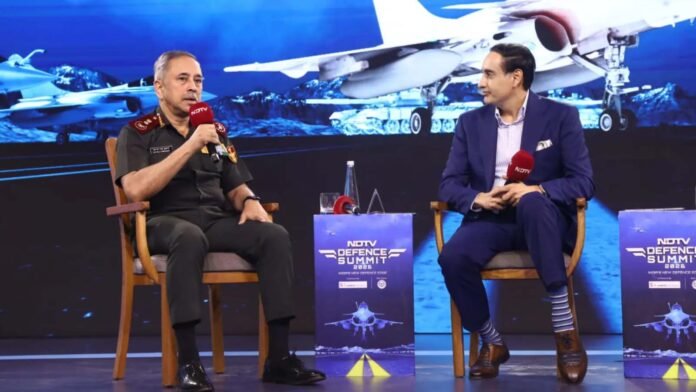
The NDTV Defence Summit 2026, held under the theme “India’s New Defence Edge”, offered a revealing snapshot of how India’s defence establishment is thinking about tomorrow’s wars. More than a conventional defence conference, the summit brought together political leadership, military commanders, technologists, defence manufacturers, strategic experts and international partners to examine a fundamental question: what will give India an enduring advantage in an era when technology, speed and industrial capacity determine battlefield outcomes as much as traditional military strength?
The presence of Defence Minister Rajnath Singh at the opening of the summit gave the event a clear strategic framing. His keynote address centred on self-reliance, future preparedness and the transformation of India’s defence-industrial base. Singh argued that India’s objective is no longer limited to meeting immediate military requirements, but to build capabilities for future forms of warfare. He described India’s approach to self-reliance in broad terms — from chips and components to ships and complete weapon systems.

His larger message was that Aatmanirbharta is increasingly being viewed not simply as an economic objective but as a component of strategic autonomy. In a world where geopolitical disruptions can affect supply chains, ammunition availability, critical electronics and military platforms, the ability to design, manufacture and sustain systems domestically becomes a security consideration.
From Aatmanirbharta to Future Warfare
The summit’s first major theme was the changing character of warfare. Singh described the contemporary environment as the fifth generation of warfare, encompassing both kinetic and non-kinetic dimensions. The emphasis was consequently not merely on acquiring larger quantities of conventional platforms but on preparing for a multidomain battlefield.
Rajnath Singh described the contemporary environment as fifth-generation warfare, encompassing both kinetic and non-kinetic dimensions. The emphasis was not merely on acquiring larger quantities of conventional platforms but on preparing for a multidomain battlefield
This theme was reinforced by Army Chief General Dhiraj Seth in his special address, “Aatmanirbharta in an Era of Transformative Wars”. The discussion placed self-reliance in the context of a battlefield where technologies are evolving rapidly and where military organisations must be able to adapt faster than potential adversaries.
The session “The Threat Matrix: Rewriting India’s Rules of Deterrence” then moved the conversation from industrial capability to deterrence. With representatives from the defence-industrial ecosystem and former senior government leadership, the discussion highlighted the connection between ammunition, advanced systems, domestic manufacturing and India’s ability to respond to emerging security challenges.

AI: From Buzzword to Battlefield Capability
The summit’s most striking feature was the prominence given to artificial intelligence. The session “AI Takes the Field. Is Mankind Still in Command?” explored a question that is becoming increasingly central to military planning: how far should decision-making be delegated to machines?
The discussion was particularly relevant because AI is no longer confined to theoretical applications. It is increasingly associated with intelligence processing, surveillance, target recognition, autonomous systems, electronic warfare, logistics and battlefield decision support.

Chief of Defence Staff General NS Raja Subramani described AI as both an opportunity and a challenge. The summit also reported that attempts had already been made to incorporate AI into aspects of Operation Sindoor
Chief of Defence Staff General NS Raja Subramani described AI as both an opportunity and a challenge. The summit also reported that attempts had already been made to incorporate AI into aspects of Operation Sindoor. The emerging concept is therefore not simply “AI in defence”, but an AI-enabled military architecture capable of processing enormous quantities of information and assisting commanders at operational speed.
This leads to an important distinction: possessing AI-enabled equipment is not the same as possessing technological sovereignty. India will increasingly need indigenous data, algorithms, secure computing, sensors, communications infrastructure and the ability to continuously upgrade these systems.
Fifth-Generation Airpower and the Sixth-Generation Ambition
Airpower received considerable attention through Air Marshal Tejpal Singh’s special address, “Fifth Generation and Beyond”. The discussion reflected the transition from traditional aircraft-centric thinking towards networks of aircraft, sensors, electronic warfare systems, unmanned platforms and other supporting technologies.
The defence minister also revealed that India is working towards developing sixth-generation fighter capabilities, alongside efforts to strengthen domestic aircraft and drone-engine manufacturing. This represents a long-term technological ambition rather than an immediate procurement programme, and Singh acknowledged that such a path would involve significant challenges.
Navy Chief Admiral Krishna Swaminathan spoke about lessons emerging from disruptions to shipping around the Strait of Hormuz and Bab el-Mandeb, emphasising the importance of diversified supply chains and self-sufficiency
The significance lies in the direction of travel: India’s defence debate is gradually shifting from what should India buy? towards what technologies should India be capable of designing and producing?
Drones, Sensors and the Innovation Economy
The session “Building Bharat’s Arsenal of Innovation: AI, Drones & Beyond” brought the defence-start-up ecosystem into the centre of the conversation. Participants discussed drones, counter-drone systems, advanced sensors, electronic warfare and autonomous technologies.
One recurring concern was speed. India’s challenge is increasingly not a shortage of engineers, entrepreneurs or ideas, but the time required to turn prototypes into deployable military capabilities. The Chief of Defence Staff subsequently underlined the armed forces’ requirement for speed, scale and volume from industry.
That may prove to be one of the summit’s most consequential messages. Modern warfare consumes technology rapidly. A system that takes a decade to develop may encounter a battlefield that has changed substantially before it enters service.
Space, Sovereignty and the Maritime Domain
The summit also broadened the meaning of defence capability beyond the traditional land-air-sea framework.
The session “Space and Sovereignty” examined the strategic importance of satellite-based capabilities. Space assets are increasingly essential for communications, navigation, surveillance, reconnaissance and battlefield awareness. The subsequent discussion on India’s space ambitions and the participation of private-sector players reflected the growing role of commercial technology in national security.
French Vice Chief of the Air and Space Force Lieutenant General Dominique Tardif discussed the evolution of airpower and the Indo-French partnership, while Russian Ambassador Denis Alipov addressed the next chapter of India-Russia defence relations
The maritime discussion was equally significant. Navy Chief Admiral Krishna Swaminathan spoke about lessons emerging from disruptions to shipping around the Strait of Hormuz and Bab el-Mandeb, emphasising the importance of diversified supply chains and self-sufficiency.
This demonstrated that India’s security calculations cannot be separated from global trade routes. Energy, shipping, undersea infrastructure and maritime surveillance are increasingly intertwined with national security.
Partnerships Without Losing Strategic Autonomy
International partnerships formed another important strand. The summit included discussions on the Indo-French defence relationship and the future of India-Russia defence ties. French Vice Chief of the Air and Space Force Lieutenant General Dominique Tardif discussed the evolution of airpower and the Indo-French partnership, while Russian Ambassador Denis Alipov addressed the next chapter of India-Russia defence relations.
The underlying tension is familiar but increasingly complex: India needs international technology partnerships while simultaneously seeking greater domestic capability.
The summit therefore presented strategic autonomy not as isolation, but as the capacity to choose partnerships from a position of technological and industrial strength.
Operation Sindoor and the Lessons of Jointness
Running through many discussions was the operational experience of Operation Sindoor. The summit’s coverage highlighted the role of jointness between India’s armed services. General NS Raja Subramani described the operation as an example of the three services working together.
Future conflicts are likely to blur the boundaries between land, sea, air, cyber, space and information domains. Joint command structures, common data networks and interoperable platforms will therefore become increasingly important
The importance of this lesson extends beyond one operation. Future conflicts are likely to blur the boundaries between land, sea, air, cyber, space and information domains. Joint command structures, common data networks and interoperable platforms will therefore become increasingly important.
The Defence Secretary’s Challenge: Turning Strategy into Capability
The summit concluded with sessions that brought the conversation back to implementation. Defence Secretary Rajesh Kumar Singh’s “Strategy to Capability: Building India’s Defence Edge” was followed by General NS Raja Subramani’s “Commanding Tomorrow’s Battlefield – The India Vision.”
That sequencing was telling. A strategy has value only when it produces deployable capability. India’s next challenge will therefore be converting ambitious announcements about AI, drones, space, advanced aircraft, propulsion and indigenous manufacturing into systems that can be produced at scale, maintained over decades and upgraded continuously.
India’s next challenge will be converting ambitious announcements about AI, drones, space, advanced aircraft, propulsion and indigenous manufacturing into systems that can be produced at scale, maintained and upgraded over decades
Takeaway: The Real Defence Edge is an Ecosystem
The strongest takeaway from the NDTV Defence Summit 2026 is that India’s emerging defence strategy is becoming ecosystem-centric. The future battlefield will not be determined by fighter aircraft, missiles, or warships; it will depend on the interaction between sensors, satellites, AI, drones, secure communications, human decision-making, manufacturing capacity, ammunition stocks, logistics, skilled personnel, and industrial supply chains.
The summit consequently offered a picture of defence transformation that goes beyond procurement. Its central message was about building the capacity to innovate, manufacture, integrate and adapt at speed. If Aatmanirbharta was once primarily discussed as a means of reducing import dependence, the summit suggested a broader interpretation: self-reliance is increasingly about ensuring that India retains the freedom to develop, sustain and modify critical military capabilities when strategic circumstances change.
The defining contest of the coming decades may therefore not simply be between platforms or armies. It may be between defence ecosystems — and the ecosystems capable of learning, innovating and scaling fastest could possess the greatest strategic resilience.

–The writer is Assistant Professor, ICFAI School of Liberal Arts, ICFAI University, Jaipur. The views expressed are of the writer and do not necessarily reflect the views of Raksha Anirveda





