


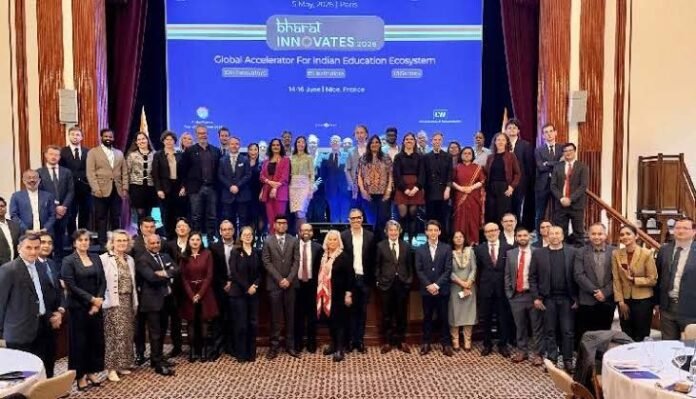
The international theatre of technology diplomacy witnessed a historic expansion as the Government of India’s Ministry of Education formally commenced the Bharat Innovates 2026 initiative.
To be held from June 14 to 16, 2026, at the Palais des Expositions in the coastal tech hub of Nice, France, the high-stakes summit acts as a bridge connecting India’s rapidly growing, intellectual property-backed startup ecosystem directly with global markets, institutional investors, and premier European research institutions.

Announced originally by the Indian Prime Minister on February 17, 2026, during the inauguration of the bilateral India-France Year of Innovation, this flagship programme gathers more than 120 handpicked deep-tech ventures.
These startups were selected from an intense competitive pool of over 1,200 applicants, all receiving comprehensive mentorship from the country’s elite scientific leadership, with strategic guidance from the Office of the Principal Scientific Adviser to the Government of India. Accompanying the cohort are representatives from 15 of India’s premier Higher Education Institutions – including multiple Indian Institutes of Technology (IITs) and the Indian Institute of Science (IISc) Bangalore – alongside five key scientific and strategic state organisations.
While the exhibition spans 13 critical technology verticals, the core focus remains squarely on four highly restricted, frontier strategic sectors: space, nuclear technology, aerospace/defence, and hardware semiconductors.
These startups were selected from an intense competitive pool of over 1,200 applicants, all receiving comprehensive mentorship from the country’s elite scientific leadership, with strategic guidance from the Office of the Principal Scientific Adviser to the Government of India
Historically, these capital-intensive fields were managed exclusively by state-run monopolies. Today, the Ministry of Education’s initiative highlights how domestic private innovators, backed by robust academic incubators, are successfully engineering sovereign, deployable solutions for the global value chain.

Powering the New Space Economy
In the highly competitive space segment, Bengaluru-based space-tech trailblazer Bellatrix Aerospace anchors the delegation. Founded at the Indian Institute of Science, Bellatrix has built a comprehensive propulsion portfolio spanning multiple core technologies, each designed to solve specific bottlenecks in satellite mobility and in-space operations.
Among its most notable innovations is Jal, a Microwave Plasma Thruster that utilises water as a propellant. This system represents the world’s first privately built plasma thruster of its kind, offering a lightweight, corrosion-free architecture designed to last significantly longer than conventional electric propulsion systems, directly addressing persistence and reliability concerns for global satellite operators.

The company has also developed Rudra, a high-performance green thruster intended as a direct replacement for highly toxic hydrazine-based chemical propulsion, delivering comparable performance without the associated environmental hazards.
Alongside Rudra, Bellatrix features Arka, an electric Hall-effect propulsion platform designed for extended operational life in orbit, and Fingernail, a micro-thruster built for the rapidly expanding small satellite market that is compact enough to fit on a fingertip.
Having completed multiple successful green propulsion firings in orbit, Bellatrix stands as a premier example of academic-turned-industrial success, backed by a strategic partnership with the Indian Space Research Organisation (ISRO) for joint technology development and a contract with NewSpace India Limited (NSIL) to integrate its Pushpak Orbital Transfer Vehicle into upcoming launch missions.
Rewriting the Chip Story: From Lab to Fab
The semiconductor vertical at the Nice pavilion highlights how India is challenging the traditional global dominance of East Asian and Western chip foundries. Driven by a trio of pioneering hardware startups – Netrasemi, AGNIT Semiconductors, and VerveSemi – this segment demonstrates an evolution from software design to foundational physical silicon manufacturing.
Backed by the government’s Design Linked Incentive (DLI) and Chips to Startup schemes under the wider India Semiconductor Mission, these companies are demonstrating that the subcontinent can own its intellectual property.
Historically, these capital-intensive fields were managed exclusively by state-run monopolies. Today, the Ministry of Education’s initiative highlights how domestic private innovators, backed by robust academic incubators, are successfully engineering sovereign, deployable solutions for the global value chain
Thiruvananthapuram-based Netrasemi, founded in 2020 and backed by around ₹125 crore from investors like Zoho and Unicorn India Ventures, is showcasing its flagship A2000 chip.
Built on a 12nm process at Taiwan’s TSMC foundry, the A2000 has recently achieved silicon bring-up and has been recognised as India’s first indigenous edge artificial intelligence system-on-chip. Optimised for surveillance cameras, drones, and robotics, it delivers ultra-low-power processing directly at the device level, with large-scale commercial volumes targeted for 2027.
Sharing the pavilion is Bengaluru-based AGNIT Semiconductors, a pioneer specialising in Gallium Nitride (GaN) radio frequency chips. Gallium Nitride represents the absolute cutting edge of solid-state electronics, vastly outperforming traditional silicon in efficiency, power density, and thermal conductivity.
AGNIT currently has three active pilots running with domestic defence public sector units and private military firms, expecting to ship between 5,000 and 10,000 specialised chips over the next six to nine months to power harsh military radar networks and electronic warfare arrays.
Completing the trio is VerveSemi, a high-growth enterprise focused on energy-efficient analog and mixed-signal integrated circuits. VerveSemi’s designs are tailored for edge-computing applications and industrial IoT, helping to insulate India’s strategic electronics manufacturing from volatile international supply chains.
By controlling the entire architectural pipeline from initial design to client integration, these three chip companies are securing long-term design-in wins, which typically lock customers into decade-long hardware relationships.
Enhancing Aerospace and Defense Autonomy
The aerospace and defence sectors are showcasing equal technological maturity at the summit, presenting innovations that address the rapidly changing realities of modern security.
In the highly competitive space segment, Bengaluru-based space-tech trailblazer Bellatrix Aerospace anchors the delegation. Founded at the Indian Institute of Science, Bellatrix has built a comprehensive propulsion portfolio spanning multiple core technologies, each designed to solve specific bottlenecks in satellite mobility and in-space operations
Indian defense startups are shifting focus away from heavy, conventional platforms to embrace decentralised, software-defined military hardware. The delegation includes enterprises displaying autonomous unmanned aerial swarms, artificial intelligence-assisted target identification systems, and advanced anti-drone electronic counter-measures.
These defence platforms utilise advanced deep-learning algorithms trained on complex, real-world terrain data to operate reliably even in high-interference environments where standard satellite navigation is completely jammed. By combining ruggedised mechanical designs with adaptive software architectures, these local companies are transforming the defense supply landscape.
They demonstrate an innate ability to rapidly design, field-test, and mass-produce intelligent defence hardware, a capability highly valued by global defence partners seeking resilient, cost-effective military tech that can be deployed within months rather than years.
Engineering Solutions for the Nuclear Frontier
In the highly sensitive domain of nuclear technology, Indian innovators are presenting breakthroughs that bridge the gap between heavy industry and precise digital control.
Historically shielded from private sector participation, the nuclear sector has gradually opened to specialised local startups capable of meeting the rigorous quality and safety standards mandated by atomic energy regulators.
At the Nice exhibition, these companies are introducing advanced radiation-hardened electronic components and robotic inspection systems engineered to operate safely within the high-radiation zones of nuclear containment facilities.
Additionally, local firms are presenting developments in advanced metallurgy and material sciences, showcasing structural materials designed to withstand extreme thermal stresses inside next-generation small modular reactors.
The semiconductor vertical at the Nice pavilion highlights how India is challenging the traditional global dominance of East Asian and Western chip foundries. Driven by a trio of pioneering hardware startups – Netrasemi, AGNIT Semiconductors, and VerveSemi – this segment demonstrates an evolution from software design to foundational physical silicon manufacturing
These modular units are gaining rapid global traction as a flexible solution for zero-emission industrial power. By combining India’s long-standing institutional research in nuclear engineering with the agility of private hardware startups, these innovators are positioning themselves as vital partners for global clean energy initiatives.
Bridging Labs and Global Markets
The primary structural goal of the Bharat Innovates 2026 summit is to systematically transform academic laboratory breakthroughs into market-ready global products. The Department of Higher Education has intentionally structured the three-day event to move beyond symbolic representation, focusing instead on securing cross-border venture capital, establishing international manufacturing lines, and forging co-development partnerships with European aerospace and defence giants.
To foster this innovative mindset at home, the government paired the international summit with a massive domestic awareness campaign across Indian schools and technical colleges throughout May. This initiative included specialised seminars on the evolving innovation landscape and introductory classes on deep-tech architectures, ensuring the next generation of students understands the strategic importance of these fields.
With India’s broader startup ecosystem projected to grow significantly by the end of the decade, platforms like Bharat Innovates 2026 ensure that the nation’s technical talent transitions from writing commercial consumer applications to mastering foundational hardware technologies.

-The writer is a New Delhi-based senior commentator on international and strategic affairs, environmental issues, an interfaith practitioner, and a media consultant. The views expressed are personal and do not necessarily carry the views of Raksha Anirveda





