


New Delhi: Post-Operation Sindoor, the Defence Research and Development Organisation (DRDO) has transferred two pivotal indigenous technologies to the Indian Army, enhancing its camouflage and deception capabilities amid evolving battlefield threats.
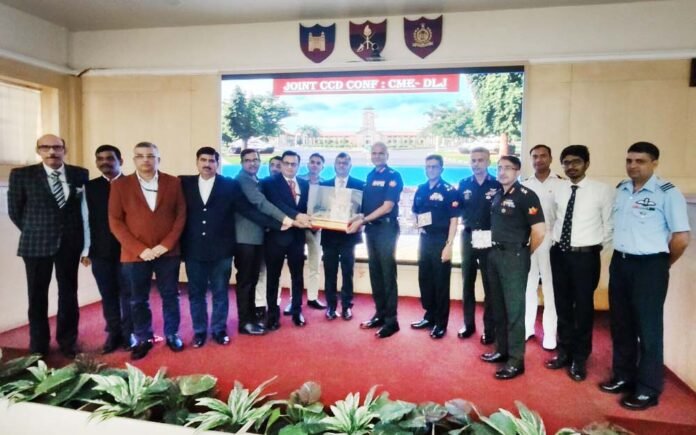
Defence Laboratory Jodhpur (DLJ), a DRDO entity, handed over the Camouflage Pattern Generation Software Sigma 4.0 (CPGSS4.0) and a full-scale Multispectral Signature Tank Mock-up to the Corps of Military Engineering (CME) in Pune during the first week of December 2025.

These transfers follow the intense 2025 India-Pakistan conflict, where Operation Sindoor saw Indian missile strikes on May 7 target terrorist infrastructure linked to groups like Jaish-e-Mohammed and Lashkar-e-Taiba in response to the Pahalgam attack.
The conflict exposed vulnerabilities, as Pakistani forces attempted to strike Indian assets including the S-400 Triumf system using missiles and drones. This underscored the urgency for advanced evasion tactics, aligning with Sun Tzu’s maxim that all warfare hinges on deception. DRDO’s initiative directly addresses these lessons, bolstering the Army’s survivability against modern sensors.
CPGSS4.0 represents a sophisticated upgrade, generating optimised multi-spectral camouflage patterns tailored to diverse terrains, weather, and operational environments. It counters detection in visible light, infrared (IR), and radar spectra, enabling soldiers to blend equipment seamlessly into surroundings. Launched on December 3 by Lt Gen A K Ramesh, Commandant of CME, in the presence of DLJ Director V S Shenoi, the software is now accessible to all tri-services for training and deployment.
Complementing the software, the full-scale Multispectral Signature Tank Mock-up serves as a realistic training aid mimicking a battle tank’s visual, thermal, IR, and radar signatures. Personnel can practise applying camouflage materials to deceive advanced threats like UAVs, thermal imagers, and radar systems. This hands-on tool bridges theoretical software use with practical deception techniques.

Operation Sindoor, involving measured strikes on nine sites in Pakistan-administered Kashmir and Punjab, marked a non-escalatory response to cross-border terrorism. Pakistan claimed civilian hits, but India maintained focus on militant facilities, averting broader military targets. The brief clash highlighted the primacy of deception in denying adversaries targeting data.
Traditional camouflage has waned in efficacy against proliferating surveillance technologies, prompting DRDO’s emphasis on multispectral solutions. These technologies integrate software simulation with physical mock-ups, fostering expertise in concealment vital for operational success. The Army can now refine tactics against radar, IR, and electro-optical sensors prevalent in contemporary warfare.

The handover ceremony underscored tri-service utility, with CPGSS4.0 poised for Navy and Air Force adoption alongside Army use. This broadens deception training across domains, from land manoeuvres to aerial and naval assets. DLJ’s innovations stem from post-conflict analysis, prioritising indigenous tools over imports.
In the broader strategic context, these developments fortify India’s edge along tense borders. Amid rapid sensor proliferation—thermal drones, synthetic aperture radar, and hyperspectral imaging—effective camouflage remains a force multiplier. The mock-up’s realism ensures troops master deception under simulated combat stress.
DRDO’s track record in such transfers, including prior camouflage aids, builds on sustained R&D investment. Post-Sindoor evaluations likely accelerated Sigma 4.0’s rollout, reflecting agile adaptation to real-world threats. The Army’s CME Pune will lead integration, disseminating skills via specialised courses.
These technologies embody self-reliance in defence, reducing vulnerability to precision strikes observed in May’s exchanges. By deceiving enemy intelligence cycles, Indian forces gain tactical breathing space, crucial in high-intensity scenarios. Future iterations may incorporate AI-driven pattern optimisation, further elevating battlefield superiority.






