


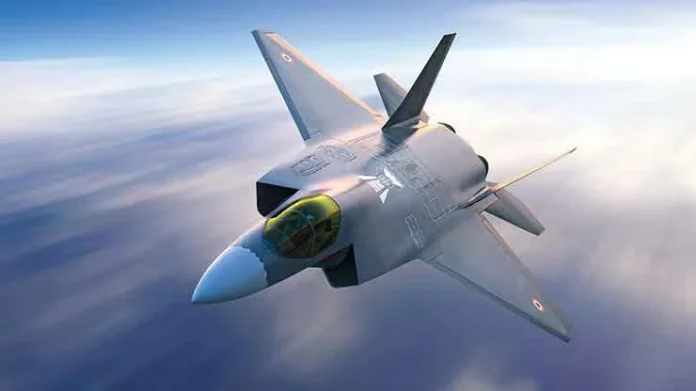
New Delhi: India’s ambitious Advanced Medium Combat Aircraft (AMCA) programme, aimed at delivering a fifth-generation stealth fighter, has sparked intense debate over whether private industry will take the lead, potentially side-lining Hindustan Aeronautics Limited (HAL). Reports surfaced earlier this month suggesting HAL might be excluded from the crucial development phase, triggering a sharp 8 per cent drop in its share price on the Bombay Stock Exchange.
This comes amid HAL’s heavy commitments, including production of 180 Tejas MK-1A fighters worth ₹1.2 lakh crore, 108 Tejas MK-2 aircraft, and various helicopter programs like the Indian Multi Role Helicopter (IMRH) and Light Combat Helicopter (LCH).

HAL swiftly clarified its position on February 4, stating it had received no official communication excluding it from AMCA and reaffirming its robust order book extending to 2032. A senior HAL official noted that even if side-lined initially, the company plans to bid for manufacturing contracts around 2035, once prototypes are ready.
The AMCA represents India’s bid for air dominance, featuring twin engines, low-observable design, internal weapons bays, advanced sensor fusion, AI-driven decision aids, and network-centric capabilities. It must counter the Indian Air Force’s shrinking squadron strength—down to 30 against a sanctioned 42.5—with more retirements looming. China’s operational J-20 stealth fighters, emerging sixth-generation prototypes like the J-36 and J-50, and Pakistan’s impending 40 J-35A jets add strategic urgency. The IAF eyes seven initial AMCA squadrons (126 aircraft) from the mid-2030s as its backbone.
HAL has long monopolised fighter production in India, from MiG variants to Su-30MKI and Tejas, but Tejas MK-1A delays have prompted a rethink.
Defence Minister Rajnath Singh has approved a new execution model opening bids to private firms, consortia, or foreign OEM partnerships, all on competitive terms with Indian compliance. This aims to build parallel assembly lines, avoiding bottlenecks and fostering a vibrant aerospace ecosystem. Seven consortia bid for the development phase; three were shortlisted: TATA with Larsen & Toubro, BEL, and Dynamatic; Bharat Forge (Kalyani Group) with BEML and Data Patterns. TATA edges ahead with its C-295 assembly line experience alongside Airbus; others excel in components like wings and fuselages. Non-shortlisted bidders included Adani with MTAR, Goodluck India with Axiscades, BrahMos Aerospace, and ICOMM Tele.

The winner, due within three months, will partner with the Aeronautical Development Agency (ADA) to build five prototypes by 2031, backed by ₹15,000 crore.
Last year, the Cabinet Committee on Security greenlit full-scale development, including prototypes, testing, and certification. Initial squadrons will use GE-F414 engines (98 kN); later ones 110 kN options from GE, Safran, or Rolls-Royce. HAL and GE are negotiating F414 co-production with 80 per cent technology transfer for $1.5 billion.

At Aero India 2025, ADA confirmed completed detailed design, ongoing procurement, and indigenous components barring ejector seats and engines—no delays anticipated.
Tejas MK-1A setbacks loom large: HAL reports five ready fighters, nine awaiting GE engines, with supply now positive from 2027-2032. Currently, the IAF lacks fifth-generation jets, relying on Su-30MKI for dominance, Rafale for 4.5-gen punch, Tejas for indigenous replacement, and upgraded MiG-29, Mirage-2000, Jaguar.
AMCA’s trajectory tests India’s defence strategy: balancing public giants like HAL with private innovation to meet threats. Private leadership could accelerate timelines, infuse capital, and diversify risks, but HAL’s expertise remains vital for scaling production.
As bids unfold, the programme signals New Delhi’s pivot towards a competitive, indigenous aerospace powerhouse.






