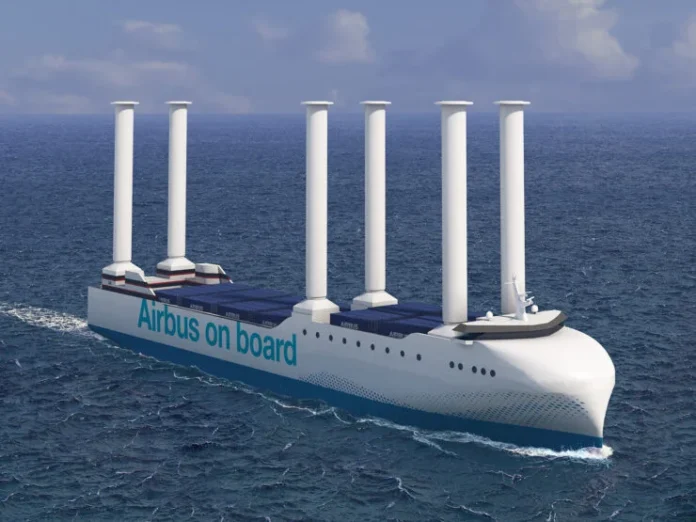
Toulouse. Airbus will renew the entire fleet of chartered vessels that transport aircraft subassemblies between production facilities in Europe and the United States with three modern, low-emission roll-on/roll-off vessels, supported by wind-assisted propulsion.
Airbus has commissioned shipowner Louis Dreyfus Armateurs to build, own and operate these new, highly efficient vessels that will enter into service from 2026.

The new fleet is expected to reduce average annual transatlantic CO2 emissions from 68,000 to 33,000 tonnes by 2030. This will contribute to Airbus’ commitment to reduce its overall industrial emissions by up to 63% by the end of the decade – compared to 2015 as baseline year – in line with the 1.5°C pathway of the Paris Agreement.
“The renewal of our marine fleet is a major step forward in reducing our environmental impact,” said Nicolas Chrétien, Head of Sustainability & Environment at Airbus. “The latest generation of vessels proposed by Louis Dreyfus Armateurs are more fuel efficient than their predecessors, using cutting-edge technologies like wind-assisted propulsion. This demonstrates our determination to lead the way in decarbonising our sector by innovating not just in aviation, but across all our industrial operations.”
“We are very pleased to have been selected by Airbus to develop this state-of-the-art and low-emission fleet and to continue our longstanding partnership,” said Edouard Louis-Dreyfus, President, Louis Dreyfus Armateurs. “This new project, setting high targets, reflects our ambition regarding the decarbonisation of the shipping industry. We are proud to support our customers in their energy transition, going even beyond their expectations by offering innovative solutions and sustainably driving change.”
Airbus will gradually renew the chartered vessels that ferry its aircraft subassemblies across the Atlantic between Saint-Nazaire, France, and its single-aisle aircraft final assembly line in Mobile, Alabama.

The new vessels will be powered by a combination of six Flettner rotors – large, rotating cylinders that generate lift thanks to the wind, propelling the ship forward – and two dual-fuel engines running on maritime diesel oil and e-methanol. Additionally, routing software will optimise the vessels’ journey across the Atlantic, maximising wind propulsion and avoiding drag caused by adverse ocean conditions.
The fleet renewal also supports Airbus ambition to increase A320 family production rate to 75 aircraft per month by 2026. Each new transatlantic vessel will have the capacity to transport around seventy 40-foot containers and six single-aisle aircraft sub assembly sets – wings, fuselage, engine pylons, horizontal and vertical tail planes – compared to three to four sets with current cargo ships.