


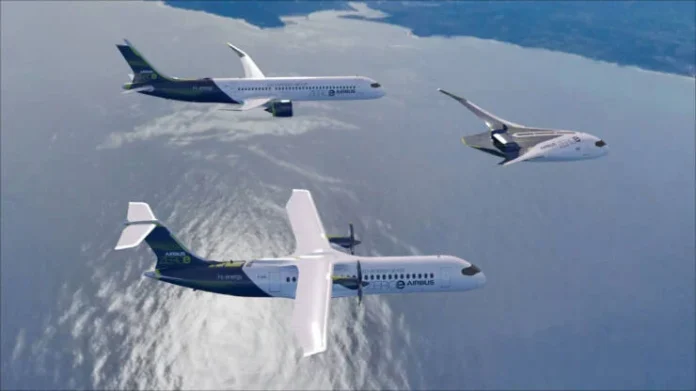
Toulouse. Airbus has decided to concentrate its efforts for metallic hydrogen tanks in a complementary setup by creating Zero-Emission Development Centres (ZEDC) at its sites in Bremen (Germany) and in Nantes (France). The goal of the ZEDC is to achieve cost-competitive cryogenic tank manufacturing to support the successful future market launch of ZEROe and to accelerate the development of hydrogen-propulsion technologies. The design and integration of tank structures is crucial to the performance of a future hydrogen aircraft.
The technology developments will cover the full product and industrial capabilities from elementary parts, assembly, systems integration and the cryogenic testing of the final liquid hydrogen (LH2) tank system. Both ZEDCs will be fully operational by 2023 to build LH2 tanks with a first flight test scheduled for 2025.

Airbus chose its site in Bremen because of its diverse setup and decades of LH2 experience within Defence and Space and ArianeGroup. The ZEDC in Bremen will initially focus on system installation as well as for the overall cryogenic testing of the tanks. Furthermore, this ZEDC will benefit from the wider hydrogen research ecosystem such as the Centre for Eco-Efficient Materials and Technologies (ECOMAT) and from further synergies from space and aerospace activities.
Airbus chose its site in Nantes because of its extensive knowledge in metallic structural technologies related to the centre wing box, including the safety-critical centre tank for commercial aircraft. The ZEDC in Nantes will bring its ability to manage equally a wide range of metallic, composite technologies and integration as well as its experience in codesign activities on nacelle inlets, radomes and centre fuselage complex work packages. The ZEDC will benefit from the Nantes Technocentre skills and capabilities, supported by an innovative local ecosystem such as the IRT Jules Verne.
In line with Northern German regional and the Pays de Loire ambitions, Airbus will foster cross-industry collaboration to support the overall transition to hydrogen-propulsion technologies, as well as the associated ground-based infrastructure in the region.
The tank is a safety-critical component, for which specific systems engineering is needed. LH2 is more challenging than kerosene because it needs to be stored at -250 °C to liquefy. Liquidity is needed for increased density. For commercial aviation, the challenge is to develop a component which can withstand repeated thermal and pressure cycling which an aircraft application demands.

It is expected that near-term LH2 tank structures for commercial aircraft applications will be metallic, however the potential performance opportunities associated with carbon-fibre-reinforced polymer composites are high.






