


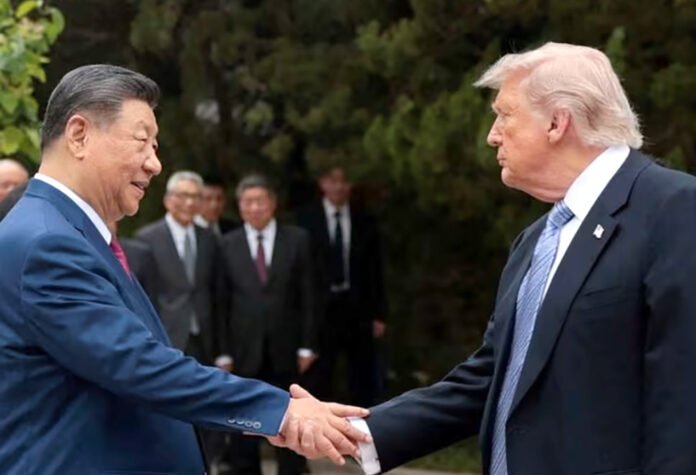
The White House has intimated that President Trump will personally receive Chinese President Xi Jinping at the airport when he arrives for his state visit on September 23. This is unprecedented, as even Trump was not received by Xi when he visited China in May this year. Xi and Trump will subsequently fly by helicopter to a newly constructed helipad in the White House. The state dinner will be in a tented environment as the new ballroom is still under construction.
Meanwhile, Marc Rubio and Chinese foreign minister Wang Yi have been discussing and finalising the visit’s agenda. The Chinese are wary of Trump’s last-minute changes and veering away from agreed topics and visit locations. The signal coming from Washington signifies that Trump needs Xi’s support at the current moment and hence the red carpet.

The US is bogged down in Iran and has no easy way out. A week before Xi’s US visit, Iranian foreign minister Abbas Araqchi was in Beijing. This was possibly to convey China’s grip on the conflict. Abbas Araqchi also spoke to Turkish and Pakistani interlocutors from Beijing on directions from Wang Yi. The underlying message from China would have been conveyed to the US. Iran has now laid down its conditions for talks, which would have been approved by China and came just days before Xi’s visit.
After talks with Abbas Araqchi, Wang Yi said China expects Iran and the US to remain rational, exercise restraint, and return to the peace deal signed in June (Islamabad MOU); “We urge all parties to take effective measures to reopen the Strait of Hormuz at an early date. China does not want to see regional tensions spill over further into Yemen and the Red Sea”
After talks with Abbas Araqchi, Wang Yi said China expects Iran and the US to remain rational, exercise restraint and return to the peace deal signed in June (Islamabad MOU), which Trump is hesitant to do. Wang Yi added, “We urge all parties to take effective measures to reopen the Strait of Hormuz at an early date. China does not want to see regional tensions spill over further into Yemen and the Red Sea.” China indirectly conveyed that Houthi actions can also be influenced by it. What is of interest to the US is the opening of the Strait of Hormuz, which it has been seeking, but failing.
China holds the cards in the conflict, from which the US seeks an honourable exit. In return, it would demand that the US lift its blockade, enabling the movement of oil from Iran, most of which it imports. Talks could then commence. The Chinese president had hinted during his address at the BRICS summit in Delhi that China could play a constructive role in resolving the conflict. This was the first time China ever mentioned its intent to do so. China had been playing a behind-the-scenes role when Pakistan was initially negotiating.
To display compromise, the US granted visas to the Iranian President and its foreign minister to travel to the UN General Assembly session in New York. It has, however, placed restrictions on their movement within the city. At the same time, it denied visas to the Palestinian delegation to attend the same. The US is aware that an exit is only possible in case China pushes Tehran, or else the US would remain bogged down.

It is also clear that the US economic stranglehold on Iran would only be effective if supported by China. Beijing has normally defied Washington, claiming these sanctions are illegal. It can continue to exploit Pakistan’s land borders with Iran for its trade in the long-term. The US needs China on this too.
On trade, Trump will seek to offset the adverse balance of payments over surging Chinese imports to the US, while extending the trade truce reached in Busan in October last year. A trade deal, including procurement of soybeans or aircraft, would be touted by Trump as a success before mid-term polls
The US also has no answer to the Houthis, who have expanded their territory and now control the entrance to the Red Sea through the Bab-al-Mandeb. The US’s Operation Rough Rider against the Houthis from March to May 2025 failed to suppress them. The US was ultimately compelled to engage in a ceasefire brokered by Oman. This time the scenario is different. The Houthis have recreated the missiles and drones destroyed by the US last year and are challenging Riyadh, which had launched an airstrike on Sanaa on July 13, targeting an Iranian aircraft that was landing there.

Once again, the US engaged in talks with the Houthis and agreed not to attack them if they did not target US ships sailing through the Red Sea and Bab-al-Mandeb. It was based on this agreement that the US refused to support Riyadh. Blocking the movement of Saudi shipping and attacking its oil infrastructure is pushing global oil prices high, impacting the global economy, including that of the US. Saudi Arabia has warned that its oil exports may stop. Qatar is currently not exporting gas. Diesel prices in the US have crossed $6 per gallon and are expected to rise further. With mid-term polls looming, Trump needs Xi’s support to cool tempers in the region.
Iran has washed its hands of it by mentioning that the Houthis are acting independently in coordination with militias in Iraq. The fact is that there are members of the IRGC embedded with the Houthis as well as militias in Iraq. Hence, Iran has power over them. The only nation that can pressure Iran to rein in its proxies is China.
It is also China that holds sway over Russia, a conflict the US is keen to resolve. The Pentagon’s current munitions shortfalls do not permit it to support any conflict which spills beyond Ukraine. If Beijing pushes Moscow, a ceasefire can come into effect on current lines and talks proceed thereafter. China would not mediate in this conflict.
Trump would be seeking that China does not weaponise the export of critical minerals. In return, he will hint at not imposing sanctions on China for purchasing oil from Iran or Russia. Xi would demand the lifting of a ban on Chinese firms receiving advanced technology from the US
While the US Senate may have passed the Lindsey Graham Sanctioning Russia and Iran Act of 2026, it would not be applied to China largely because China could retaliate by blocking exports of rare earths. To further assuage China, Trump has delayed approving the sale of weapons to Taiwan. Beijing had warned Washington that if it does so, the visit could be called off. Trump, as he has done before, would seek Xi’s guarantee that China will not invade Taiwan during his watch.
In SE Asia, China’s growing power alongside the unreliability of US support is compelling nations, including its allies, to cater for their own defence and also create their own defensive groupings without the US. Nations are also wary of acting against Chinese interests. The US is indirectly handing over the region to China. The US is also losing ground in the Middle East by avoiding supporting nations of the region against Iran and the Houthis, opening doors for China.
On trade, Trump will seek to offset the adverse balance of payments over surging Chinese imports to the US, while extending the trade truce reached in Busan in October last year. Any trade deal, including procurement of soybeans or aircraft, would be touted by Trump as a success before mid-term polls. To get it, he would have to make concessions, as China is aware that Trump is desperate to win the mid-term polls. The fact is that the economies of both countries are facing a downturn.
Simultaneously, Trump would be seeking that China does not weaponise the export of critical minerals. In return, he will hint at not imposing sanctions on China for purchasing oil from Iran or Russia. Xi would demand lifting of a ban on Chinese firms from receiving advanced technology from the US. Whether AI is discussed and any limitations on it are mutually agreed to is questionable. There is a lot on the table; what emerges is to be watched.
The writer is a strategic analyst and a motivator. He can be reached at @kakar_harsha. The views expressed are of the writer and do not necessarily reflect the views of Raksha Anirveda





