


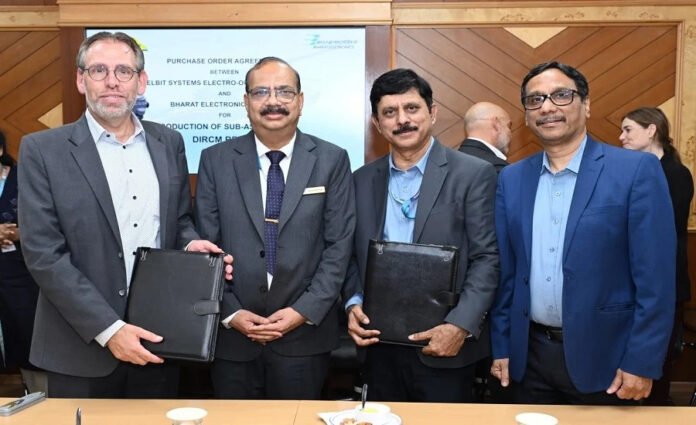
Bharat Electronics Limited (BEL) has signed an export purchase-order agreement with Elbit Systems Electro-Optics ELOP Ltd for the production and supply of sub-assemblies used in Directed Infrared Countermeasure (DIRCM) systems.
The agreement was signed on September 16 in Bengaluru by Rajnish Sharma, Director of BEL’s Bengaluru Complex, and Shai Cohen, Senior Vice President at Elbit Systems. Senior officials from both companies attended the ceremony, including BEL Director of Marketing Anoop Kumar Rai and Bnaya Ziv, Elbit’s Head of DIRCM Systems.

The financial value of the order and the identity of the eventual aircraft operators were not disclosed. However, the agreement represents another step in BEL’s expansion into international defence supply chains, while deepening its long-standing industrial relationship with Elbit Systems.
DIRCM technology is designed to protect aircraft from heat-seeking surface-to-air missiles, particularly shoulder-fired man-portable air-defence systems, or MANPADS. These weapons are widely available and pose a serious threat to military, government and civilian aircraft operating at low altitude.
A typical DIRCM system combines missile-warning sensors, thermal imaging and a directional infrared laser or jammer. When the system detects an incoming missile, it identifies the weapon’s infrared seeker and directs a modulated beam toward it. The interference disrupts the seeker’s tracking process, causing the missile to lose its target or miss the aircraft.
The technology is especially important during takeoff, landing and low-altitude flight, when aircraft can be vulnerable to missiles launched from the ground. Unlike conventional flares, which release heat sources to confuse a missile, DIRCM systems actively detect and engage the threat. They can also provide protection against multiple attacks when integrated with an aircraft’s broader electronic-warfare suite.

Elbit Systems says its DIRCM family uses fibre-laser technology, high-frame-rate thermal cameras and a rapidly moving mirror turret. Its systems are built around an open architecture intended to support installation on various fixed-wing aircraft and helicopters. The company markets several versions, including J-MUSIC, MUSIC, Mini-MUSIC and C-MUSIC.
Elbit’s DIRCM systems have been selected for a range of platforms and operators. The company has identified applications involving Israeli commercial aircraft, Italian Air Force transport and helicopter fleets, and Brazil’s KC-390 aircraft. In December 2024, Elbit also announced contracts worth $175 million to supply electronic-warfare and DIRCM self-protection suites to a NATO European country.

BEL’s role in the latest agreement is focused on sub-assemblies, rather than the manufacture and sale of complete DIRCM systems. That distinction is significant: the Indian company will produce specialised components that will feed into Elbit’s finished systems and international integration programmes.
The deal builds on an established partnership. BEL and Elbit have previously collaborated on electro-optical and infrared payloads, helmet-mounted display systems and other defence electronics. BEL has also held global supply-chain partner status with Elbit’s electro-optics division and earlier received an export order valued at about $33 million for electro-optical infrared payloads.
For BEL, the agreement supports the Indian government’s effort to expand defence exports under the Aatmanirbhar Bharat and Make in India programmes. The Navratna public-sector undertaking manufactures radars, communications equipment, electronic-warfare systems, missile electronics and other strategic products for India’s armed forces and overseas customers.
The agreement also highlights a broader shift in India’s defence industry. Rather than focusing solely on supplying complete platforms to domestic users, Indian manufacturers are increasingly seeking positions as specialised component suppliers within global aerospace and defence programmes.
That approach can generate export revenue, strengthen manufacturing capabilities and expose Indian firms to international quality standards. For Elbit, cooperation with BEL offers access to an established electronics producer and a potential additional manufacturing base for DIRCM-related production.
The immediate contract will not by itself make BEL an independent DIRCM supplier. It does, however, place the company inside a strategically important aircraft-survivability supply chain – one expected to grow as militaries confront the continuing spread of portable infrared-guided missiles and other low-cost threats to airborne operations.






