

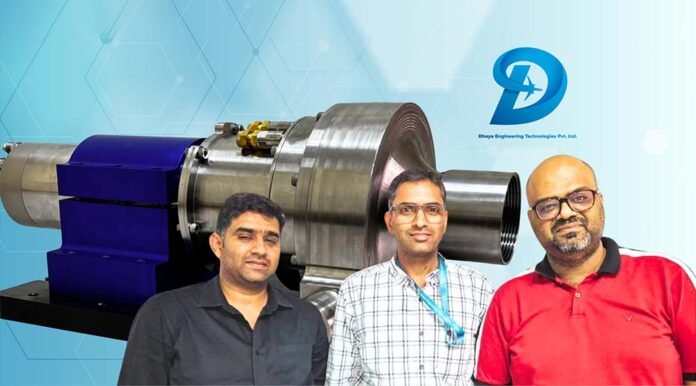
DheyaTech’s pre-Series A round was led by Avaana Capital, with participation from aerospace manufacturing company Unimech Aerospace and Manufacturing. DheyaTech said the capital will support higher manufacturing capacity, a fully integrated engine-testing facility and closer engagement with Indian and international customers.
Founded in 2018 by aerospace engineers Gurushankara K C, Abhinav Alva and Chetan Kumar, DheyaTech is developing a family of small gas turbine engines covering thrust levels from 20 kilogram-force (kgf) to 400 kgf. The engines are intended for advanced aerial platforms, unmanned systems, distributed power generation and emerging energy applications.

The company’s immediate objective is to move from technology development to production readiness. Flight trials are targeted for the fourth quarter of 2026, while DheyaTech said it has already received confirmed orders from Indian and global original equipment manufacturers.
“This funding marks an important step in our journey from technology development to production readiness,” chief executive officer and co-founder Gurushankara K C told media. He added that the company would use the funding to expand manufacturing, strengthen testing and work with customers to move its propulsion systems into real-world applications.
Small gas turbine engines are difficult to design and manufacture because they require expertise across turbomachinery, combustion, high-temperature materials, precision engineering, electronic controls and validation. India has historically depended substantially on imported technology in this segment, making domestic development strategically important for aerospace, defence and energy companies.
DheyaTech is pursuing a full-stack engineering model, managing the product journey from design and development to manufacturing and testing. Its portfolio includes a proprietary adaptive engine control unit, or ECU, which provides in-house control capability for its gas turbine systems.

The startup is also developing fuel-flexible and hydrogen-based technologies. In collaboration with the Indian Institute of Science in Bengaluru, it has developed a hydrogen-based flexi-fuel combustor for a 60-kilowatt flexi-fuel turbogenerator. Its portfolio additionally includes a hydrogen blower that has received ATEX safety certification, a recognised standard for equipment used in potentially explosive environments.
For aerospace deployment, DheyaTech is pursuing independent airworthiness certification under the guidance of the Centre for Military Airworthiness and Certification, or CEMILAC, which operates under the Defence Research and Development Organisation. The company said it is the first Indian private company to pursue such certification independently for its gas turbine engines under the CEMILAC-DRDO framework.

Certification will be central to the company’s ability to supply engines for mission-critical aerial platforms. The process is expected to test the systems’ reliability, safety and performance before they can be used in demanding operational environments.
Unimech Aerospace and Manufacturing is supporting DheyaTech as a strategic manufacturing partner. Its role includes precision manufacturing of turbine components and systems, an area where consistency and tight tolerances are crucial to engine performance.
The funding arrives amid growing investor interest in Indian aerospace and defence deep-tech companies. Other ventures, including Nabhdrishti Aerospace, LAT Aerospace and Paninian, are also developing propulsion or gas-turbine technologies for aviation, unmanned systems and defence applications.
DheyaTech’s next challenge will be execution. Scaling from prototypes to reliable commercial production, completing certification and delivering successful flight trials will require substantial engineering and manufacturing discipline. If those milestones are achieved, the company could help reduce India’s dependence on imported small turbine engines while creating a domestic platform for propulsion, power generation and hydrogen applications.






