


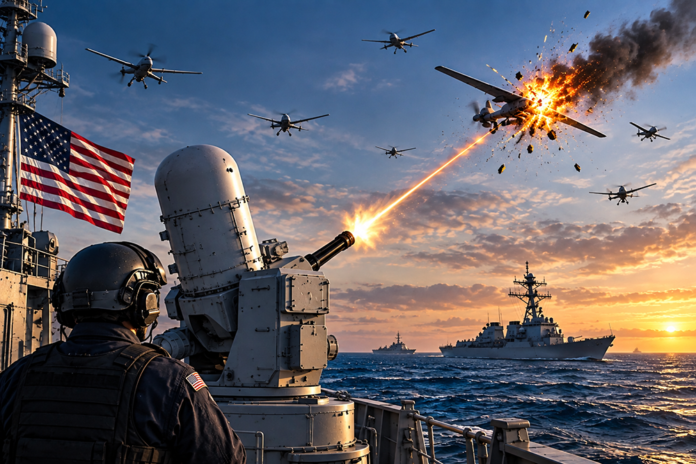
The US Navy has opened a competition for a new low-cost interceptor designed to counter drones, cruise missiles and other mass aerial threats without relying exclusively on expensive, traditional missiles. The service issued a request for white papers on September 16, seeking “mature, affordable” missile-based air-defense systems that could be adapted for maritime operations and produced at scale. The initiative, known as the Naval Affordable Interceptor Prototype, is intended to become the first in a potential family of rapidly developed naval interceptors.
A central requirement is a containerised launcher capable of holding at least 60 interceptors. The launcher should be installable aboard a ship without permanent modification, allowing the Navy to move the system between vessels or deploy it on platforms that were not originally designed to carry the weapon.

The Navy also wants an operational capability within 12 months of contract award. Suppliers must demonstrate a credible production pathway capable of manufacturing at least 500 interceptors annually, along with the associated launchers and support equipment. Companies responding to the request are expected to provide details on system maturity, estimated costs and their plan for reaching the production target.
The search reflects a growing imbalance in naval air defence. In recent years, US warships operating in and around the Red Sea have used sophisticated and costly interceptors against relatively inexpensive one-way attack drones launched by Iran-backed groups. Repeated exchanges of expensive defensive missiles for cheap attacking systems can rapidly deplete a ship’s magazine and impose unsustainable costs.
The Navy’s request specifically identifies low-cost, turbojet-powered unmanned aircraft, cruise-missile-like weapons and other low-altitude threats as a growing challenge. Large salvos could overwhelm existing defences, particularly when ships must reserve premium interceptors for more dangerous missiles or potential high-end conflict scenarios.
The proposed system would supplement, rather than replace, existing naval defences. Selected Arleigh Burke-class destroyers have received counter-unmanned-aircraft systems including RTX’s Coyote and Anduril’s Roadrunner. The Navy is also procuring L3Harris’ VAMPIRE counter-UAS system, while Littoral Combat Ships equipped with Hellfire modules gained a limited ability to engage drones after upgrades in 2024.

The containerised approach is part of a broader Navy effort to place offensive, defensive, sensing and electronic-warfare capabilities on ships through modular packages. Such systems could be installed on lightly armed vessels, open decks or helicopter landing areas, adding protection without requiring extensive redesign or lengthy shipyard work.
The concept also aligns with the Navy’s developing Modular Missile programme, which aims to reduce costs and create weapons adaptable to multiple aerial and surface targets. A related low-cost interceptor effort is being pursued by the Missile Defence Agency for more demanding ballistic and hypersonic threats, although the Naval Affordable Interceptor is focused primarily on the immediate problem of affordable air defence.

Responses to the Navy’s initial request are due September 25 and will be reviewed on a rolling basis. The process will begin with white-paper submissions before moving to full proposals from companies judged capable of meeting the minimum requirements.
No specific interceptor design, manufacturer or unit price has been selected. The success of the programme will depend on whether industry can deliver a weapon that is inexpensive enough for repeated use, reliable enough for naval operations and capable of defeating increasingly fast and numerous drones. The effort nevertheless signals a significant shift in US maritime defence: future fleets may need not only the most advanced missiles, but also large stocks of simpler weapons capable of winning the cost exchange.






