


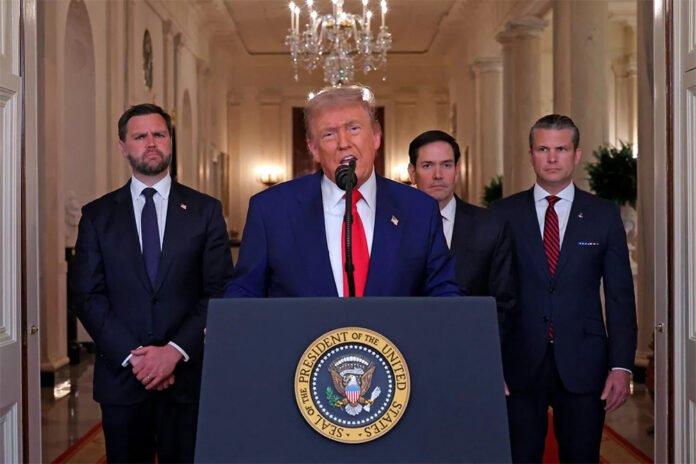
Trump’s latest warnings mark a sharp escalation in language during a conflict already stretching across the Middle East. In an interview with Fox News, he reportedly described himself as being in “deciding mode,” weighing several options: striking Iran, allowing its economy to deteriorate, or negotiating a deal. He also asked when he should “blow the entire nation up,” adding that Iran “better behave.” In separate remarks to Axios, Trump said he faced a major decision over whether to “go in and annihilate” the Iranian regime.
The statements leave deliberate ambiguity around what “annihilate” means. Trump has referred at different times to destroying the government, crippling military capabilities, or imposing overwhelming economic pressure. That uncertainty is itself part of the strategy: Washington wants Tehran to believe that continued resistance could bring an attack far larger than previous exchanges. But the threat also raises the danger of miscalculation, particularly when military forces, missiles, drones and naval assets remain deployed throughout the Gulf.

Iran has answered with a mixture of defiance, deterrence and diplomacy. Its central military command said it had received information that the United States was preparing to resume military action, potentially with support from regional countries. Tehran warned that an American attack would produce sustained strikes against US bases and interests across the region. It further cautioned neighbouring states that assistance to Washington could make them parties to the conflict.
That warning is intended to widen the perceived cost of escalation. American troops and facilities are spread across several Gulf countries, while US naval forces operate near the Strait of Hormuz and in the Gulf of Oman. Iran’s ability to threaten those positions has been central to its retaliation doctrine. Tehran is also signaling that any conflict would not remain confined to Iranian territory: commercial interests, maritime traffic and allied fronts could all become targets.
By holding the vital Strait of Hormuz hostage, Iran has pushed global energy prices past $100 a barrel, turning maritime trade into a high-stakes bargaining chip
The Strait of Hormuz is the immediate bargaining point. Iran’s parliament speaker, Mohammad Bagher Ghalibaf, said the waterway would not reopen until Tehran’s conditions were fulfilled. He argued that Iran must both fight and negotiate, presenting military pressure and diplomacy as complementary rather than contradictory instruments. The strait carries a substantial share of global energy shipments, so its continued disruption has pushed oil prices above $100 a barrel and intensified pressure on Washington, Asian importers and Gulf monarchies.
Iran’s position is not simply that the strait should remain closed indefinitely. Rather, Tehran wants its reopening tied to guarantees and concessions. Iranian officials say Washington must end attacks on Iran, lift its naval blockade, release frozen Iranian assets, stop interfering in Iranian internal affairs and terminate the war across all fronts, including Lebanon. Those demands were reportedly transmitted to the United States through Qatar, which has become a principal intermediary between the two governments.

Mohsen Rezaei, secretary of Iran’s Supreme National Security Council, said Tehran had communicated seven conditions for beginning negotiations and was awaiting Trump’s response. He presented the offer as a pathway out of a crisis created by Washington, not as a request for relief. Rezaei also said Iran continued to respect a religious edict prohibiting nuclear weapons and had not decided to withdraw from the Nuclear Non-Proliferation Treaty, although further pressure could change that calculation.
A potential face-to-face encounter between Trump and Iranian President Pezeshkian at the UN General Assembly could open a direct political lifeline or collapse into an explosive stalemate
The offer for talks therefore contains both an opening and an ultimatum. Iran says it is prepared to negotiate, but not under fire or while the blockade remains in place. Tehran wants recognition of its rights, an end to military operations and a settlement that addresses the wider regional war. It has also denied direct responsibility for every allied operation, including actions involving Yemen’s Houthis, while saying it could help mediate disputes concerning the Bab al-Mandeb Strait.

Qatar and Pakistan are trying to preserve that narrow diplomatic space. Both governments previously helped establish the memorandum of understanding that halted direct US-Iran fighting in June. The agreement created a 60-day negotiating period, but that window expired in August without a final settlement. Since then, each side has accused the other of violating commitments, while mediators have continued relaying messages. The breakdown illustrates the central problem: Washington seeks concessions before easing pressure, whereas Tehran demands pressure be removed before making concessions.
Trump’s own public signals are contradictory. He has threatened regime annihilation while indicating that he may meet Iranian President Masoud Pezeshkian during the United Nations General Assembly in New York. The possible encounter could create a dramatic diplomatic moment, particularly because both leaders are expected to address the international community within days of each other. Washington has approved visas for the Iranian delegation but imposed strict limits on its movement, reflecting the broader relationship’s mixture of formal diplomacy and intense hostility.
Mediators like Qatar and Pakistan are racing to revive negotiations before mutual posturing, miscalculations, or accidental misfires force both sides into an uncontainable war
A meeting would not automatically mean negotiations had succeeded. Trump could use it to demand an immediate reopening of Hormuz, limits on Iran’s nuclear programme and restrictions on missiles or regional allies. Pezeshkian, meanwhile, would likely emphasise sovereignty, the lifting of the blockade and the cessation of attacks. Even a brief conversation could matter, however, because it would establish direct political contact at a moment when messages are travelling through Qatar, Pakistan and other intermediaries.
The danger is that rhetoric may outrun diplomacy. Threats to destroy an entire country can corner Iranian leaders, making compromise appear dangerous at home. Iranian warnings of retaliation can produce the same effect in Washington, where officials may fear that restraint will be interpreted as weakness. Military commanders then prepare for the worst, increasing the possibility that an accident, unauthorised launch or misread manoeuvre could ignite a larger war.
The humanitarian and economic consequences would be severe. A renewed US campaign could damage power plants, bridges, oil infrastructure and military sites, while Iranian retaliation could endanger bases, shipping and cities across the region. Gulf governments hosting American forces would face pressure to support Washington without becoming direct targets. Energy markets would react immediately, and disruption in Hormuz would affect consumers far beyond the Middle East.
The crisis rests on a razor’s edge: outcome depends entirely on whether both leaders are using brinkmanship as leverage to negotiate-or preparing to act on their rhetoric
Diplomacy remains possible because both sides have something to gain from a pause. Trump can claim that coercion forced Iran back to the table. Tehran can present negotiations as recognition of its resilience and bargaining power. Mediators can offer verification mechanisms, phased sanctions relief, controlled maritime access and guarantees against renewed attacks. Such an arrangement would be difficult, but it is more realistic than expecting either side to accept unconditional surrender.
The next decision belongs partly to Trump, but not to him alone. Iran’s conditions give Washington a concrete framework to accept, reject or modify. Tehran’s military warnings make clear that rejection could carry immediate costs. The proposed Trump-Pezeshkian meeting offers a channel, yet the president’s annihilation rhetoric threatens to close it before it opens.
For now, the conflict sits between escalation and negotiation. Iran is insisting that the Strait of Hormuz, its military deterrent and its nuclear rights cannot be separated from any settlement. Trump is trying to preserve maximum leverage by keeping military action on the table. The outcome will depend on whether both leaders treat threats as bargaining tools – or allow them to become instructions for war.

-The writer is a New Delhi-based senior commentator on international and strategic affairs, environmental issues, an interfaith practitioner, and a media consultant. The views expressed are personal and do not necessarily carry the views of Raksha Anirveda





