



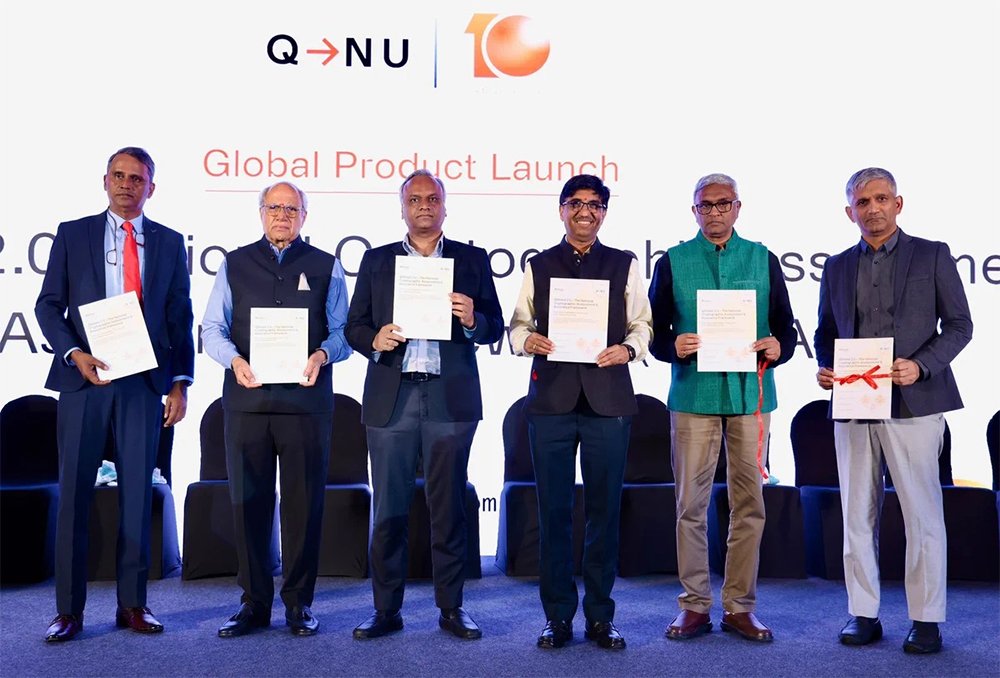
QNu Labs, the Bengaluru-based deep-tech cybersecurity company incubated at IIT Madras Research Park, has launched QShield 2.0 as it marks a decade of work in quantum-safe communications and cryptography. QShield 2.0 was unveiled at a function in Bengaluru, dedicated to celebrate 10 years of QNu’s work in the field of QKD.
The platform is designed to help organisations discover, assess and modernise their cryptographic infrastructure before advances in quantum computing undermine widely used public-key algorithms.

According to QNu Labs, QShield 2.0 will power the National Cryptographic Assessment and Assurance Framework, giving enterprises and government bodies a structured way to evaluate cryptographic risk and plan migration.
The framework is intended to address a growing problem: many organisations do not have a complete inventory of the encryption algorithms, certificates, keys, libraries and protocols operating across their networks. Without that visibility, replacing vulnerable systems becomes difficult, expensive and vulnerable to disruption.
QShield 2.0 combines cryptographic discovery, risk assessment, post-quantum cryptography, quantum key distribution, quantum random-number generation and key management within a single platform. QNu describes the architecture as hybrid and crypto-agile, allowing users to adopt different security technologies as standards and threats evolve.
QShield 2.0 is built around three principal technology layers. Post-quantum cryptography uses mathematical algorithms designed to resist attacks from both conventional and quantum computers. Quantum key distribution uses the properties of quantum physics to detect interception during key exchange. Quantum random-number generators produce unpredictable values for encryption and authentication systems
The company’s approach reflects the changing debate around “harvest now, decrypt later” attacks. Adversaries can collect encrypted data today and retain it until sufficiently powerful quantum computers become available. Information with a long shelf life – including defence records, financial data, health information and strategic communications – could therefore remain exposed even if it is currently protected.

QShield 2.0 is built around three principal technology layers. Post-quantum cryptography uses mathematical algorithms designed to resist attacks from both conventional and quantum computers. Quantum key distribution uses the properties of quantum physics to detect interception during key exchange. Quantum random-number generators produce unpredictable values for encryption and authentication systems.

The platform’s discovery capability is particularly important for large organisations. QNu says its cryptographic bill of materials can map certificates, keys, algorithms, protocols, libraries and dependencies across an enterprise. That inventory can help security teams identify systems that require immediate replacement, those that can be upgraded and those that can continue operating during a staged migration.
QNu’s launch comes as governments and standards bodies accelerate preparation for post-quantum computing. The United States’ National Institute of Standards and Technology has standardised initial post-quantum cryptographic algorithms, while regulators and major industries are developing transition plans. India is also pursuing a national quantum strategy through its National Quantum Mission, which supports research, communications infrastructure and domestic technology development.

The company’s origins date to 2016, when it was incubated at IIT Madras Research Park. Over the period of last 10 years, QNu Labs has developed Armos, a quantum key-distribution system, and Tropos, a quantum random-number generator. Its products have been delivered or tested with Indian defence and government organisations, including the Army, Navy, the Defence Research and Development Organisation and the Weapons and Electronics Systems Engineering Establishment.
For QNu Labs, the platform provides a commercial expression of its decade-long strategy: build Indian intellectual property for a quantum-safe future while supplying tools that can be deployed across government, defence, banking, telecoms and critical infrastructure
In 2022, the company won the iDEX Open Challenge 2.0 and developed a 150-kilometre QKD system with trusted nodes. In 2024, it announced that it has delivered 25 QKD systems to the Indian Navy. The Department of Science and Technology has also identified QNu as a participant in efforts to build an Indian end-to-end quantum-safe heterogeneous network.
The latest launch therefore represents more than a product update. It signals an attempt to move quantum security from laboratory demonstrations and isolated hardware deployments into an enterprise-wide governance and migration process.
QShield 2.0 will still face practical challenges, including compatibility with legacy systems, the cost of replacing cryptographic assets, skills shortages and the need for independent validation. Its broader significance will depend on how effectively organisations can turn cryptographic inventories and risk scores into measurable upgrades.
For QNu Labs, the platform provides a commercial expression of its decade-long strategy: build Indian intellectual property for a quantum-safe future while supplying tools that can be deployed across government, defence, banking, telecoms and critical infrastructure.






