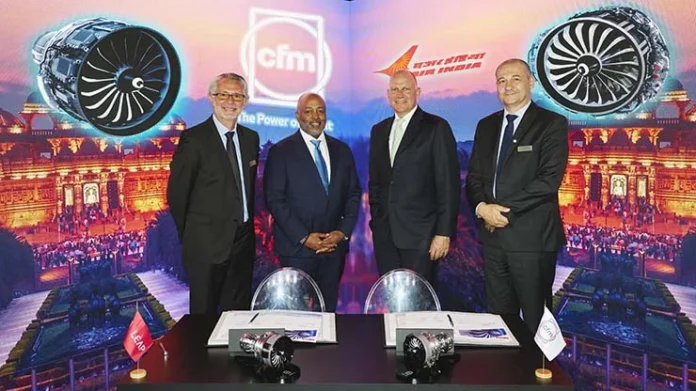
WEST CHESTER Ohio. Air India and CFM International have finalized the order for LEAP engines that will power the airline’s new fleet of 210 Airbus A320neo/A321neos and 190 Boeing 737 MAX family aircraft, which was first announced in February 2023. The companies also signed a multi-year services agreement that will cover the airline’s entire fleet of LEAP engines.
Air India has been a CFM customer since 2002, when the airline began operating Airbus A320ceo aircraft powered by CFM56-5B engines. In 2017, Air India began operating A320neos, becoming the first LEAP-1A powered operator in India. The airline currently has 27 LEAP-1A-powered A320neo family aircraft in its fleet.

“We are delighted to celebrate with CFM a major deal that will play a key role in our future development.” Campbell Wilson, CEO and Managing Director of Air India.
“We are delighted to celebrate with CFM a major deal that will play a key role in our future development,” said Campbell Wilson, CEO and Managing Director of Air India. “The introduction on a greater scale of the LEAP engine as well as our services agreement will help us to optimize our operations in terms of environmental footprint and operational cost, while benefiting our customers.”
“The renewed trust of Air India is a major milestone in CFM history,” said Gaël Méheust, president and CEO of CFM International. “This order strengthens our presence in India and commits us to further support Air India’s development with the best CFM standards in terms of reliability, efficiency and customer support.”
The LEAP engine family has achieved one of the fastest accumulations of flight hours in commercial aviation history, amassing more than 35 million engine flight hours and 15 million flight cycles.

LEAP provides 15 to 20 percent better fuel consumption and lower CO2 emissions, as well as a significant reduction in noise compared to previous generation engines. Since its entry into service in 2016, the LEAP engine has allowed our customers to save more than 25 million tons of CO2 compared to the same flights operated using aircraft powered by previous generation engines.