


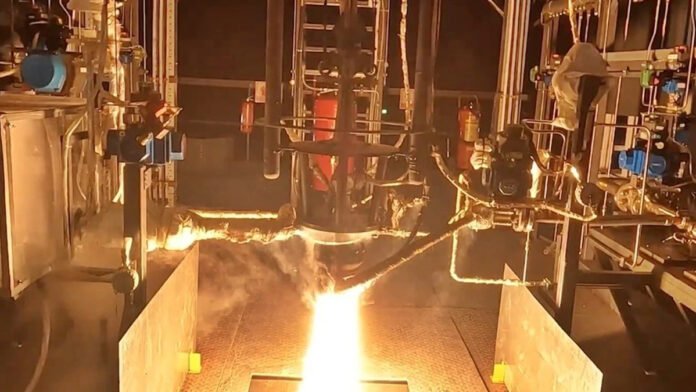
New Delhi: Agnikul Cosmos, the Chennai-based space start-up, has achieved a significant milestone by successfully test-firing two electric pump-fed semi-cryogenic rocket engines simultaneously. These engines, which are entirely 3D-printed using the proprietary Agnilet technology, represent an advanced propulsion design that replaces traditional gas generator or turbo pump systems with electric motors powering the pumps.
This novel approach allows for precise, software-based control of thrust balance between engines, enhancing performance smoothness and reliability in multi-engine configurations. The simultaneous firing test demonstrated the ability to finely adjust thrust across the two engines using in-house developed engine computer software. This control capability is crucial for stabilising the rocket’s performance.

Additionally, the Agnilet technology facilitates manufacturing the engine as a single 3D-printed piece without assembled joints, reducing potential leak points and production turnaround times, which is vital for enabling rapid, on-demand launches of small satellites.
This milestone is a preparatory step for the upcoming launch of Agnikul’s Agnibaan SOrTeD (Suborbital Technological Demonstrator), poised to become India’s first rocket powered fully by 3D-printed engines.
Agnikul operates from India’s pioneering private launchpad and mission control centre at Sriharikota, cementing its position as a leader in India’s burgeoning private space sector and contributing to strengthening India’s capability in small satellite launch technology.
The use of electric pump-fed semi-cryogenic engines echoes pioneering global developments, such as Rocket Lab’s Rutherford engine, but scaling this architecture for larger rockets remains a formidable challenge given the power requirements.

Agnikul’s successful test of a dual-engine cluster under private sector initiative exemplifies a cutting-edge advancement in India’s space propulsion technologies, offering improved thrust control and engine efficiency for future orbital missions. This achievement marks a crucial advancement for Agnikul and the Indian space ecosystem, preparing the path for more frequent, reliable, and technologically sophisticated space launches from India.






