


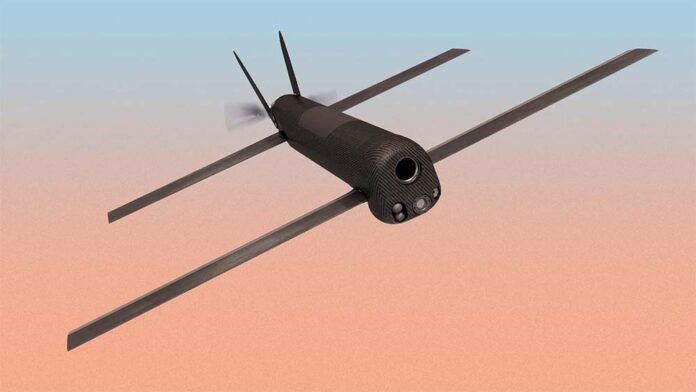
The newly awarded delivery order represents a major procurement expansion for the AeroVironment’s combat-proven suicide drones, securing additional units of the Switchblade 600 Block 2 variant alongside Block 1 systems designated for an unnamed US military ally through a Foreign Military Sale.
Issued under the US Army’s five-year, $990 million Indefinite Delivery, Indefinite Quantity framework established for Lethal Unmanned Systems, the agreement highlights steady demand for versatile loitering munitions tailored to counter heavy armour and fortified positions on modern multi-domain battlefields.

Designed in close collaboration with United States Special Operations Command, the upgraded Switchblade 600 Block 2 incorporates key architectural improvements aimed at operating in highly contested, electronic warfare-heavy environments.
Equipped with advanced avionics, automated target recognition systems and resilient Silvus MANET radios, the platform can maintain dynamic communications, handoff control across extended distances and operate reliably even in GPS-denied combat zones.
Weighing roughly 15 kilogrames, the tube-launched munition bridges the operational space between lightweight reconnaissance drones and heavy artillery. The weapon features an anti-armour warhead capable of destroying main battle tanks and hardened command structures, boasting an operational flight time exceeding 40 minutes and an engagement range beyond 40 kilometres.
The contract extension builds upon extensive operational deployment, with Switchblade 600 systems integrated into more than 20 US Army brigade combat teams while hundreds of personnel undergo specialised training. Defence officials note that expanding domestic manufacturing capacity for the loitering platform ensures infantry and special operations formations maintain long-range, pinpoint fire support while remaining safely beyond direct enemy counter-fire.

The AeroVironment Switchblade 300 and Switchblade 600 are both tube-launched, precision-guided loitering munitions, but they are engineered for fundamentally different tactical profiles, target types and operational footprints.
System Scale and Target Engagement
The primary distinction between the two platforms lies in their size, lethality and intended targets. The Switchblade 300 is a compact system weighing approximately 3.7 pounds, with the complete round and launcher totaling around 7.2 pounds. It carries a lightweight, directional fragmentation warhead designed for precise anti-personnel strikes against exposed enemy infantry, sniper positions, open mortar pits and unarmoured light vehicles, while keeping collateral damage strictly limited.

In contrast, the Switchblade 600 is a significantly larger anti-armour platform. The missile itself weighs around 33 pounds, while the complete system – including its tube launcher and fire control suite – weighs roughly 65 pounds. It incorporates a heavy anti-tank warhead derived from top-attack anti-tank guided missile designs, granting it the kinetic firepower needed to penetrate explosive reactive armour and destroy main battle tanks, heavy fighting vehicles and hardened structures.
Range, Endurance and Logistics
The operational reach of each system reflects its physical scale. The Switchblade 300 provides a flight endurance of over 20 minutes, a maximum dash speed of approximately 100 miles per hour, and an effective operational range of up to 30 kilometres when paired with extended directional antennas. Because of its light weight, a single dismounted infantry soldier can carry the full system inside a standard rucksack and deploy it in under two minutes.
The Switchblade 600 expands this operational envelope substantially, offering over 40 minutes of flight time, dash speeds reaching 115 miles per hour, and an operational range extending up to 90 kilometres via forward pass-off techniques. Because of its 65-pound transport weight, the system is typically operated by multi-person teams or mounted directly on light tactical vehicles, requiring under ten minutes to set up and launch in the field.
Guidance and Electronics
While both platforms feature automated waypoint navigation, touch-tablet controllers and instantaneous strike abort or wave-off capabilities to prevent unwanted casualties, their communication suites differ. The Switchblade 600 utilises advanced sensor gimbals and specialised MANET radios to maintain data links and precise targeting capabilities across extended ranges, non-line-of-sight terrain and environments with heavy GPS jamming or electronic warfare.






