


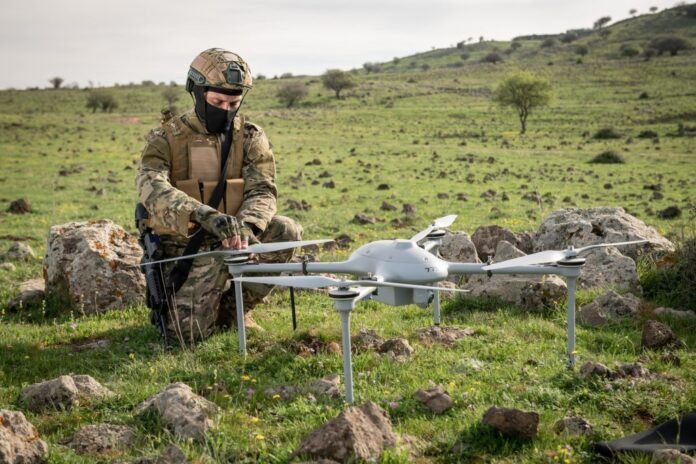
Israeli defence-drone maker Aero Sentinel is preparing to expand production of the SeniX, a backpack-sized tactical surveillance drone, with an investment of several million shekels in manufacturing infrastructure and camera systems. The company says the spending is intended to increase capacity, strengthen its supply chain and reduce production costs. It aims to reach annual capacity of approximately 1,000 units by 2029.
The company, a subsidiary of Tel Aviv-listed Veloryx, is positioning the SeniX as an Israeli-made option in a market where Chinese manufacturers have a substantial presence. The effort comes as governments and security agencies weigh supply-chain dependence and information-security concerns when choosing unmanned aircraft systems. Aero Sentinel says it wants to compete internationally on both capability and price.

The SeniX is designed for tactical surveillance and intelligence gathering. According to the company’s specifications reported by CTech, it can remain airborne for approximately 70 to 80 minutes and communicate across distances of up to 10 kilometres. Its low acoustic signature is intended to make it less noticeable, while day- and night-imaging equipment supports observation in different lighting conditions. The compact design is meant to let personnel carry and deploy the aircraft rapidly in the field.
Aero Sentinel says the drone is already in use by a special Israel Defence Forces unit. It has also served as an intelligence-gathering platform during international exercises conducted by Israeli defence contractor Rafael. In those exercises, CTech reported, the SeniX was integrated with Rafael’s Spike missile family to relay real-time visual information in support of beyond-line-of-sight operations. The companies’ reported use of the system in exercises does not, by itself, establish its performance in every operational setting.
A planned software and navigation upgrade is central to the company’s development roadmap. By 2027, Aero Sentinel intends to add visual-based navigation, which it says would reduce reliance on satellite positioning such as GPS. That capability is designed for environments where satellite signals are jammed or disrupted, an increasingly important consideration for military systems operating amid electronic interference. The company’s website likewise highlights resilient navigation and operation in GPS-denied conditions as priorities across its tactical-drone portfolio.
The manufacturing target is ambitious: reaching a capacity of roughly 1,000 SeniX drones a year by 2029 will require the company to scale beyond its current production level. The planned investment is directed not only at facilities but also at camera procurement, indicating that component availability and supply-chain resilience are part of the expansion challenge. Aero Sentinel has not disclosed the precise current output or a unit price for the drone in the report.

The push comes amid broader growth in demand for unmanned systems used in defence, border monitoring, infrastructure protection and intelligence missions. Competition is intense, particularly in compact tactical aircraft, where buyers consider price, ease of deployment, endurance, communications and the ability to operate when navigation signals are degraded. Aero Sentinel’s pitch combines portability with extended flight time and a lower acoustic profile, while its planned navigation upgrade aims to address contested operating conditions.
For Veloryx, the programme also fits a broader homeland-security strategy. The Jerusalem Post reported in March that Veloryx was negotiating to acquire a controlling stake in Israeli drone manufacturer Aero Sol, as it sought to build a portfolio spanning unmanned systems, sensors, detection tools and command-and-control technologies. The report described the proposed acquisition as part of an effort to serve defence and civilian security markets; it did not establish the status of the transaction as of November.

Whether Aero Sentinel can turn its production goal into sustained deliveries will depend on scaling manufacturing, securing components and winning customers against established suppliers. The planned 2027 navigation upgrade and 2029 capacity target set clear milestones for a company seeking a larger role in a competitive global drone market.







