


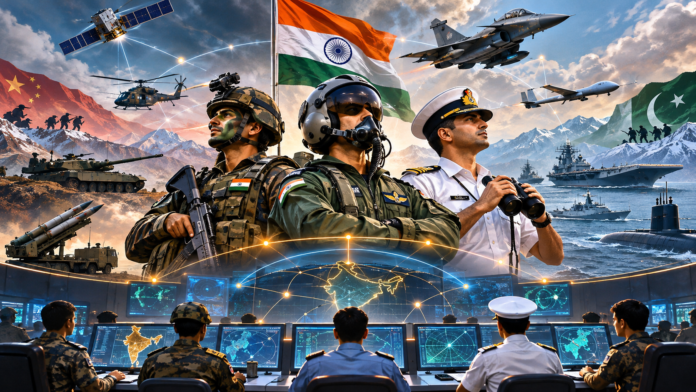
“Jointness is no longer merely an organisational reform; it is India’s strategic imperative for the future”.
India stands at a consequential juncture in its national security evolution. Its geography, continental boundaries, maritime responsibilities and geopolitical environment expose it to an increasingly complex spectrum of challenges. The possibility of simultaneous military pressure from China along the northern and eastern borders and from Pakistan along the Western Front cannot be treated as an isolated contingency.

It must be seen against regional instability, strategic partnerships, technological competition and the changing character of war itself. The central challenge is not merely to fight on several fronts but to generate integrated combat power without letting adversaries exploit geographical, technological or institutional vulnerabilities. That is the problem this series sets out to examine.
A simultaneous crisis with China and Pakistan can no longer be treated as an isolated contingency. India’s military is not built for it
The traditional picture of warfare, with clearly defined battlefronts and conventional engagements, is dissolving. Contemporary conflicts show that belligerence can begin long before conventional forces cross a border. Cyber intrusions, satellite disruption, electronic interference, information manipulation, economic pressure, proxy operations and attacks on critical infrastructure can precede or accompany military action.
A conflict may simultaneously span high-altitude mountains, deserts, coastlines, maritime approaches, airspace, cyberspace and outer space. The distinction between frontline and hinterland is blurring, and civilian infrastructure, communication networks, financial systems, energy installations and logistics corridors may become strategically significant during hostilities.
For India, this demands a fundamental reassessment of preparedness. It is no longer enough to maintain strong individual services if their capabilities cannot be synchronised in a major conflict. The Army, Navy and Air Force must operate as complementary parts of one warfighting architecture, backed by intelligence agencies, technology institutions, defence industry and national infrastructure.

The answer to multi-front pressure, is an “All of a Nation” approach that generates combat power across several theatres at once
The central requirement is an “All of a Nation” approach: the capacity to generate combat power across several theatres at once while retaining the flexibility to shift resources as priorities change. The joint warfighting must evolve from inter-service coordination into a comprehensive national capability, built on integrated theatre commands, common planning, intelligence fusion, network-centric operations and unified logistics.
The Strategic Geometry
India’s security environment is shaped by two nuclear-armed continental neighbours whose interests and capabilities complicate any operational plan. China is a long-term strategic challenge, through its military modernisation, infrastructure building, technological advance and expanding regional influence.

It fields advanced missiles, integrated air defence, space-based surveillance, cyber warfare capabilities and an increasingly sophisticated navy. The PLA has also stressed joint operations, information dominance, precision strike and integrated command, reflecting an understanding that future wars will be decided less by numerical strength than by the speed and quality of information-driven decisions.
Army, Navy and Air Force each bring their strongest capabilities, but fight best under one framework, leading to a joint operational philosophy
Pakistan remains a persistent challenge through its conventional forces, its nuclear posture, cross-border terrorism and the potential use of asymmetric and proxy instruments. Its strategic relationship with China adds a further dimension to India’s calculations.
The most serious contingency is coordinated pressure on the northern and western fronts. Even without a formally coordinated campaign, simultaneous crises could force India to divide its attention, resources and political decision-making. Instability in the Indian Ocean Region, across the Arabian Sea, the Bay of Bengal and the approaches to critical sea lanes, would add to the Navy’s burden. India must therefore prepare for several overlapping contingencies:
- a prolonged land confrontation along the northern borders
- a simultaneous crisis on the Western Front
- maritime pressure in the Arabian Sea and the Bay of Bengal
- cyber and electronic warfare against military and civilian infrastructure
- disruption of space-based surveillance and communications
- missile and drone attacks on strategically important installations
- proxy warfare, terrorism and information operations
- economic and logistical pressure on the nation’s capacity to sustain a war
Who commands what? Theatre commanders and service headquarters should divide authority without adding bureaucratic layers
The significance of these contingencies lies in their cumulative effect. An adversary may try to create many problems at once, forcing India to scatter its forces and its decision-makers’ attention. The answer is an integrated military response that can escalate, de-escalate or redirect operations according to national objectives.
From Three Services to One Force
The Army, Navy and Air Force have distinct operational cultures, equipment, doctrines and command structures, which are natural consequences of their different responsibilities. In a multi-front conflict, however, each must contribute its strongest capabilities to common objectives within a shared strategic and operational framework.
The Army holds territory, conducts manoeuvres and secures critical objectives. The Air Force provides air superiority, air defence, strategic mobility and precision strike. The Navy protects maritime interests, secures sea lines of communication and contributes to deterrence across the Indian Ocean. Their effect multiplies when they share intelligence, planning and situational awareness. What is needed is a joint operational philosophy that determines how forces are employed across theatres, rather than merely how each service performs its assigned tasks.
The Case for Theatre Commands
Integrated theatre commands are the institutional vehicle for this change. Separate service commands cannot always supply the speed and unity of command that complex simultaneous operations demand. Theatres should be shaped by India’s geography and strategic needs, covering the northern and eastern land borders, western security requirements and maritime responsibilities, rather than by an arbitrary division of existing service commands.
More broadly, it calls for a clear division of labour. A theatre commander should have the authority and resources to achieve assigned objectives, while service headquarters retain responsibility for raising forces, training, equipment development and professional standards.
Six principles, from unity of command to clear accountability, should guide India’s theatre commands. Thus, a phased rollout beats abrupt restructuring
The Chief of Defence Staff and the Department of Military Affairs should ensure strategic coherence, joint capability development and inter-service integration. The structure must not add bureaucratic layers or dilute service expertise. The goal is a military that thinks, plans, trains and fights jointly. Six principles should guide the process:
- Unity of command: each theatre has one commander with defined authority and responsibility.
- Joint operational planning: the three services plan together before a crisis, not after it.
- A common operational picture: commanders have real-time intelligence, surveillance and reconnaissance.
- Integrated logistics: equipment, ammunition, maintenance, medical support and transport are coordinated across services.
- Operational flexibility: forces can be reassigned between theatres as the situation evolves.
- Clear accountability: command relationships, responsibilities and resource procedures are settled before implementation.
A phased approach, with pilot arrangements, joint exercises and assessments, is preferable to abrupt restructuring. However, there are services’ concerns, particularly over air assets, maritime capabilities, autonomy and scarce resources. The Air Force, with limited combat aircraft, needs centralised flexibility, since air power cannot be divided mechanically into geographical compartments without sacrificing concentration and rapid redeployment.
Naval operations likewise need a maritime-command philosophy that recognises the distinct demands of sea control, sea denial, submarine operations and carrier aviation. Theatre integration must therefore combine unity of command with the freedom to concentrate specialised capabilities wherever national interests require.
Next, in Part Two: What these Commands must fight with, and in which domains.

Lt Gen S K Gadeock is a distinguished military leader, global strategist, and scholar who served as the Commandant of the Defence Services Staff College. A decorated veteran and former Logistics Advisor to the Botswana Defence Force, he has held numerous high-ranking appointments including Director General of the Amity Institute of Defence & Strategic Studies. Serving on the Advisory Board of Raksha Anirveda, he is a prolific writer and motivational speaker.






