


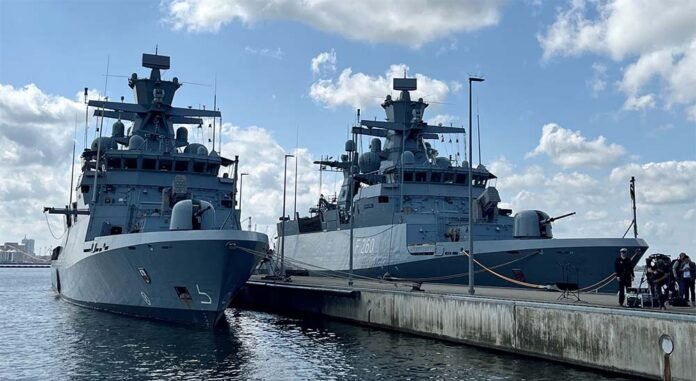
Rostock (Germany): The US and NATO allies will launch scaled-back drills in the Baltic Sea this week, as conflicts in other regions draw ships away, though the exercise will still send a message of unity and strength to Russia, a senior German military official said.
The annual exercise, held for more than five decades since 1971, brings together some 20 vessels from 15 nations with around 6,000 personnel – roughly half the size of last year’s drills – during a period of heightened tensions in the Baltic region. Officials say the smaller footprint reflects operational realities rather than waning commitment, as Western navies remain tied up in other areas including the Middle East’s Strait of Hormuz and the Arctic.

The US BALTOPS naval exercise, which takes place from June 4 to June 20, will still be the biggest manoeuvre in the Baltic Sea this year, with Washington providing the flagship Mount Whitney vessel, despite months of fierce criticism of NATO by US President Donald Trump and plans to cut US commitments to the alliance.
While the US-led exercise is not designed as a direct response to current events, German Rear Admiral Stephan Haisch said the timing inevitably amplifies its political relevance.
“In this period, it is a sign of the alliance’s strength, that a major exercise is being conducted, under US leadership, with broad NATO participation”, he said. “It is a sign of the alliance’s unity and strength, and I am speaking of all allies here.”
As Commander Task Force Baltic, Haisch is in charge of a multinational naval headquarters for the Baltic Sea, established by Germany in the coastal city of Rostock in 2024 amid a growing focus on the area as tensions with Russia grew. His headquarters is capable of leading NATO operations in the Baltic Sea during a conflict with Russia and will do so for the upcoming US BALTOPS drills which are traditionally planned by the US.

BALTOPS will begin with drills in the western Baltic before shifting eastward to rehearse resupply and protection of free sea routes around the Swedish island of Gotland – a core task for NATO as the region’s strategic importance has grown.
Open sea routes are seen as critical, particularly for supplying the Baltic states – linked only by a narrow land corridor to NATO’s mainland – in a crisis. “Free sea lines of communication – that is central,” Haisch said, pointing to the need to safeguard military logistics as well as commercial shipping.

Asked about past incidents in the Baltics attributed to Russia by Western officials, Haisch said he did not expect Moscow to cross a threshold that would trigger NATO’s collective defence clause, known as Article 5, even as tensions remain elevated. “I would assume Russia to stay below the Article 5 threshold if they seek to test us.”






