

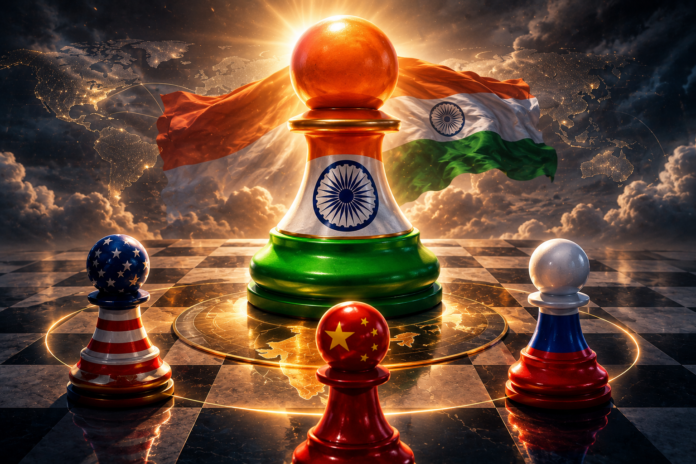
The defining geopolitical contest of the twenty-first century is no longer a binary rivalry between the United States and China. It has evolved into a far more intricate strategic triangle in which an increasingly assertive China, a resilient Russia and a still pre-eminent United States are reshaping the global balance of power. Their contest extends well beyond military capability and economic influence.
It now encompasses technology, artificial intelligence, semiconductors, quantum computing, space, cyber power, critical minerals, energy corridors, maritime dominance, financial systems and the race to shape global norms. Every instrument of national power has become an instrument of strategic competition.

The Great Power Triangle
This is not a return to the Cold War. The ideological certainties and rigid alliance structures that characterised the twentieth century have given way to a world defined by strategic ambiguity, transactional partnerships and selective cooperation. Nations increasingly compete in one domain while collaborating in another.
Economic interdependence coexists with strategic distrust. The international system is therefore neither bipolar nor conventionally multipolar. It is a fluid order in which influence is continuously negotiated and national interest has become the principal organising principle of statecraft.
The United States remains the world’s foremost military, technological and financial power. Its global alliance network, innovation ecosystem, reserve currency and unmatched force projection continue to provide structural advantages that no competitor can presently replicate.
The global balance of power is driven by a fluid triad: a structurally advantaged but coalition-focused United States, an ambitious but economically constrained China, and a resilient, disruptive Russia. None can establish total global dominance, creating a tense yet enduring decade-long equilibrium
Yet, Washington increasingly recognises that preserving its leadership will depend less on unilateral dominance than on strengthening coalitions capable of sustaining a favourable balance of power. The strategic priority has therefore shifted from managing regional crises to competing with systemic rivals.

China represents the principal long-term challenger, while Russia continues to demand sustained attention because of its military capabilities, nuclear arsenal and capacity to disrupt the Euro-Atlantic security architecture.
China has emerged as the most consequential challenger to the post-Second World War international order. Through sustained military modernisation, industrial expansion and technological ambition, Beijing seeks not merely regional primacy in Asia but greater influence over global institutions, supply chains and standards of governance.

Yet, China’s trajectory is no longer free of structural constraints. Economic growth has moderated, demographic decline has begun to reshape its labour force, debt burdens continue to mount, and investor confidence has weakened. But these challenges are unlikely to diminish Chinese strategic ambition.
If anything, they may reinforce the leadership’s determination to demonstrate national strength externally while consolidating political authority internally. The Taiwan Strait and the wider Indo-Pacific consequently remain the principal theatres where miscalculation could have global consequences.
Russia occupies a unique position within this strategic triangle. More than four years after the outbreak of the Ukraine war, Moscow has demonstrated an ability to absorb economic sanctions, sustain military operations and reorient significant elements of its economy towards Eurasian and Global South markets.
The conflict has undoubtedly increased Russia’s dependence upon China, but it has not reduced Moscow to a subordinate power. Its vast energy reserves, Arctic geography, strategic nuclear forces and enduring diplomatic reach ensure that Russia remains an indispensable actor in global geopolitics.
It retains sufficient capacity to influence crises across Europe, West Asia, Africa and the Indo-Pacific, compelling every major power to account for Russian interests in their broader strategic calculations.
Geopolitical supremacy has shifted from conventional military size to technological sovereignty. The race to dominate artificial intelligence, quantum computing, advanced semiconductors, and critical mineral supply chains has effectively merged economic policy with national security imperatives
The interaction among these three powers has created an unstable but enduring equilibrium. The United States seeks to prevent the emergence of a hostile Eurasian coalition while simultaneously reinforcing deterrence in both Europe and the Indo-Pacific.
China attempts to exploit American strategic overstretch without inviting a direct military confrontation. Russia seeks to weaken Western cohesion while preserving strategic autonomy despite growing economic asymmetry with Beijing.
None possesses sufficient power to establish uncontested global dominance, yet each retains enough capability to deny such dominance to the others. This competitive equilibrium is likely to define international politics throughout the coming decade.
Technology as the New Battlefield
Technology has become the decisive arena of geopolitical competition. Artificial intelligence, quantum technologies, advanced semiconductors, biotechnology, autonomous systems and space capabilities increasingly determine national power as much as conventional military strength.
The contest over advanced manufacturing, digital infrastructure, critical minerals and trusted supply chains resembles a new industrial revolution unfolding under strategic rather than purely commercial imperatives. Technological sovereignty has become inseparable from national security.
Equally significant is the transformation of the global economy. The era of unrestricted globalisation is steadily giving way to selective interdependence. Supply chains are being diversified, investment increasingly reflects geopolitical considerations, and economic resilience has become a central pillar of national strategy.
States are no longer seeking maximum efficiency alone. They are seeking strategic reliability. Economic policy and security policy have effectively merged.
No longer a peripheral observer, New Delhi has converted its unique position – partnering with Russia, expanding tech defence with the US, and checking Chinese expansion – into immense diplomatic leverage, transforming traditional non-alignment into a proactive policy of national interest-driven multi-alignment
For India, this evolving strategic triangle presents an opportunity unmatched in its post-independence history. Unlike in previous decades, New Delhi is no longer reacting to great-power politics from the margins.
It has become one of the pivotal states whose choices influence the wider strategic equilibrium. Washington increasingly regards India as an indispensable partner in preserving a stable Indo-Pacific and building resilient technological and industrial ecosystems.
Moscow continues to view India as a trusted strategic partner capable of preserving balance within an increasingly fragmented international system.
Beijing recognises that India’s demographic strength, economic momentum, maritime location and expanding military capabilities represent the principal long-term constraint on Chinese predominance across Asia.
This convergence of external interests significantly enhances India’s diplomatic leverage. Yet, strategic opportunity can easily dissipate without strategic clarity. Strategic autonomy must therefore evolve beyond its traditional interpretation of maintaining distance from competing blocs.
In contemporary geopolitics, it should signify the capacity to engage every major power while preserving complete independence of judgment and freedom of action.
India’s Pivot to Multi-Alignment
India’s balanced position on Ukraine, sustained strategic partnership with Russia, expanding defence and technology cooperation with the United States and active participation in the Quad, BRICS, the SCO and the G20 collectively demonstrate the maturation of this approach.
Rather than reflecting contradiction, these engagements represent the practical expression of multi-alignment, firmly anchored in the national interest.
India’s foreign policy should now move beyond balancing relationships towards shaping the regional and global strategic environment. The first imperative is to preserve strategic autonomy while deepening issue-based partnerships with all major powers without allowing any single relationship to become disproportionately dominant.
To solidify its status as a principal architect of the global order, India must execute five key strategies: maintain strategic autonomy, lead the Global South, secure the Indo-Pacific theatre, institutionalise deep tech diplomacy, and accelerate domestic economic and defence industrial growth
Second, India must accelerate leadership within the Global South by positioning itself as the principal bridge between advanced economies and developing nations on questions of technology, climate finance, resilient supply chains, food security and development financing.
Third, New Delhi should consolidate the Indo-Pacific as its primary geopolitical theatre by strengthening maritime partnerships with like-minded countries while simultaneously expanding its continental engagement across West Asia, Central Asia and Europe through connectivity, energy and digital cooperation.
Fourth, India must institutionalise technology diplomacy by forging trusted partnerships in artificial intelligence, semiconductors, quantum technologies, cyber security and critical minerals, recognising that technological leadership will increasingly define geopolitical influence.
Finally, sustained economic growth must remain the centrepiece of foreign policy. A nation that aspires to shape the international order must first possess the economic weight, technological capacity and defence industrial base necessary to convert diplomatic influence into enduring strategic power.
Diplomacy alone, however, cannot sustain India’s strategic relevance. The coming decade will reward nations capable of integrating economic growth, technological innovation, military capability and institutional resilience into comprehensive national power.
The Reality of Comprehensive Power
Recent conflicts, from Ukraine to West Asia and India’s own experience during Operation Sindoor, have reaffirmed an enduring principle of statecraft. Credible diplomacy ultimately rests upon credible military capability.
They have also demonstrated that future conflicts will increasingly integrate autonomous systems, precision-strike weapons, cyber operations, artificial intelligence, and space-based assets at every stage of military planning and execution.
India must therefore accelerate the transformation of its armed forces while simultaneously strengthening indigenous defence production, technological innovation and national resilience.
Credible diplomacy ultimately rests on credible, modernised military capability. To convert diplomatic influence into enduring strategic power, India must swiftly integrate autonomous systems, cyber, and AI into its armed forces while remaining focused on sustained internal economic expansion
The strategic triangle of the United States, China and Russia will continue to shape international politics for the foreseeable future. Still, its outcome will not be determined solely in Washington, Beijing or Moscow.
Increasingly, it will be influenced by pivotal powers capable of stabilising the broader international equilibrium. India has entered that category.
It is no longer a peripheral observer of great power rivalry, nor merely a balancing state responding to external pressures. It is steadily emerging as one of the principal architects of the evolving international order.
History rarely offers nations the opportunity to transform themselves while simultaneously helping shape a changing world. India stands at precisely such an inflexion point. Its challenge is not to choose between competing poles of power but to strengthen its own.
The true measure of India’s success will not lie in the alliances it joins or the rivalries it avoids. It will lie in its ability to convert sustained economic growth, technological leadership, military credibility and diplomatic agility into enduring strategic influence.
In an era defined by the interaction of the United States, China and Russia, India’s greatest strategic advantage lies in ensuring that it is no longer merely a participant in history, but one of its principal authors.

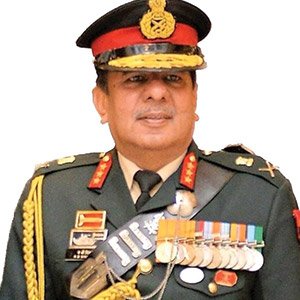
The writer, a PVSM, AVSM, VSM has had an illustrious career spanning nearly four decades. A distinguished Armoured Corps officer, he has served in various prestigious staff and command appointments including Commander Independent Armoured Brigade, ADG PP, GOC Armoured Division and GOC Strike 1. The officer retired as DG Mechanised Forces in December 2017 during which he was the architect to initiate process for reintroduction of Light Tank and Chairman on the study on C5ISR for Indian Army. Subsequently he was Consultant MoD/OFB from 2018 to 2020. He is also a reputed defence analyst, a motivational speaker and prolific writer on matters of military, defence technology and national security. The views expressed are personal and do not necessarily carry the views of Raksha Anirveda





