


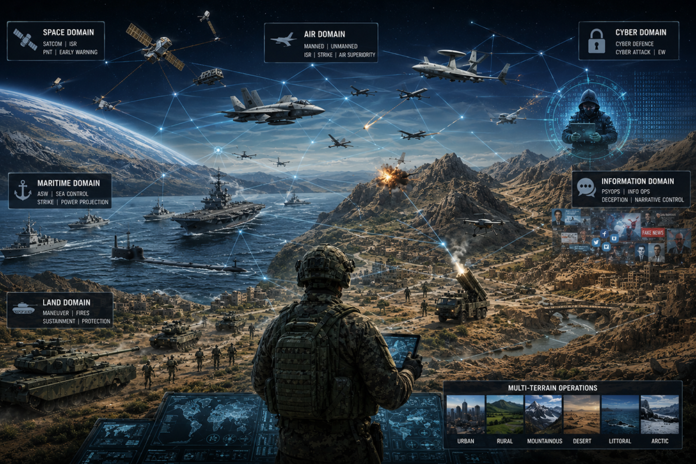
The character of warfare is undergoing one of its most profound transformations since the Industrial Revolution. Emerging technologies, geopolitical competition, artificial intelligence, autonomous systems, cyber warfare, and space-based capabilities are reshaping the future battlespace, introducing unprecedented levels of complexity, deception, and strategic surprise. Yet, despite these rapid technological advances, geography continues to remain a decisive factor in military operations. Future wars will no longer be fought within a single operational environment; instead, they will unfold simultaneously across diverse and interconnected domains, including mountains, deserts, jungles, urban centres, maritime spaces, cyberspace, and the electromagnetic spectrum. Success in such conflicts will depend not only on technological superiority but also on the ability to operate seamlessly across multiple terrains and domains while adapting to their unique operational challenges.
The ongoing conflicts in Eastern Europe, the Middle East, and the Indo-Pacific have demonstrated that military success increasingly depends on the ability to integrate and synchronise capabilities across multiple domains while operating effectively in challenging geographical environments. Future warfare will therefore be defined not merely by superior land, maritime, air, and space-based firepower, but by the capacity to achieve decision dominance across complex terrain, information, and cognitive environments. For India, this reality carries profound strategic significance.

The nation faces a diverse spectrum of operational challenges, ranging from the high-altitude Himalayan frontiers and the deserts of Rajasthan to the dense forests of the North-East, extensive coastlines, island territories, and rapidly expanding urban centres. Future conflicts may require the simultaneous conduct of high-intensity military operations across multiple theatres, supported by calibrated escalation-control mechanisms, while also countering cyber-attacks, information warfare campaigns, and space-based threats. Consequently, a comprehensive understanding of the dynamics of warfare across diverse terrains and interconnected domains is essential for strengthening India’s military preparedness and safeguarding its national security interests.
Emerging Multi-Domain Battlespace
The traditional battlefield has evolved into a multidimensional operational environment where actions in one domain can generate cascading effects across others. Contemporary military doctrines increasingly emphasise Multi-Domain Operations (MDO), integrating land, air, maritime, cyber, space, and electromagnetic capabilities into a unified operational framework designed to offset an adversary’s cumulative attritional advantages. Modern warfare seeks to create and exploit operational advantages through synchronised action across all domains rather than relying on a single-service approach. This concept has gained prominence among major military powers and is increasingly shaping military reforms worldwide.
Future conflicts are likely to involve simultaneous engagements across both physical and virtual environments. A military commander operating in mountainous terrain may employ satellites for intelligence gathering, autonomous drones for surveillance, cyber operations to disrupt enemy communications, sabotage of underwater Wi-Fi and optical fibre cables (OFCs), and precision-guided munitions (PGMs) to neutralise adversary positions. The convergence of these capabilities transforms terrain from a purely physical challenge into a multidimensional operational problem.
Recent statements by India’s military leadership reflect a similar understanding of the evolving character of warfare, wherein conventional military plans must be executed in tandem with diplomatic initiatives through a collaborative and synergised approach to achieve time-bound objectives. The former Chief of Defence Staff highlighted the emergence of “hybrid warriors” capable of operating across conventional, technological, cyber, and information domains. Similarly, the Chief of Army Staff has emphasised that future conflicts will extend well beyond traditional battlefields into the cyber, space, and cognitive domains.

Mountains: Enduring Northern and North-Eastern Strategic Frontiers
Mountain warfare will remain a defining feature of India’s security environment. The Himalayan frontier continues to present persistent challenges related to mobility, logistics, surveillance, and force sustainment. However, future mountain warfare is expected to become increasingly technology-driven. Unmanned aerial systems (UAS), artificial intelligence-enabled surveillance, satellite imagery, and autonomous logistics platforms are likely to transform high-altitude operations.
Small drones capable of operating in rarefied environments can provide real-time intelligence and reconnaissance, while autonomous ground systems may reduce the logistical burden of sustaining forces in remote areas. Artificial intelligence is also expected to enhance battlefield decision-making by analysing terrain, weather patterns, troop movements, and logistical requirements in real time. Such capabilities could significantly improve operational responsiveness, enhance situational awareness, and compress decision-making timelines during crises.

Jungle Warfare and Information Dominance
Dense forests and jungle environments remain among the most challenging terrains for conducting swift and coordinated military operations. Limited visibility, communication constraints, and complex navigation continue to favour defenders and irregular forces. Future jungle warfare will increasingly rely on autonomous surveillance systems, sensor networks, AI-enabled terrain mapping, and precision-strike capabilities.
The force capable of integrating capabilities across land, air, maritime, cyber, space, and electromagnetic domains into a coherent operational framework will possess a decisive advantage in the battlespace of tomorrow
Advances in machine learning may enable real-time analysis of movement patterns within dense vegetation, helping forces detect hostile activity that would otherwise remain concealed. Information superiority will be a critical determinant of success in jungle operations. The force capable of integrating data from sensors, drones, satellite imagery, and human intelligence into a coherent and transparent operational picture will possess a significant advantage over adversaries relying primarily on traditional methods.
Desert Warfare and Autonomous Operations
The deserts of western India present both unique opportunities and significant challenges. Their open terrain facilitates the rapid manoeuvre of mechanised forces and long-range engagements, but also exposes military formations to detection, surveillance, and precision-guided strikes. Future desert warfare is expected to witness the extensive employment of autonomous systems, including unmanned combat vehicles, drone swarms, and robotic logistics platforms. Precision-guided weapons, long-range artillery systems, and hypersonic capabilities are likely to dominate engagements across vast distances.
The emerging concept of ‘Bhairav’ units should be integrated with frontline formations at the earliest to enhance combat effectiveness, generate tactical surprise, and facilitate battlefield deception. Their deployment could significantly strengthen offensive capabilities, disrupt adversary decision-making cycles, and create psychological as well as operational advantages during high-intensity combat operations.
The increasing integration of artificial intelligence into targeting systems could significantly accelerate engagement cycles. Future commanders may possess the capability to visualise, identify, prioritise, and engage targets within minutes rather than hours. Consequently, survivability will increasingly depend on mobility, dispersion, deception, concealment, and the effective employment of advanced electronic warfare capabilities across the electromagnetic spectrum.
Urban Warfare: The Most Complex Battlespace
Urban environments are rapidly emerging as the most challenging operational terrain of the twenty-first century. Their dense infrastructure, extensive civilian presence, and complex physical layout make them ideal settings for close-quarter combat, sniper operations, mine warfare, and the concentrated application of diverse firepower. As global urbanisation accelerates, future conflicts are increasingly likely to unfold within densely populated cities characterised by sophisticated infrastructure, subterranean networks, and interconnected digital systems.
Future urban warfare will involve the integration of smart robotics, autonomous surveillance systems, cyber operations, and information warfare. Military forces may encounter battlefields embedded within smart-city ecosystems, requiring simultaneous operations against both physical and digital targets.
The proliferation of underground facilities, tunnels—as witnessed in Gaza during operations against the Israel Defence Forces—and interconnected infrastructure networks will further complicate military manoeuvre and operational planning. As the Chief of Defence Staff has observed, future warfare is likely to involve specialised operations in subterranean environments. Equally significant will be the battle for narratives. Information operations, influence campaigns, and psychological warfare are likely to become as important as the control of physical territory. Success in urban warfare will depend not only on military effectiveness but also on maintaining legitimacy, shaping perceptions, and controlling the information environment.
Maritime and Littoral Warfare (Indian Ocean Region)
The maritime domain is becoming increasingly contested, particularly within the Indo-Pacific region. Future naval operations will focus on sea denial, anti-access and area-denial (A2/AD) strategies, maritime surveillance, and the protection of critical sea lines of communication (SLOCs). Autonomous underwater vehicles, unmanned surface vessels, long-range anti-ship missiles, and space-based maritime surveillance systems are expected to play a central role in future maritime operations. The integration of artificial intelligence with naval command-and-control systems will further enhance maritime situational awareness, decision-making, and operational responsiveness.
India’s security challenges span the Himalayan frontiers, the deserts of Rajasthan, the forests of the North-East, vast maritime spaces, and rapidly expanding urban centres. Preparing for multi-terrain and multi-domain warfare is a strategic imperative
For India, the Indian Ocean Region (IOR) remains strategically vital. Control of maritime chokepoints, island territories, and critical shipping routes will continue to shape regional security dynamics. Recent tensions in the Gulf region have once again underscored the strategic significance of the Strait of Hormuz, highlighting its economic and military importance for global trade, energy security, and regional stability.
The Andaman and Nicobar archipelago is likely to assume even greater importance as a forward-operating base and strategic military outpost capable of supporting joint and multi-domain operations, monitoring vital sea lanes, and safeguarding critical lines of communication during periods of conflict. Similarly, the Lakshadweep Islands are expected to acquire enhanced strategic relevance in India’s future maritime posture across the western Indian Ocean.
Recent successes under the Aatmanirbhar Bharat initiative, including the induction of platforms such as INS Dunagiri and advanced indigenous weapon systems such as the Air-to-Ground Anti-Radiation Missile (ARM), represent significant force multipliers. These capabilities will enhance the operational reach, lethality, and deterrent potential of the Indian Navy, strengthening its ability to secure national interests across the maritime domain.
High-End Technology Spectrum: The Decisive Enabler
The future battlefield will increasingly be shaped by a succession of emerging and disruptive technologies. Artificial intelligence, autonomous systems, quantum computing, advanced communication networks, cyber capabilities, and space technologies are rapidly transforming the conduct of military operations. Contemporary military thought recognises that while the nature of war remains constant, its character evolves through technological innovation. Consequently, the effective integration of emerging technologies will be essential for achieving military superiority in future conflicts.
Artificial intelligence is expected to revolutionise intelligence processing, target acquisition, logistics management, predictive maintenance, and battlefield decision-making. Autonomous systems may undertake high-risk missions, including reconnaissance, explosive ordnance disposal, logistics support, and precision strikes. Meanwhile, cyber warfare and electronic warfare will become integral components of military campaigns. Future adversaries are likely to target command-and-control networks, communication systems, satellites, logistics chains, and critical national infrastructure. As military operations become increasingly network-centric, resilience against cyber and electronic disruption will emerge as a strategic imperative.
Artificial intelligence, autonomous systems, quantum technologies, cyber capabilities, and advanced communication networks are rapidly transforming military operations. Technological superiority will increasingly determine battlefield outcomes in future conflicts
Implications: India’s Military Transformation
India’s evolving security environment demands a transition from service-centric structures to integrated, theatre-based warfighting capabilities. The ongoing move towards Integrated Theatre Commands (ITCs) represents a significant step towards enhancing joint operational effectiveness and preparing the armed forces for future multi-domain conflicts. These theatre commands seek to integrate the capabilities and resources of the Army, Navy, and Air Force under unified command structures capable of responding rapidly and effectively to complex security challenges across diverse operational environments.
India’s Future Defence Preparedness: Key Areas of Focus
To enhance battle readiness and operational effectiveness in an increasingly complex security environment, India’s defence preparedness must focus on five critical areas:
(a) Accelerating ITCs
India must expedite the development and operationalisation of ITCs. Any further delay will complicate the synchronisation of operations across the land, air, maritime, cyber, and space domains. The deployment of platforms, weapon systems, and critical assets should be undertaken in accordance with a clearly defined roadmap under the guidance of the Chief of Defence Staff (CDS), with timelines approved by the Ministry of Defence and the Raksha Mantri. The success of future multi-domain operations will depend significantly on the timely implementation of this transformational reform.
(b) Strengthening Indigenous Technological Capabilities
Under the Aatmanirbhar Bharat initiative, priority should be accorded to the development of artificial intelligence, autonomous systems, advanced sensors, cyber capabilities, quantum technologies, and next-generation weapon systems. The Defence Research and Development Organisation (DRDO) must play a central role in the modernisation and indigenisation of the Armed Forces’ combat capabilities. Regular strategic-level reviews involving the CDS, DRDO leadership, and key stakeholders should be conducted to assess war preparedness, identify capability gaps, and formulate integrated modernisation plans across all domains.
(c) Enhancing Integrated ISR Architecture
Tri-service Intelligence, Surveillance, and Reconnaissance (ISR) networks must be further strengthened to create a unified operational picture across multiple theatres. The Director General, Defence Intelligence Agency (DG DIA), in coordination with the respective intelligence organisations of the Army, Navy, and Air Force, should develop a dynamic and responsive intelligence architecture capable of supporting ITCs. As new command structures emerge and advanced strategic assets are inducted, intelligence systems and operational plans must remain fully synchronised to ensure rapid decision-making and seamless information flow across all levels of command.
(d) Strengthening Special Operations Capability
Tri-service specialised forces trained for mountain, jungle, desert, urban, and maritime operations must be further integrated and strengthened. The establishment of an Integrated Joint Special Operations Command (IJSOC), drawing upon elements of the Para Special Forces, MARCOS, and GARUD, would significantly enhance India’s capability to undertake complex strategic and operational missions. Functioning within the framework of the ITCs, IJSOC could provide a unified structure for planning and executing specialised operations in accordance with national military objectives and CDS directives.
(e) Developing High-Altitude Offensive Capability
Particular attention should be given to the development and sustainment of specialised formations capable of conducting offensive and defensive operations in difficult high-altitude terrain. Such formations require an integrated mix of armour, mechanised infantry, artillery, air defence, engineers, signals, logistics, ISR assets, drones, aviation support, and special forces components, supported by a robust multi-layered communications infrastructure. Given the extreme climatic conditions and operational demands of high-altitude warfare, these formations must be led by highly capable commanders and supported by exceptionally motivated and well-trained personnel. Their combat effectiveness will depend not only on advanced equipment but also on professional leadership, rigorous training, and sustained logistical support.
The ongoing transition towards Integrated Theatre Commands, strengthened intelligence networks, specialised forces, and indigenous technological capabilities represents a critical step in preparing the Indian Armed Forces for the demands of future multi-domain warfare
Finally, the Armed Forces must invest substantially in the development of specialised human capital capable of operating effectively in technology-intensive and globally interconnected battle environments. The future warfighter will require expertise not only in conventional combat but also in cyber operations, information warfare, data analytics, artificial intelligence, and other emerging technologies.
Takeaways
Future warfare will be characterised by the convergence of geography, technology, and information. While terrain will continue to influence military operations, technological superiority, information dominance, and multi-domain integration will increasingly determine battlefield outcomes, including in the evolving grey-zone environment. Military forces capable of synchronising capabilities across physical and virtual domains while adapting to diverse terrain challenges will possess a decisive strategic advantage.
For India, whose security challenges span mountains, deserts, jungles, maritime spaces, and urban environments, preparation for multi-terrain and multi-domain warfare is no longer optional—it is a strategic imperative. The future battlefield will reward multidimensional agility, integrated operations, resilience, adaptability, and continuous innovation. Building these capabilities today will determine India’s ability to deter conflict, protect its national interests, and prevail in the wars of tomorrow.
Equally important is the role of diplomacy in supporting military objectives during periods of crisis. Strategic partnerships, international cooperation, and carefully calibrated diplomatic initiatives can significantly enhance the effectiveness of military planning and national security decision-making. The successful integration of military preparedness, foreign policy, economic resilience, and inter-agency coordination will remain essential for achieving national objectives in an increasingly complex global security environment. As the enduring maxim of warfare reminds us: NO RUNNERS UP IN WAR; THE WINNER TAKES IT ALL.

Lt Gen S K Gadeock is a distinguished military leader, global strategist, and scholar who served as the Commandant of the Defence Services Staff College. A decorated veteran and former Logistics Advisor to the Botswana Defence Force, he has held numerous high-ranking appointments including Director General of the Amity Institute of Defence & Strategic Studies. Serving on the Advisory Board of Raksha Anirveda, he is a prolific writer and motivational speaker.





