


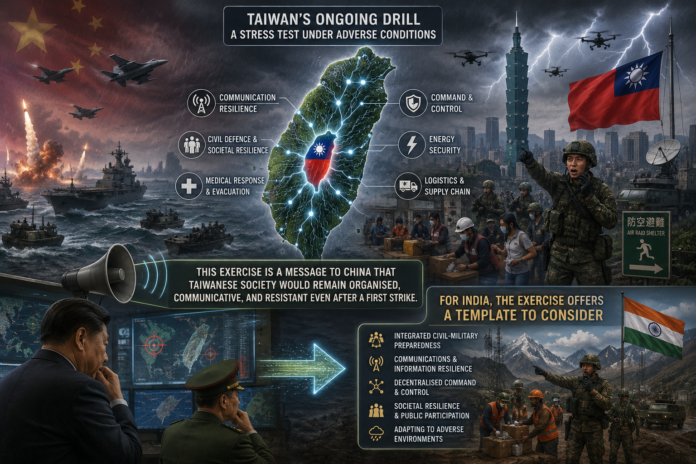
Taiwan’s Urban Resilience Exercises run from April through August, revealing a doctrine in which the battlefield is society itself. Early in July, in the mountainous county of Nantou, more than 370 Taiwanese officials rehearsed the end of the world as they know it. The scenario handed to them by planners was deliberately merciless, meaning a Chinese naval blockade, a magnitude 6.8 earthquake exploited for maximum chaos, hijacked television broadcasts spewing Beijing’s propaganda, sabotaged power plants, a run on banks, and finally, a full invasion. Reuters was given rare access to watch it unfold. What it saw was not a ceremonial fire drill of the kind Taiwan has run for decades. It was something closer to a stress test of the Taiwanese state’s nervous system. For India, watching China from a different flank, the exercise offers a template that arrives years before it may be needed.
A War That Doesn’t Start with Tanks
The defining insight of the Nantou exercise is sequencing. The drill did not open with an amphibious assault. It opened with economic coercion, moved through a natural disaster exploited by an adversary, escalated with cyberattacks and disinformation, and only then reached conventional war. This is not paranoia. It mirrors what most serious military planners believe Chinese doctrine actually intends, i.e., a campaign designed to exhaust, confuse, and demoralise a society before a single missile needs to fly. Taiwan’s planners, watching Ukraine and the Middle East unfold in real time, have concluded that the war they must prepare for begins in the grey zone, in hospital basements turned into wartime wards, in the fog of a hijacked broadcast, long before it reaches a beachhead.

The defining insight of the Nantou exercise is sequencing. The drill did not open with an amphibious assault. It opened with economic coercion, moved through a natural disaster exploited by an adversary, escalated with cyberattacks and disinformation, and only then reached conventional war
Borrowing Ukraine’s Playbook
Three Ukrainian lessons are visible throughout the exercise. The first is that civilian morale and functioning local governance are strategic assets in their own right, not soft add-ons to the real business of defence. Taiwan tested food distribution, shelter management and medical continuity with the same seriousness it applied to shooting down a mock Chinese drone. The second, decentralisation comes in the form of prefecture heads and state officials, not just the central command in Taipei, who were made to answer granular questions about draft-age men, baby formula stocks and hospital capacity, because a government that only survives at the centre does not survive at all. The third is the information battlefield. Hijacked broadcasts and AI-generated disinformation were built into the scenario, a tacit admission that a war fought only with weapons and lost in the narrative space is still a war lost.
The ‘Rear Area’ Concept
The most radical idea to quietly emerge from the drill is Nantou’s designated role as Taiwan’s ‘rear area’, its only landlocked county, reimagined as a refuge for displaced civilians, a logistics hub and a fallback seat of government if frontline regions come under direct assault. This is Taiwan’s manufacturing strategic depth, which it does not naturally possess, in the way Ukraine’s Western Front became a rear base after February 2022. For an island as geographically compressed as Taiwan, this is less a contingency plan than an admission that any war will not stay contained to a single front.
India does not face Taiwan’s geographical issues or invasion timeline, but it faces the same adversary’s doctrine and increasingly the same toolkit, deployed by both China and Pakistan. India’s conventional military capability remains considerably stronger than Taiwan’s, but its whole-of-society resilience architecture does not
Why This Matters in New Delhi
India does not face Taiwan’s specific geography or its immediate invasion timeline. But it faces the same adversary’s doctrine, and increasingly the same toolkit, deployed by both China and Pakistan, i.e., grey-zone pressure, cyber intrusion, disinformation targeting communal fault lines, infrastructure sabotage and drone incursions, any of which could plausibly coincide with a natural disaster or a flashpoint along the Line of Actual Control. India’s conventional military capability remains considerably stronger than Taiwan’s. Its whole-of-society resilience architecture does not.
That gap is the real lesson of Nantou. India has stronger military institutions, competent disaster-response mechanisms and capable state administrations, but these largely operate in parallel silos rather than as an integrated resilience system. A useful first step would be institutionalising a National Resilience Commission under the National Security Council Secretariat, tasked with knitting together civil defence, critical infrastructure protection, cybersecurity and strategic communications into a single coordinating architecture, the equivalent of the shared operational maps that let Taiwan’s military reserve commands and local governments see the same crisis in real time.

Stress-Testing Before the Real Test
Equally instructive is what the drill exposed rather than what it proved. Taiwanese officials seemed to struggle a bit when they were pressed on mobilisation figures and stockpile levels, which is the whole point of doing the exercise early, not while a crisis is already unfolding. India should take that discipline straight-up and copy it as is, which means running nationwide red-team tests against power grids, ports, rail systems, digital payment rails like UPI, and telecom networks, not because you want to prove you’re ready, but because you want to catch where the gaps are.
India should conduct nationwide exercises to secure power grids, ports, rail systems, digital payment rails like UPI, and telecom networks, not to prove readiness but to find the gaps. Also, counter-drone protection around nuclear facilities, air bases, and refineries really should get the same urgency
Also, counter-drone protection around nuclear facilities, air bases and refineries really should get the same urgency, since cheap drones have already bent the contours of the fighting in both the Ukrainian theatre and the Middle Eastern one. And there needs to be a standing inter-agency arrangement to spot and neutralise disinformation in real time, because in today’s environment AI-generated material can be produced faster than it can be checked and verified.

Deterrence by Endurance
The deeper strategic logic behind Taiwan’s exercise is a message to Beijing, not merely a preparation for war: that even a successful first strike would not deliver a governable, compliant Taiwan, because the society underneath would remain organised, communicative and resistant. This is deterrence achieved not by matching an adversary’s firepower but by degrading its confidence in the payoff. It is a logic that India, hedged between two hostile borders and a fast-evolving information war, would do well to internalise on its own scale, building not just a stronger military, but a country that, if struck, does not break.

The writer is an expert on geopolitics, national security, and counter-terrorism; and he regularly contributes his subject thought-leadership and academic commentary with several publications in newspapers, journals, and periodicals. He works with investigative agencies, regulatory bodies, financial institutions and enterprises, providing strategic and regulatory advisory. The views expressed are personal and do not necessarily carry the views of Raksha Anirveda





