


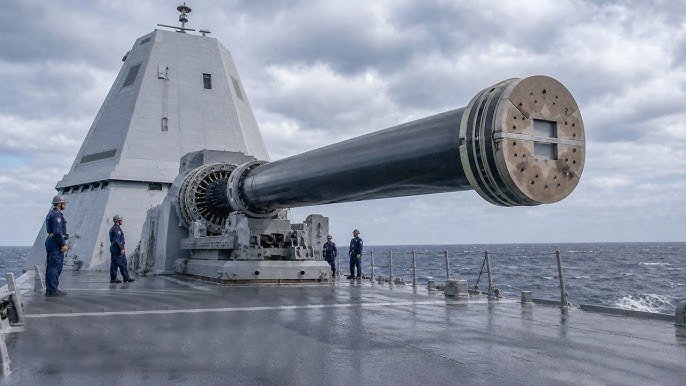
WASHINGTON. In a milestone event for futuristic weaponry, defence researchers have initiated a comprehensive series of live-fire operational trials for a highly advanced electromagnetic railgun (EMRG). The testing programme represents a major breakthrough in moving kinetic energy weapons out of laboratory environments and closer to practical deployment on the battlefield.
Unlike traditional artillery, which relies on chemical propellants like gunpowder to expand gases and push a shell down a barrel, an electromagnetic railgun utilises pure physics. By running a massive electrical current down parallel conductive rails, it creates a powerful Lorentz force – a magnetic push – that accelerates a conductive armature holding a solid tungsten projectile.

Unprecedented Speed and Range
During the initial live-fire phases, the prototype system achieved staggering performance metrics. The weapon successfully accelerated non-explosive, hyper-velocity projectiles to speeds exceeding Mach 7 (nearly 5,400 miles per hour). At these speeds, the sheer kinetic energy delivered upon impact is enough to decimate heavily armoured targets without requiring a volatile, explosive warhead inside the shell itself.
Engineers noted that the projectiles reached altitudes surpassing the lower limits of the atmosphere within seconds. This rapid velocity opens up a wide array of mission profiles, including long-range precision land bombardment, anti-ship operations and robust air defence against incoming aircraft.
Solving the Thermal and Structural Hurdles
While the concept of a railgun has existed for decades, previous military programmes – including a heavily funded initiative by the US Navy in the 2010s – stumbled due to profound engineering bottlenecks. The intense friction and extreme thermal energy generated by channeling millions of amperes of electricity down the rails would warp, melt or radically degrade the barrel after just a few shots.
According to technical briefs associated with the new trial, researchers have largely overcome these historical roadblocks by integrating custom advanced materials. The new prototype utilises specialised carbon-nanotube reinforced copper alloys for the rails, alongside an innovative automated liquid-nitrogen cooling system. These upgrades drastically mitigate thermal stress, theoretically allowing the gun to fire repeatedly without suffering catastrophic structural wear.

The Power Grid Challenge
Despite these material advancements, integrating a railgun onto a standard military vessel remains an immense logistical puzzle. Generating the hyper-velocity speeds requires massive amounts of electrical power stored and released in milliseconds. The system relies on advanced, ultra-dense capacitor banks to gather power from a ship’s engines and discharge it instantly.
Because of this immense power requirement, defence researchers suggest that the weapon will likely be paired with next-generation integrated power system (IPS) platforms, such as modern nuclear-powered hulls or advanced electric-drive destroyers.

The successful live-fire trials have fundamentally shifted the conversation around hypersonic deterrence. As nations race to counter highly manoeuverable hypersonic cruise missiles, a rapid-firing electromagnetic railgun offers a highly cost-effective solution. While an interception missile can cost millions of dollars per shot, a solid tungsten railgun projectile costs just a fraction of that, offering an efficient, high-volume curtain of defence that could redefine maritime security for decades to come.






