


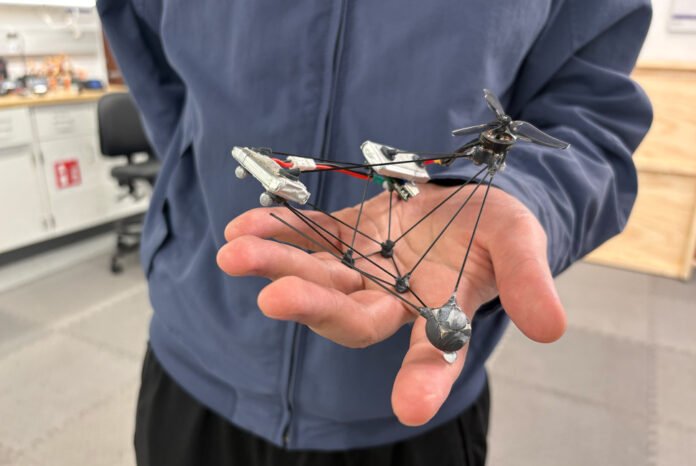
SYDNEY. Rather than relying on expensive camouflage materials or complex light-bending optical mirrors, an engineering team at Northwestern University has unveiled a radical approach to stealth aviation: an aircraft that hides by spinning into visual oblivion. Dubbed the “Phantom Twist” the experimental single-propeller drone treats motion itself as a cloaking device, morphing into a faint, semi-transparent smudge that seamlessly blends into its surroundings.
The research team presented their breakthrough paper, “Computational Design of a Low-Visibility UAV Using a Human-Aligned Perceptual Metric” at the prestigious Robotics: Science and Systems 2026 conference in Sydney, Australia. By designing the aircraft around the specific limitations of human and animal visual processing, the roboticists managed to reduce the drone’s visual prominence by a staggering factor of ten compared to standard consumer quadcopters.

Tricking the Biological Shutter
Conventional drones remain highly conspicuous because their bulky central frames and electronic components stay completely stationary while only the rotors spin. The Phantom Twist flips this architecture entirely on its head. It features a single offset motor where the lone propeller spins in one direction, forcing the entire body of the drone to rotate rapidly in the exact opposite direction.
This dizzying structural spin, reaching between 15 and 25 revolutions per second, directly targets the fixed “shutter speed” of human vision.
“The human eye takes time to accumulate signals, roughly analogous to the exposure time of a camera,” explained Emma Alexander, a computer vision expert on the Northwestern research team. “When an object spins quickly, we perceive it as blurring out and losing distinct features. Because this new drone is almost entirely transparent, its few opaque components are visually averaged with the background for an overall appearance of a slight haze.”
AI-Optimised Dispersal
To maximise this optical illusion, the researchers couldn’t just spin a standard drone frame. They needed an engineering layout where the solid components wouldn’t cluster together to form dense, dark rings while rotating.

The team turned to artificial intelligence and optimisation software to solve the physics equation. An evolutionary algorithm generated roughly 20,000 stable flight configurations under 40 grams, automatically shifting the precise locations of the motor, circuit board, counterweights and dual batteries.
The algorithm evaluated the configurations by simulating them spinning against 100 real-world backgrounds viewed from 10 distinct angles. The software purposefully scattered the core electronic components across varied heights and angles with immense open space in between. By preventing the parts from visually overlapping during high-speed rotation, the final physical layout averages the ambient light, mimicking a faint, ghostly cloud rather than a recognisable, dark mechanical silhouette.

Applications and Current Limitations
The roboticists point out that the initial design was engineered to provide a less disruptive option for civilian and scientific applications. Visible commercial drones frequently startle wildlife, causing birds to abandon nests and mammals to flee. A visually discreet drone could quietly monitor delicate ecosystems, conduct precise environmental surveys or inspect infrastructure like power lines and bridge undercarriages with minimal visual impact on the public and local fauna.
However, the team acknowledges that the Phantom Twist prototype is not yet a perfect phantom. While it successfully escapes the eyes, it cannot yet escape the ears; the single propeller still produces an audible buzz during flight. Additionally, structural elements like its essential connecting rods and wiring remain subtly visible under close inspection.
Looking forward, the Northwestern team intends to experiment with completely transparent materials and alternative, ultra-quiet propulsion systems to turn their spinning, hazy illusion into a truly imperceptible eye in the sky.






