


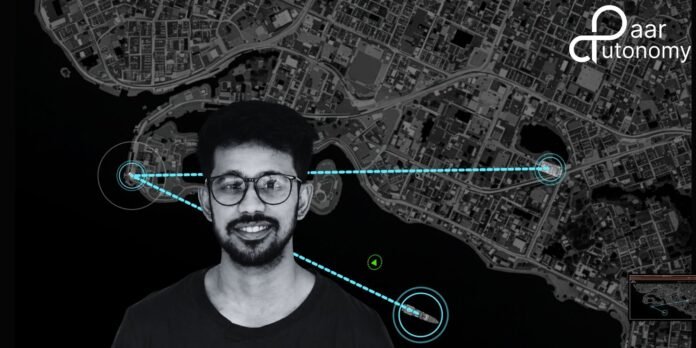
BENGALURU. A critical reality of modern robotics is that an autonomous machine is only as functional as its sight. A drone or ground vehicle cannot navigate contested borders, inspect complex industrial pipelines or track moving targets without highly sophisticated sensors and the computational intelligence to decode what they see. Addressing this exact bottleneck, homegrown deep-tech startup Paar Autonomy has pioneered to build the definitive “perception layer” for the next generation of unmanned vehicles.
Founded in 2024 by robotics engineer Vignesh Jayaraman – a Washington University alumnus and former product lead at Asteria Aerospace – the Bengaluru-headquartered firm is carving out a rare, cross-domain niche. While most defence and industrial tech companies specialise in a single domain, Paar Autonomy is developing a unified software and hardware stack engineered to operate seamlessly across air, land and sea.

Superhuman Vision Across Three Domains
At the heart of Paar’s innovation is a cutting-edge, multi-sensor, gyro-stabilised gimbal camera system. This advanced hardware is purposefully engineered to grant unmanned platforms what the company refers to as “superhuman perception” – delivering steady, ultra-high-resolution vision even in the most chaotic environmental or combat conditions.
When fused with the startup’s proprietary agentic AI, the system transitions from a passive camera into an active decision-making hub. This allows unmanned aerial systems (UAS), uncrewed surface vessels (USVs) and unmanned ground vehicles (UGVs) to autonomously detect imminent threats, navigate complex terrain without GPS dependencies and execute mission parameters without requiring a human operator to steer every step.
The addressable dual-use applications for this stack are expansive:
- Defence and Policing: Empowering military drones, patrol boats and border-security robots with automated multi-target tracking and advanced surveillance.
- Industrial Inspection: Allowing automated systems to map dangerous oil pipelines, high-voltage power grids and subterranean construction sites, drastically lowering commercial operational costs while taking humans out of harm’s way.
Capital Infusion to Fuel Local Production
Operating in a deeply capital-intensive sector, Paar Autonomy recently secured a vital lifeline to transition from prototype to production. The company raised ₹3.5 crore (~$397,000) in a pre-seed funding round led by prominent early-stage investor Venture Catalysts, bringing its total capital raised across two rounds to nearly $400,000.

Currently pre-revenue, the startup is deploying the fresh capital to establish its first dedicated manufacturing line. This infrastructure will allow Paar to scale up production of its stabilised gimbal systems and initiate advanced field testing and pilot programmes with the Indian Armed Forces and various Public Sector Undertakings (PSUs). These upcoming trials are designed to rigorously validate the system’s resilience under extreme tactical conditions before scaling into larger procurement contracts.
Targetting a Multi-Billion Dollar Frontier
The financial horizon for the physical AI and robotics sector is massive. Market projections suggest the global defence market for unmanned aerial systems alone will soar to $6 billion by 2030, with ground and maritime robotic ecosystems accounting for an additional $4 billion to $5 billion.

By positioning itself as a core component supplier for B2B and B2C clients rather than building whole vehicles, Paar Autonomy insulates itself from the long procurement cycles of individual drone manufacturers. Ultimately, Jayaraman’s long-term vision is to transform India from a traditional net importer of defence technology into a major global exporter of elite, sovereign autonomous intelligence.






