


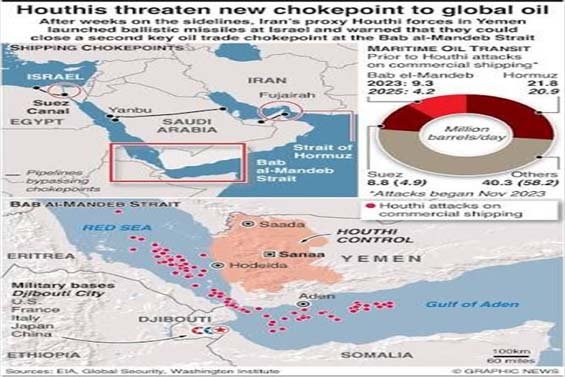
On July 15, 2026, The Telegraph reported that Houthi rebels are laying the groundwork to close the Bab el-Mandeb Strait on Iran’s behalf, coordinating with Somalia’s al-Shabab to control both banks of the waterway linking the Red Sea to the Indian Ocean. Iran may want “the other side of the Red Sea,” replicating the leverage it already holds over the Strait of Hormuz.
The timing is not incidental. It follows the war Israel and the United States launched against Iran on February 28, 2026, a conflict that saw Tehran shut the Strait of Hormuz to shipping and sent oil prices spiking well beyond the region. A single strait closure reshaped global energy markets earlier this year. A second, if it comes, would not be an escalation. It would be a system.

The significance lies not merely in another vulnerable sea lane but in the emergence of a connected architecture of maritime coercion. Control over Hormuz influences the world’s energy lifeline; influence over Bab el-Mandeb reaches the arteries of global commerce. Together they create the possibility of strategic pressure extending from the Persian Gulf to the entrance of the Suez Canal. Few states possess the geography, proxy network and political intent to contemplate such layered leverage.
Bab el-Mandeb is easy to overlook next to Hormuz, yet the numbers tell a different story. Roughly ten to twelve per cent of global maritime trade and close to thirty per cent of container traffic between Asia and Europe pass through this narrow gateway to the Suez Canal. Since Houthi attacks began in late 2023, Red Sea transit volumes have collapsed by seventy per cent from pre-crisis levels, forcing carriers to take the Cape of Good Hope route, adding six to eleven thousand nautical miles per voyage. The strait has already shown it can be closed in practice. What has changed now is the intent behind that capability.
The coordination with al-Shabab is the more significant development because it extends Houthi reach beyond Yemen’s coastline into the Horn of Africa, giving Iran’s proxy network a foothold on both sides of the strait. Houthi operatives may be transferring drone technology to al-Shabab, with the group described as becoming “leaders of the region” within Iran’s axis.
This is not merely a favour passed between allied militants. It is the construction of a chokepoint that can be squeezed from both directions at once, a capability Iran does not currently possess at Hormuz, where it relies solely on its own naval and missile assets.

Iran is expanding its proxy network to the Horn of Africa by linking Houthi operatives with al-Shabab militants. Controlling both sides of the Bab el-Mandeb Strait enables a bidirectional squeeze on a waterway carrying 12% of global trade, creating a unified system of maritime coercion alongside the Strait of Hormuz
Iran’s restraint so far deserves as much attention as its intent. The same source noted that using every card at the outset would be unwise, an admission that Tehran is deliberately managing escalation rather than acting impulsively. This calibration mirrors what Andreas Krieg of King’s College London has called a second nuclear option; a threat held in reserve until the regime concludes that a return to full-scale war has become unavoidable.
Iran learned from the war that opened in February that overwhelming force invites overwhelming retaliation. A slow, deniable build-up of proxy capability at Bab el-Mandeb achieves the same leverage without the same exposure.

This reflects a wider evolution in statecraft. Contemporary powers increasingly seek influence without direct occupation, preferring proxy forces, deniable technologies and persistent disruption below the threshold of conventional war.
Maritime chokepoints have become instruments of political signalling as much as military geography, allowing revisionist states to impose economic costs while preserving strategic ambiguity.
That patience extends to leadership as well. The Houthis are reportedly studying how Iran’s command structure absorbed the decapitation strikes that killed much of Tehran’s senior leadership during the war, and are now naming multiple successors for each senior post.
Abdul-Malik al-Houthi has designated a family member to take over if he is killed, part of a deliberate system of shadow leaders. A movement built to survive assassination is planning for a long campaign, not a single dramatic gesture.
Analysts studying the strait’s dynamics have identified real constraints on Iran and the Houthis, who are using this leverage to the fullest. Closing Bab el-Mandeb outright would prompt a direct international naval response, similar to the one that protected Red Sea shipping after 2023. It would also undermine the very Gulf alternatives, such as Saudi Arabia’s East-West pipeline to the Red Sea, that Riyadh built precisely to reduce its own exposure to Hormuz.
A full closure would therefore harm Gulf partners that Iran still needs to manage carefully. And any dramatic escalation risks reviving international attention on Houthi control of Hodeidah on Yemen’s western coast, a political file that has remained dormant for years. These constraints explain why calibrated harassment, rather than full closure, remains the more likely near-term posture. But calibrated harassment is still coercion, and it still works.
Learning from the early 2026 war that decimated Tehran’s senior leadership, the Houthis are adapting their command structure for a prolonged campaign. By establishing a robust system of shadow leaders and naming multiple successors for each senior post, the movement is actively planning to survive targeted decapitation strikes
The economic exposure is already evident without a single ship being stopped. Insurance premiums for Red Sea transits remain elevated, container rates on Asia-Europe routes are well above pre-crisis levels, and roughly 60% less traffic moves through the Suez today than before the disruptions began. A deliberate closure, even partial or temporary, would compound an already-stressed shipping architecture rather than create a new one from scratch.
For India, the exposure runs deeper than commentary usually allows. Nearly half of India’s exports and a substantial share of its imports move through the Bab el-Mandeb and Suez corridor towards Europe, North America and North Africa.
India already imports the overwhelming majority of its crude oil, with roughly half transiting Hormuz and much of the remainder dependent on a Gulf and Red Sea shipping architecture now under repeated strain.
A simultaneous squeeze on both straits, even short of full closure, would not remain a distant headline. It would show up directly in freight costs, energy prices and industrial input schedules within weeks.
The Indian Navy has expanded its presence in the northern Indian Ocean and strengthened coordination with the Combined Maritime Forces in Bahrain, a sound instinct. But presence without a funded, multi-year shipbuilding and escort capability cannot outlast a sustained crisis. Chokepoint exposure of this kind belongs in national planning, not only in shipping company advisories.
An outright closure of the strait remains unlikely as it would trigger an intense international naval response and alienate critical Gulf partners by blocking alternative routes like Saudi Arabia’s East-West pipeline. Instead, Iran favours a slow, deniable buildup of proxy capability to enforce economic coercion through persistent, calculated disruption
India’s response cannot rest solely on additional naval deployments. It requires a comprehensive maritime resilience strategy that integrates sustained mission-based deployments, accelerated naval modernisation, resilient energy supply chains, expanded strategic petroleum reserves, stronger logistics partnerships with friendly navies and continuous maritime domain awareness stretching from the Gulf of Aden to the western Indian Ocean.
Economic security has become inseparable from sea control. For India, this reinforces an enduring strategic reality. As the principal resident maritime power in the northern Indian Ocean, its credibility increasingly rests not only on defending its own trade but also on contributing to the security of the wider maritime commons upon which regional prosperity depends.
What makes this moment different from previous Red Sea disruptions is its deliberate nature. Houthi attacks since 2023 were reactive, tied to the Gaza war and later to the wider Iran conflict. What The Telegraph describes is architecture, a patient effort to build durable leverage over a second global chokepoint, one that can be activated on Tehran’s schedule rather than in response to events.
That distinction matters for how governments, insurers and navies should read the coming months. A capability under construction is not yet a crisis, but it is no longer merely a contingency either.
With nearly half of its exports and the vast majority of its crude oil imports dependent on the vulnerable Gulf and Red Sea shipping architectures, India faces direct exposure to surging freight costs and energy price shocks. Temporary naval deployments are no longer sufficient; New Delhi requires a funded, multi-year shipbuilding and comprehensive maritime resilience strategy to protect its economic security
China is likely to watch these developments with considerable interest. Its permanent naval presence in Djibouti, expanding commercial footprint across the Horn of Africa and dependence on uninterrupted maritime trade make prolonged instability both a challenge and, under certain circumstances, a source of strategic leverage.
The convergence of regional conflicts with great-power competition could therefore complicate any future crisis around Bab el-Mandeb far beyond the Middle East.
The world spent the first half of 2026 relearning the economic consequences of a disrupted Strait of Hormuz. Bab el-Mandeb now presents the prospect of a second pressure point, linked not by geography but by strategy.
For India and other maritime trading powers, the challenge is no longer simply protecting shipping lanes. It is preserving the resilience of the global trading system against deliberate coercion. Strategic warning has already been delivered; prudent nations should use the time that remains before capability becomes crisis.

The writer, a PVSM, AVSM, VSM has had an illustrious career spanning nearly four decades. A distinguished Armoured Corps officer, he has served in various prestigious staff and command appointments including Commander Independent Armoured Brigade, ADG PP, GOC Armoured Division and GOC Strike 1. The officer retired as DG Mechanised Forces in December 2017 during which he was the architect to initiate process for reintroduction of Light Tank and Chairman on the study on C5ISR for Indian Army. Subsequently he was Consultant MoD/OFB from 2018 to 2020. He is also a reputed defence analyst, a motivational speaker and prolific writer on matters of military, defence technology and national security. The views expressed are personal and do not necessarily carry the views of Raksha Anirveda





