


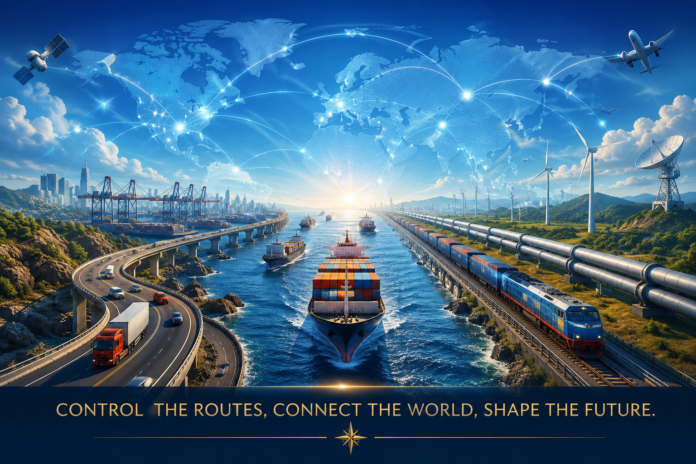
A Narrow Strait, A Global Crisis: Barely thirty-three kilometres separate Iran from Oman at the narrowest point of the Strait of Hormuz. Yet this slender waterway commands the attention of governments, financial markets and military planners across the globe. Whenever tensions escalate in the Gulf, oil prices rise, insurance premiums soar, naval deployments increase and policymakers thousands of kilometres away begin preparing for economic shockwaves.
At first glance, it appears to be a regional crisis. In reality, it is something much larger.

The world is reacting not merely to a conflict between states but to the vulnerability of a route upon which modern civilisation depends.
This has become one of the defining characteristics of twenty-first-century geopolitics. Nations are no longer competing solely for territory or resources. Increasingly, they are competing to build, protect and influence the routes through which energy, trade, technology, finance, information and strategic influence flow. A disruption at one critical junction can reverberate through global supply chains, unsettle markets and alter diplomatic calculations across continents.
The geography of power has not disappeared. It has evolved.
For centuries, maps were interpreted through borders. Today, they must also be read through corridors, sea lanes, pipelines, fibre-optic cables, railways and digital networks. These arteries sustain the global economy much as blood vessels sustain the human body. Their uninterrupted functioning has become a prerequisite for economic stability, national resilience and geopolitical influence.

Routes derive value only when they remain secure. A single disruption in a maritime chokepoint can trigger consequences far beyond the immediate theatre. Security today extends beyond defending borders; it includes safeguarding the arteries that sustain national life
The contest for connectivity is therefore no longer an economic undertaking alone. It has become a strategic enterprise.
The Great Game of the nineteenth century revolved around territorial influence across Central Asia. The emerging Great Game of the twenty-first century is unfolding across maritime chokepoints, transcontinental corridors, digital highways and strategic infrastructure. The objective is not necessarily to occupy land, but to shape the movement of commerce, energy, technology and information.

Civilisations have always travelled on routes. So has power.
From Empires to Corridors
History demonstrates that the rise of great powers has often depended less upon the extent of their territories than upon the routes they created and secured.
The Roman Empire understood this better than most. Its celebrated roads were not merely engineering achievements; they were instruments of governance, military mobility and economic integration. They enabled legions to move swiftly, commerce to flourish and distant provinces to remain connected with the imperial centre. Roads transformed conquest into enduring control.
Long before the age of modern nation-states, the Silk Route linked China, Central Asia, India, Persia and Europe. It transported far more than silk and spices. Along its paths travelled ideas, religions, technologies, languages and cultures, shaping civilisations across continents. Whoever influenced these routes exercised influence disproportionate to territorial size.
The great maritime powers of later centuries reached similar conclusions. Portugal and the Netherlands expanded their influence through sea lanes rather than continental conquest. The British Empire, often described as an empire upon which the sun never set, rested fundamentally upon secure maritime communications. Control of strategic passages such as the Suez Canal enabled Britain to connect its commercial and imperial interests across the globe with remarkable efficiency.
The twentieth century reinforced the same lesson. The Panama Canal transformed global shipping. The Trans-Siberian Railway bound together the vast Russian landmass. Strategic highways became indispensable during the Second World War, while the Cold War witnessed intense competition over ports, airfields and logistical corridors.
History leaves little room for ambiguity. Those who shape the routes frequently shape the future. The twenty-first century has not invalidated this principle. It has expanded it beyond anything previous generations could have imagined.
New Routes of Power
The routes that define strategic influence today extend far beyond highways and shipping lanes. They form a vast and interconnected network through which the lifeblood of the global economy continuously flows.
Energy moves through maritime chokepoints, pipelines and electricity grids. Trade travels along container shipping routes, rail corridors and multimodal logistics networks. Information races through undersea fibre-optic cables carrying almost the entirety of global digital communications. Financial transactions depend upon secure digital payment systems and resilient cyber infrastructure. Satellites connect aircraft, ships, armed forces and emergency services across continents, while data centres increasingly constitute strategic assets in their own right.
India has great strategic advantages, geographically. Located at the centre of the Indian Ocean, positioned between the energy-rich Gulf and the manufacturing hubs of East Asia, India naturally occupies one of the world’s most consequential geopolitical crossroads
Connectivity itself has become a domain of competition.
The Belt and Road Initiative (BRI), the India-Middle East-Europe Economic Corridor (IMEC), the International North-South Transport Corridor INSTC), Arctic shipping routes, transcontinental railway networks and digital infrastructure partnerships all reflect the same strategic reality. Nations are investing not merely in infrastructure but in influence. Every corridor represents an economic opportunity, a diplomatic partnership and a potential strategic advantage.
The significance of these routes extends well beyond commerce. During crises, infrastructure determines resilience. Secure ports sustain maritime trade. Reliable railways maintain industrial production. Strategic highways enable military mobilisation. Digital networks preserve financial stability and governmental continuity. Undersea cables have become as vital to national security as oil pipelines once were.
The distinction between economic infrastructure and strategic infrastructure is steadily disappearing. Connectivity is no longer simply a facilitator of development. It has become an instrument of statecraft.
A nation may possess abundant natural resources, formidable armed forces and a large domestic market. Yet if it remains disconnected from the principal arteries of global commerce and information, its strategic influence will inevitably be constrained.
The reverse is equally true. Countries that become indispensable connectors often acquire geopolitical significance far exceeding their geographic size. The lesson for policymakers is both simple and profound.
In the twenty-first century, power belongs not merely to those who possess resources, but increasingly to those who enable movement — of goods, energy, capital, ideas and people. Connectivity is no longer the by-product of national power. It is becoming one of its primary sources.
Building, Protecting and Controlling Routes
If connectivity has become the new currency of geopolitics, then strategy must increasingly focus on three interconnected imperatives: building, protecting and controlling routes. Together, they define the architecture of twenty-first-century power.
- Building: Infrastructure is often viewed through the narrow prism of economic development. Roads reduce travel time, ports facilitate trade, railways move freight and airports improve connectivity. While all this is true, infrastructure performs a far deeper strategic function. It transforms geography into capability.
A mountain pass without a road remains a natural obstacle. A coastline without ports offers little maritime advantage. A border without reliable infrastructure limits both economic activity and military responsiveness. By contrast, strategic highways, tunnels, bridges, ports, logistics hubs and digital networks convert physical geography into national strength.
Throughout history, infrastructure has enabled states to integrate distant regions, extend governance and project influence. In the twenty-first century, it has also become an instrument of deterrence. A nation that can mobilise rapidly, sustain logistics efficiently and maintain uninterrupted connectivity possesses strategic options that others do not.
- Protecting: Routes derive value only when they remain secure. A single disruption in a maritime chokepoint, a cyber-attack on a digital network or sabotage of an energy pipeline can trigger consequences far beyond the immediate theatre. Security today extends beyond defending borders; it includes safeguarding the arteries that sustain national life.
The world’s most valuable assets are no longer confined within national borders. They move continuously across oceans, corridors, pipelines, cables, satellites and digital networks. Their uninterrupted movement has become essential to global prosperity and national security alike
This responsibility is increasingly multi-domain. Navies secure sea lanes. Air forces protect critical infrastructure. Cyber agencies defend digital networks. Intelligence organisations monitor threats to undersea cables, satellite systems and energy grids. Diplomacy builds partnerships that enhance collective security across shared corridors.
The protection of routes has become as important as their creation.
- Controlling: Control should not be understood solely in military terms. In the contemporary strategic environment, influence frequently matters more than occupation. Nations exercise control by shaping standards, financing infrastructure, providing technology, managing logistics, setting regulatory frameworks and forging long-term partnerships.
A port need not fly a foreign flag to influence regional trade. A digital platform can shape commerce without crossing national borders. A satellite navigation system can create enduring strategic dependence without occupying a single kilometre of territory.
Power increasingly resides in the ability to shape how the world’s critical routes function.
The New Great Game, therefore, is not simply about where routes exist. It is about who builds them, who protects them and who shapes the rules by which they operate.
India’s Strategic Opportunity
Few nations are as favourably placed as India to benefit from this transformation.
Geography has endowed India with exceptional strategic advantages. Located at the centre of the Indian Ocean, positioned between the energy-rich Gulf and the manufacturing hubs of East Asia, India naturally occupies one of the world’s most consequential geopolitical crossroads. Nearly every major maritime artery connecting Europe, Africa and Asia passes through waters of direct strategic relevance to India.
Yet geography alone does not guarantee influence.
History rewards nations that convert geographic opportunity into strategic capability.
India has increasingly recognised this imperative. The expansion of border infrastructure, the modernisation of ports, the development of industrial corridors, initiatives such as Sagarmala and Bharatmala, investments in digital public infrastructure, growing space capabilities and participation in connectivity initiatives such as the India-Middle East-Europe Economic Corridor all reflect a broader understanding that infrastructure is no longer merely developmental—it is strategic.
History’s great powers-built roads, secured sea lanes and connected distant frontiers. The successful powers of the future will do the same, albeit with technologies and networks unimaginable to earlier generations
Equally significant is India’s emphasis on trusted connectivity. In an era when infrastructure projects are evaluated not only for economic viability but also for transparency, sustainability and respect for sovereignty, India has the opportunity to offer an alternative model of partnership. Trust itself is emerging as a strategic resource.
India’s challenge now is to integrate these diverse initiatives into a coherent national vision. Maritime strategy, border infrastructure, logistics, digital connectivity, manufacturing, energy security, and diplomacy should not evolve in isolation. They are mutually reinforcing components of a comprehensive strategy.
Geography gives nations opportunities. Infrastructure converts opportunities into strategic advantage. Leadership transforms that advantage into enduring influence.
The New Map of Power
Every era produces its own measure of national strength.
In the nineteenth century, power was often measured by the extent of empires and colonies. The twentieth century elevated industrial production, military capability and economic output as the principal indicators of influence.
The twenty-first century is writing a different story.
Power will increasingly belong to those who enable movement rather than merely occupy territory; to those who connect markets rather than simply control resources; and to those who secure the networks through which energy, trade, finance, information and technology flow.
The next Great Game will not be won by those who conquer the most territory. It will be won by those who build, protect and shape the world’s most critical routes
The world’s most valuable assets are no longer confined within national borders. They move continuously across oceans, corridors, pipelines, cables, satellites and digital networks. Their uninterrupted movement has become essential to global prosperity and national security alike.
This reality demands a broader understanding of strategy. Military power remains indispensable. Economic strength remains fundamental. Diplomacy remains essential. Yet each of these increasingly depends upon resilient connectivity.
The map of power is therefore being redrawn — not by new borders, but by new routes.
From the Strait of Hormuz to the Strait of Malacca, from Arctic sea lanes to transcontinental rail corridors, from undersea fibre-optic cables to space-based communication networks, the emerging contest is not simply about geography. It is about connectivity, resilience and influence.
History’s great powers-built roads, secured sea lanes and connected distant frontiers. The successful powers of the future will do the same, albeit with technologies and networks unimaginable to earlier generations.
The next Great Game will not be won by those who conquer the most territory. It will be won by those who build, protect and shape the world’s most critical routes.

Lt Gen Rajeev Chaudhry (Retd) writes on contemporary national and international issues, strategic implications of infrastructure development towards national power, geo-moral dimension of international relations, and leadership nuances in a changing social construct. The views expressed are of the author and do not necessarily reflect the views of Raksha Anirveda





