


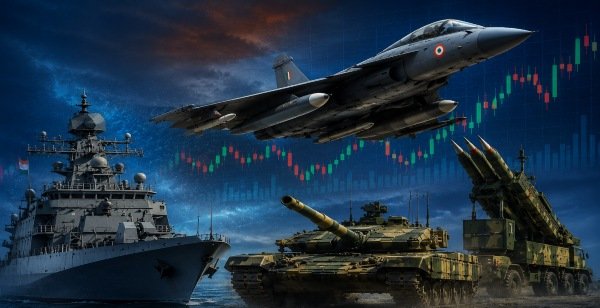
Every few months, a fresh set of figures arrives confirming that India’s defence sector is expanding rapidly. The latest, drawn from a Kotak Institutional Equities report, projects that defence capital expenditure will grow by 11 per cent annually to reach ₹2.8 trillion by FY2030. Defence exports have multiplied several-fold within a single decade. Analysts now speak confidently of a ten-year horizon in which India could spend US$25–30 billion on drones and another US$4–5 billion on counter-drone capabilities.
The figures are real—and undeniably impressive. Yet numbers of this scale are also seductive. The temptation is to read them as a verdict rather than a question. The apparent verdict is that India has already arrived as a major defence power.

The more important question is subtler: Has India built an industrial ecosystem capable of sustaining that transformation, or has it merely created the demand for it?
From Procurement to Production
The case for optimism is stronger than many sceptics acknowledge. India’s transformation from the world’s largest arms importer into a credible defence producer is not merely a market phenomenon. It is the result of deliberate policy choices.
The Defence Acquisition Procedure (DAP) 2020, successive Positive Indigenisation Lists, and the decision to reserve 75 per cent of the capital acquisition budget for domestic procurement have fundamentally reshaped the country’s defence acquisition ecosystem.
India’s defence numbers are impressive, but the industrial ecosystem behind them is the real story
Domestic companies that once competed for relatively modest opportunities now account for the core of the procurement pipeline. The share of defence procurement sourced domestically has crossed 70 per cent, compared with little more than half only a few years ago.

This represents a structural transformation rather than a temporary budgetary adjustment.
Unlike annual expenditure allocations, structural reforms continue to shape industrial behaviour long after individual budgets have been spent.

Combat Validation Changes Everything
What procurement statistics alone cannot fully capture, the battlefield recently did. During Operation Sindoor in May 2025, India’s calibrated military response following the Pahalgam terrorist attack, indigenous defence systems were tested under operational conditions rather than on the parade ground.
Weapons that had previously existed largely in brochures acquired something no marketing campaign can purchase: combat credibility.
For international buyers, a platform that has demonstrated its effectiveness under actual combat conditions possesses significantly greater value than one that has merely completed developmental trials.
The global defence market understands this distinction exceptionally well.
Why Exports Matter
That credibility is already beginning to translate into commercial success. India’s defence exports reached a record ₹38,424 crore in FY2025–26, representing an increase of nearly 63 per cent over the previous year and reaching customers in more than 80 countries.
Against this backdrop, the Government’s target of ₹50,000 crore in defence exports by 2029 no longer appears overly ambitious. Equally significant is the changing geography of those exports.
The United States continues to import the largest volume, primarily in the form of components and sub-systems. Increasingly, however, countries such as Armenia, along with several European nations, are purchasing complete platforms rather than merely individual components.
This reflects an important evolution in India’s defence-industrial profile. Defence exports have quietly become an instrument of strategic statecraft. Countries that procure another nation’s radars, missile systems or defence platforms rarely establish purely commercial relationships.
They also develop enduring strategic, logistical and technological linkages that often outlast political declarations and summit communiqués.
The Drone Economy
If one theme connects virtually every recent conflict—from Ukraine and Nagorno-Karabakh to the Red Sea and India’s own military exchanges with Pakistan—it is that relatively inexpensive unmanned systems can now destroy platforms many times their own value.
The economics of warfare have undergone a profound transformation. A loitering munition costing a few thousand dollars can neutralise a tank or sophisticated air-defence system worth millions.
No amount of armour fundamentally alters that equation.
India’s projected investment in drone and counter-drone capabilities is therefore not a passing technological trend, but a recognition that the nature of deterrence itself is changing.
Operation Sindoor gave indigenous defence systems something no marketing campaign can buy—combat credibility
The nation that masters swarm technologies, autonomous systems and affordable precision strike capabilities will increasingly be able to impose disproportionate costs on an adversary.
For India’s emerging defence-industrial ecosystem, this transformation presents a unique opportunity.
Unlike established military powers burdened by legacy platforms, India has greater flexibility to innovate in technologies that are likely to define the next generation of warfare.
Three Reasons for Caution
None of this, however, justifies the triumphalism that often accompanies bullish forecasts. A serious strategic assessment requires equal attention to the risks. Three considerations deserve as much prominence as the encouraging numbers.
A Forecast is Not a Fact
The first is that a forecast should never be mistaken for an accomplished reality. Analysts point to the nearly tenfold increase in Acceptance of Necessity (AoN) approvals, suggesting trillions of rupees in future procurement.
However, an Acceptance of Necessity represents an intention—not a signed contract. India’s defence procurement history is replete with programmes that were delayed, restructured or quietly abandoned before reaching fruition.
Treating a procurement pipeline as guaranteed revenue is a sure way of allowing optimism to outpace reality.
The Technology Gap
The second caution lies in what may be called the engine room of India’s defence-industrial ecosystem. Despite remarkable progress in indigenous manufacturing, India continues to depend on imports for several of the most critical high-end technologies, including jet and aero-engines, advanced semiconductors, Active Electronically Scanned Array (AESA) radar components, propulsion systems and sophisticated sensors.
An industrial base capable of assembling and integrating advanced platforms, but unable to design and manufacture their technological core, inevitably faces strategic limitations. There is an important distinction between financial indigenisation and technological indigenisation. The former measures the proportion of procurement expenditure retained within the country.
True strategic autonomy will depend less on procurement budgets than on innovation, intellectual property and technological self-reliance
The latter measures ownership of intellectual property, critical technologies and design capability.
India has progressed considerably further on the first than on the second.
Innovation Will Decide the Outcome
The third—and perhaps most decisive—challenge is research intensity. Indian defence companies continue to invest a relatively modest proportion of their revenues in research and development (R&D) compared with many leading global defence firms.
Healthy operating margins can sometimes conceal this weakness. A licence manufacturer may appear highly profitable until the licence expires or the underlying technology evolves beyond its existing capabilities.
Innovation, rather than manufacturing alone, ultimately determines long-term competitiveness.
Investors have understandably recognised the sector’s growth potential. Indian defence companies now trade at valuations approaching 50 times forward earnings, compared with approximately 28 times for many established global peers.
Such expectations leave relatively little room for the inevitable delays and technological setbacks that accompany every major industrial transformation.
Beyond the Numbers
Which brings us back to the central question beneath the statistics. The real significance of the present moment is not simply that India will spend more on defence. Many wealthier nations confronted by growing security challenges have done precisely that.
The more consequential development is that India may finally be constructing something it has never before possessed: a genuinely self-sustaining defence-industrial ecosystem.
The future of Indian defence lies not merely in spending more, but in building an industrial ecosystem capable of sustaining military power
Such an ecosystem would allow capital investment, combat validation, exports, innovation and industrial capability to reinforce one another in a virtuous cycle that depends increasingly upon domestic strengths rather than foreign technology or political goodwill.
If that cycle matures, the very meaning of national power begins to change. Military strength will no longer be measured solely by the size of standing armed forces or annual procurement budgets.
Increasingly, it will be measured by industrial depth, technological innovation, supply-chain resilience and the capacity to design, manufacture and export advanced defence systems at scale.
That represents the deeper meaning of strategic autonomy. It is also an achievement far more enduring than any single year’s export record. The numbers may capture today’s headlines. The industrial ecosystem that produces them will determine tomorrow’s strategic strength. And whether India succeeds in completing that transformation is, ultimately, the only question that truly matters.

The writer is an expert on geopolitics, national security, and counter-terrorism; and he regularly contributes his subject thought-leadership and academic commentary with several publications in newspapers, journals, and periodicals. He works with investigative agencies, regulatory bodies, financial institutions and enterprises, providing strategic and regulatory advisory. The views expressed are personal and do not necessarily carry the views of Raksha Anirveda





