


In October 2025, when Defence Minister Rajnath Singh released Lt Gen Raj Shukla’s book on the subject, he framed civil-military fusion not merely as integration but as a “strategic enabler” that fosters innovation, preserves talent, and propels the nation toward technological self-reliance.
A month later, addressing young civil servants at Mussoorie, he called Operation Sindoor a brilliant example of civil-military fusion in which administrative machinery worked seamlessly with the armed forces. The phrase has now entered India’s strategic vocabulary, repeated in seminars, doctrine documents, and ministerial speeches. The question is whether the country understands what it is signing up for – and, more importantly, where the lines must be drawn before enthusiasm outruns prudence.

Why Fusion, and Why Now
For most of the post-Independence period, India’s national security architecture rested on a deliberate separation. The armed forces fought wars; the bureaucracy administered; the political executive decided. This division of labour served the republic well, keeping the military firmly out of politics at a time when much of the post-colonial world was succumbing to coups and praetorian rule.
But the same arrangement also produced a costly fragmentation. Defence research lived in one silo, private industry in another, academia in a third, and the uniformed services in a fourth – each speaking a different language, guarding its own turf, and rarely sharing a roadmap.
The Defence Research and Development Organisation (DRDO) designed in isolation from the private firms that might have manufactured at scale; universities studied strategy with little access to the practitioners who made it; and the services themselves often duplicated effort while starving joint capabilities of attention.
Modern conflict has rendered that separation untenable.

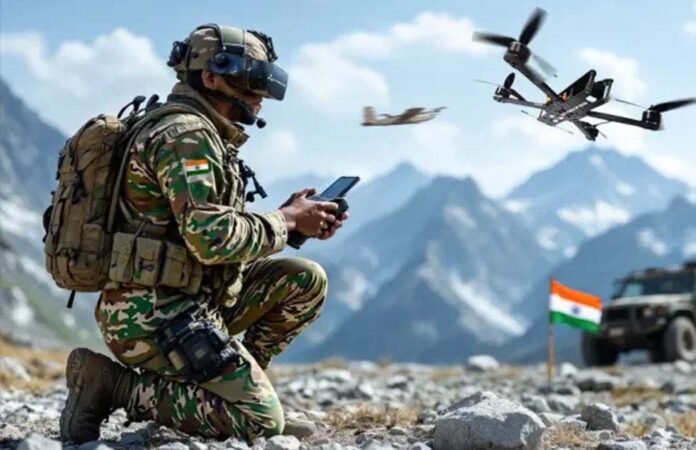
As the Defence Minister noted, wars are now fought in hybrid and asymmetrical forms, not only at the borders. Drones, cyber intrusions, satellite intelligence, disinformation campaigns, and precision munitions blur the boundary between the soldier and the civilian, between the battlefield and the supply chain.
For most of the post-Independence period, India’s national security architecture rested on a deliberate separation. The armed forces fought wars; the bureaucracy administered; the political executive decided. This division of labour served the republic well, keeping the military firmly out of politics at a time when much of the post-colonial world was succumbing to coups and praetorian rule
A semiconductor shortage can ground an air force. A software vulnerability can blind a command centre. A coordinated information operation can shape public morale faster than any artillery barrage. In this environment, fusion is not ideology but arithmetic: a nation cannot field a twenty-first-century military on a twentieth-century industrial and intellectual base.

The countries that have pulled ahead – the United States, and increasingly China – did so by knitting their defence establishments tightly to their civilian economies, their research institutions, and their technology sectors. India is, in this sense, playing catch-up to a logic it can no longer avoid.
Operation Sindoor as Proof of Concept
The Pahalgam terror attack and the military campaign that followed gave the abstraction concrete shape. Sindoor demonstrated intelligence fusion, international liaison, and technology-driven coordination, with channels run by R&AW, the Defence Intelligence Agency, and military intelligence feeding a common operational picture rather than competing for primacy.
On the home front, district administrations conducted mock drills, managed public messaging, and sustained civilian morale while strike packages did their work across the border. The operation showcased what an integrated response could look like when the seams between agencies were, however briefly, stitched together.
It also validated the broader theaterisation reform, the most ambitious restructuring of the Indian military since Independence, which seeks to place the Army, Navy, and Air Force under unified theatre commanders rather than the seventeen separate service commands that exist today.
The operation served as a proof of concept that integrated warfare is a practical necessity, not a theoretical luxury, and it has injected fresh urgency into a reform that had drifted for years amid inter-service disagreement. Yet the same episode exposed the unfinished nature of these reforms.
The reform process remains, in the words of one assessment, marked more by institutional defensiveness than by coherent design, and it is in precisely that gap – between ambition and architecture – that the real risks of fusion live.
As the defence minister noted, wars are now fought in hybrid and asymmetrical forms, not only at the borders. Drones, cyber intrusions, satellite intelligence, disinformation campaigns, and precision munitions blur the boundary between the soldier and the civilian, between the battlefield and the supply chain
The Danger Inside the Idea
Fusion is powerful precisely because it dissolves boundaries – and that is also its hazard. When the lines between the civil and the military are erased rather than merely coordinated, the result is not synergy but confusion of authority.
Analysts have warned that blurred civil-military boundaries allow political offices to encroach on professional operational decisions, and that without clear rules of rank and command, theaterisation could end up giving politics greater leverage over tactical command than ever before.
The chain of command is not an administrative nicety; it determines who can issue lawful orders, who must obey them, and how accountability is enforced. When that chain is clear, discipline holds. When it diffuses, professionalism erodes.
This is the central tension running through India’s fusion project. The same instinct that wants industry, academia, and the services to share a national purpose can, if left unguarded, invite the political executive to treat operational matters as extensions of the political project.
There is a meaningful and constitutionally important difference between a defence minister setting strategic priorities – an entirely legitimate civilian function in any democracy – and political actors claiming credit for, or directing the conduct of, specific military operations.
Civilian control of the military is the bedrock of democracy; the politicisation of the military is its corrosion. The two are easily confused in rhetoric but are opposites in practice. India has so far avoided the praetorian pathologies that have hollowed out institutions across its neighbourhood. Fusion must not become the back door through which they quietly enter.
Equally troubling is the slow drift of the military into the domain of public messaging and political symbolism. When operations become campaign material, when soldiers’ sacrifices are converted into electoral currency, the armed forces lose the one asset that makes them trusted across every partisan divide: their apolitical character.
The countries that have pulled ahead – the United States, and increasingly China – did so by knitting their defence establishments tightly to their civilian economies, their research institutions, and their technology sectors. India is, in this sense, playing catch-up to a logic it can no longer avoid
A military celebrated by one party and therefore distrusted by another is a weaker military, regardless of how many drones it flies or how advanced its missiles are. Trust, once politicised, is difficult to reclaim, and a force that becomes a symbol in domestic contests forfeits the unifying authority that is its quiet strength.
Recommendations
First and foremost, the military must not be politicised. Civil-military fusion should integrate capabilities, not erode the constitutional firewall between professional soldiering and partisan politics.
Operations should be communicated to the public through institutional, non-partisan channels, and credit for tactical success should rest with the uniform, not with any political office.
The armed forces must remain an institution that belongs to the republic, not to a government of the day. This principle should be treated not as an aspiration but as a hard constraint on how fusion is implemented.
Second, codify the chain of command in law. The current reform has been left largely to the services and the CDS, with political leadership engaging mainly through rhetoric.
India needs legislation that clearly defines who issues lawful orders within theatre commands, the role of service chiefs in raising and training forces, and the precise remit of the Chief of Defence Staff as coordinator and principal adviser. Ambiguity in command is an open invitation to political encroachment, and codification is the surest defence against it.
Operation Sindoor served as a proof of concept that integrated warfare is a practical necessity, not a theoretical luxury, and it has injected fresh urgency into a reform that had drifted for years amid inter-service disagreement. Yet the same episode exposed the unfinished nature of these reforms
Third, build fusion outward, not just upward. The genuine promise of fusion lies in connecting civil industry, the private sector, academia, and the defence sector for a common national purpose.
This means sustained funding for indigenous research, predictable procurement cycles that let private defence firms plan and invest for the long term, and serious investment in strategic studies within universities so that doctrine is informed by independent scholarship.
Fusion that stops at the doors of the political establishment, never reaching the laboratory or the factory floor, is not fusion at all – it is merely centralisation by another name.
Fourth, institutionalise rather than personalise. The extension of the CDS’s tenure to keep theaterisation moving reflects how dependent the entire reform remains on particular individuals.
A tri-service think tank, joint doctrine bodies, and permanent civil-military planning cells would embed the process in institutions that outlast any single officer or minister, ensuring continuity through changes of government and leadership.
Fifth, protect professional dissent. The Air Force’s reservations about fixed theatre commands are not obstruction but professional judgment grounded in operational experience.
Civilian control of the military is the bedrock of democracy; the politicisation of the military is its corrosion. The two are easily confused in rhetoric but are opposites in practice. India has so far avoided the praetorian pathologies that have hollowed out institutions across its neighbourhood. Fusion must not become the back door through which they quietly enter
A fusion culture that punishes honest disagreement will manufacture consensus on paper and brittleness in war. Healthy reform absorbs dissent and is strengthened by it; brittle reform suppresses it and pays the price on the battlefield.
The Balance Worth Striking
India is right to pursue civil-military fusion. The strategic environment – a collusive China-Pakistan axis, hybrid and grey-zone threats, and the relentless pace of military technology – leaves little realistic alternative. But fusion is a scalpel, not a sledgehammer.
Used with precision, it can knit together a fragmented security ecosystem into something far greater than the sum of its parts: a nation whose universities, industries, and armed forces pull in the same direction. Used carelessly, it can dissolve the very boundaries that have kept Indian democracy and its military both healthy and distinct.
The republic’s enduring achievement has been a military strong enough to defend it and disciplined enough never to threaten it, and a political class that has, by and large, respected the line between command and conduct.
Fusion must strengthen the first quality without ever compromising the second. It must make India’s forces more lethal, more integrated, and more self-reliant – while leaving them as apolitical as the day the Constitution was written. That is the balance worth striking, and the line worth defending.

The writer is an independent researcher. The views expressed are of the writer and do not necessarily reflect the views of Raksha Anirveda





