


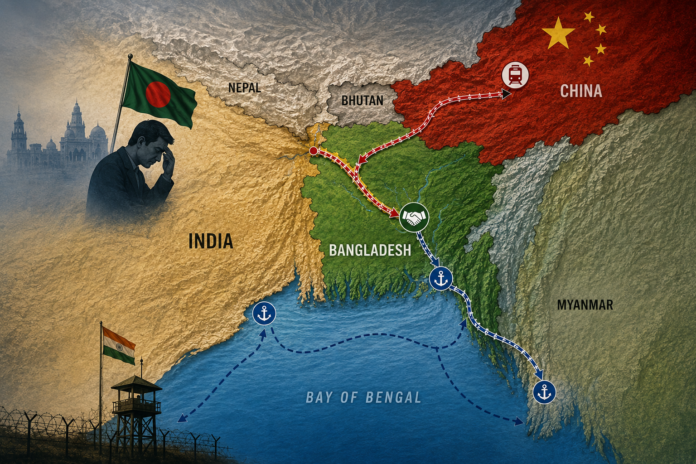
There is a certain type of strategic danger that emerges quietly—not through the mobilisation of armies or the issuance of diplomatic ultimatums, but through the gradual accumulation of engineering contracts, party-to-party memoranda and river-management frameworks.
China’s deepening embrace of Bangladesh, which crystallised during Prime Minister Tarique Rahman’s visit to Beijing in June 2026, fits this pattern almost exactly.

The risk to Indian national security is genuine, structural and accelerating, and it is being constructed with Bangladesh’s active participation.
To understand why, one must look beyond the immediate headlines and ask what China is actually building in Bangladesh. It is not merely an economic partnership. Rather, it resembles a comprehensive strategic blueprint that simultaneously touches India’s most sensitive geographic, maritime and political interests.
The Geography of Vulnerability
The Teesta River project, perhaps the most immediately concerning outcome of the Rahman visit, is not merely a water-management initiative. It places a substantial Chinese engineering and technical presence close to India’s Siliguri Corridor, the narrow strip of land—barely twenty-two kilometres wide at its narrowest point—that connects mainland India with its entire northeastern region.
In military geography, this corridor is often referred to as the “Chicken’s Neck”, a term that accurately captures its strategic significance: if this corridor is severed, or even subjected to sufficient pressure, India’s eight northeastern states could effectively be isolated from the rest of the country.

Indian security planners have long regarded external interference near this corridor as a strategic red line.
The concern surrounding the Teesta project is not that Chinese hydrologists will suddenly transform into intelligence operatives. Rather, it is that a sustained Chinese presence in this region—comprising engineers, technical personnel, data systems and communications infrastructure—creates persistent opportunities for surveillance, intelligence collection and dual-use strategic leverage that no responsible defence establishment can afford to ignore.

The Siliguri Question
Hydrological data relating to river flows and topography near the Siliguri Corridor possess significant operational value.
China will have access to such data.
India, meanwhile, will have little practical ability to prevent that access.
The implications extend beyond hydrology.
A long-term Chinese technical footprint in northern Bangladesh creates opportunities for the gradual accumulation of geographical, infrastructural and operational knowledge in one of India’s most strategically sensitive regions. Such activities may remain entirely civilian in appearance while simultaneously generating information that could possess substantial strategic utility.
This possibility, rather than any immediate military threat, explains why developments around the Teesta project have generated such concern within India’s strategic community.
Mongla and the String of Pearls
The Siliguri proximity is sufficiently concerning in isolation. However, the Teesta project must be examined alongside another equally consequential development: China’s acquisition of the Mongla Port Economic Zone project.
The project was originally allotted to an Indian developer. Following the political transition in Dhaka, it passed into Chinese hands. This is not merely a commercial setback for India.
Mongla represents a strategic foothold on Bangladesh’s southwestern coast, providing China with enhanced access to the Bay of Bengal at precisely the moment when Beijing is consolidating its presence across the wider Indian Ocean region.
Indian strategic thinkers have long viewed such developments through the prism of the so-called “String of Pearls” strategy—China’s gradual expansion of port and maritime infrastructure stretching from Hambantota in Sri Lanka to Kyaukpyu in Myanmar and now, increasingly, to Mongla in Bangladesh.
The Teesta project is not merely about water management; it is about geography, access and strategic leverage
Viewed individually, each of these projects can be presented as a commercial transaction.
Viewed collectively, however, they suggest a systematic effort to establish Chinese presence at strategic locations and maritime chokepoints surrounding the Indian subcontinent.
Bangladesh represented perhaps the most conspicuous gap in this strategic arc.
That gap is now narrowing.
The Defence Dimension
Equally significant is the institutionalisation of Dhaka-Beijing defence cooperation.
The two countries have signalled their intention to establish a 2+2 dialogue mechanism involving their foreign and defence ministers, a format typically associated with relationships possessing substantial strategic depth.
More concretely, Bangladesh is reportedly close to finalising the acquisition of twenty-four Chinese J-10CE fighter aircraft, along with associated drone technologies.
If concluded, this would represent a qualitative expansion of Chinese military influence within a country sharing a 4,156-kilometre border with India.
For decades, India maintained de facto security primacy in Bangladesh.
Dhaka’s armed forces relied upon a diverse mix of suppliers, while defence cooperation with New Delhi—though not without periodic friction—provided India with meaningful influence over Bangladesh’s broader security calculus.
Chinese military hardware integration, however, is not merely a commercial transaction.
It brings with it training programmes, maintenance arrangements, technical dependencies and interoperability frameworks that gradually reorient a country’s defence establishment towards Beijing.
Once such integration becomes deeply embedded, it becomes extraordinarily difficult to reverse.
Strategic Consequences
The significance of these developments lies not in any immediate military threat to India.
Rather, it lies in the gradual creation of strategic dependencies.
Military influence is rarely established through dramatic geopolitical shifts. More often, it emerges incrementally through institutional relationships, technical reliance and the accumulation of operational familiarity.
China appears to understand this dynamic particularly well.
The cumulative effect of infrastructure projects, defence cooperation, technical integration and political engagement is to create a strategic ecosystem that becomes progressively more difficult for competitors to displace.
It is this cumulative logic, rather than any individual agreement signed in Beijing, that should concern Indian strategic planners most.
The Strategic Logic of Dhaka’s Pivot
India needs to resist the temptation to portray Bangladesh as a passive victim of Chinese strategic “seduction”. In reality, Dhaka is pursuing a deliberate multi-vector foreign policy, using competition among major powers to maximise development opportunities while preserving its own strategic autonomy.
China’s acquisition of Mongla strengthens a maritime network that India has long viewed as part of the ‘String of Pearls’ strategy
This is rational state behaviour.
Indian frustration with Bangladesh’s choices, however understandable, should not obscure the underlying causes of Dhaka’s strategic calculations.
Chief among these is India’s decade-long inability to conclude the Teesta water-sharing agreement.
For generations, the Teesta has sustained agricultural livelihoods in Bangladesh. Many Bangladeshis have watched upstream Indian dams and barrages reduce the river’s flow to seasonal levels. New Delhi’s inability—or unwillingness—to overcome domestic political opposition in West Bengal and deliver a binding agreement has conveyed a broader strategic message: India’s commitments to Bangladesh remain subject to internal political constraints and are therefore not always entirely reliable.
China’s decision to step into the Teesta vacuum is not, in itself, an act of aggression.
It is the exploitation of a strategic opportunity that India inadvertently created.
India’s Response: Necessary but Insufficient
New Delhi has not been entirely passive.
The resumption of normal tourist visa processing for Bangladeshi nationals signals a desire to rebuild frayed people-to-people ties following a difficult transitional period.
On the military side, India has reinforced its defensive posture along the northeastern corridor by deploying Rafale aircraft and BrahMos missile systems to relevant theatre commands and by establishing additional military infrastructure to secure the Siliguri approaches.
Bangladesh is not drifting towards China; it is pursuing a rational strategy to maximise its own strategic autonomy
These are prudent and necessary measures.
However, reactive measures do not address the structural causes of India’s eroding position.
Military reinforcement around the Siliguri Corridor is essential. It is not a substitute for the political will required to resolve the Teesta dispute.
Visa liberalisation is welcome. It does not compete with Chinese investment commitments worth hundreds of millions of dollars.
Diplomatic engagement remains indispensable. Yet it cannot substitute for a coherent strategy that positions India as Bangladesh’s preferred partner, rather than as a neighbour whose interests Dhaka must periodically balance.
The Stakes for India
India faces a compounding strategic challenge.
Each unresolved bilateral issue—whether related to Teesta, trade imbalances, border management or transit connectivity—creates opportunities for external actors willing to exploit them.
China is precisely such an actor, and it possesses one attribute that India often underestimates: strategic patience.
The BNP-CPC party-to-party memorandum signed during the Rahman visit ensures that Chinese political influence in Bangladesh is now embedded across electoral cycles, rather than remaining dependent upon the fortunes of any particular government.
Beijing has therefore made its position in Bangladesh structurally durable.
India’s challenge is no longer merely to counter China, but to address the unresolved bilateral issues that created the opening for Beijing in the first place
India must do the same.
Not merely through the transactional logic of aid and investment, but through the genuine resolution of disputes that have encouraged Bangladesh to seek strategic alternatives.
The Teesta agreement must be concluded.
Investment commitments must be implemented, not merely announced.
Defence cooperation must be expanded on terms that respect Bangladeshi sovereignty rather than assuming the permanence of Indian strategic primacy.
The Window Is Narrowing
The Chicken’s Neck has always been narrow, and India has always known it.
What the events of June 2026 have made increasingly clear is that Beijing understands this reality equally well and is positioning itself accordingly—one memorandum of understanding at a time, one river project at a time and one port at a time.
The window for India to regain the strategic initiative in one of its most consequential bilateral relationships is narrowing.
Reversing this trend will require more than sharper diplomacy.
It will require the political will to make difficult decisions that successive governments in New Delhi have deferred for far too long.

The writer is an expert on geopolitics, national security, and counter-terrorism; and he regularly contributes his subject thought-leadership and academic commentary with several publications in newspapers, journals, and periodicals. He works with investigative agencies, regulatory bodies, financial institutions and enterprises, providing strategic and regulatory advisory. The views expressed are personal and do not necessarily carry the views of Raksha Anirveda





