


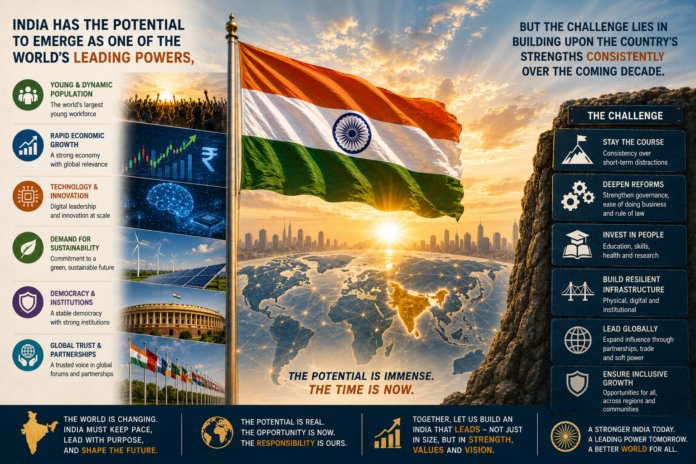
Over the past decade, India has witnessed a period of significant structural transformation across its economy, technology base and foreign policy. It has transformed from a fragile economy into the world’s fourth-largest, while building digital public infrastructure, expanding defence and space capabilities, and pursuing a more confident, multi-aligned foreign policy. Rather than representing a sudden emergence as a global power, the changes reflect a gradual strengthening of India’s economic capabilities, technological capacity and international engagement.
The country has moved beyond being viewed primarily as a large consumer market to becoming an increasingly important manufacturing destination, a leader in Digital Public Infrastructure (DPI) and a more active participant in shaping regional and global conversations.

These developments have enhanced India’s international standing. At the same time, they should be viewed as part of an ongoing transition rather than its completion.
Economic Transformation
India’s economic transition over the past decade has been driven by structural reforms, public investment in infrastructure, expanding manufacturing and a growing emphasis on digitalisation.
The country has gradually moved away from its earlier “Fragile Five” perception and, by 2025, emerged as the world’s fourth-largest economy in nominal terms, supported by sustained domestic growth and a larger manufacturing base.
An important feature of this transition has been the emphasis on capital expenditure. Large-scale investments in highways, railways, ports and multimodal connectivity have sought to improve logistics efficiency, reduce transport costs and strengthen industrial competitiveness.

While the long-term impact of these investments will become clearer over time, they have already begun to improve physical connectivity and support economic activity across several regions.
Growth with Greater Stability
India’s economic performance has remained comparatively resilient despite global economic uncertainty. Sustained GDP growth has enabled the country to retain its position among the fastest-growing major economies, while improvements in banking-sector health have strengthened financial stability.

The reduction in non-performing assets (NPAs) has improved credit availability for businesses and supported fresh investment across multiple sectors.
According to the World Bank, India’s economy is expected to grow by 6.6 per cent in FY2026–27, while the International Monetary Fund (IMF) projects 6.5 per cent growth during the same period. These forecasts continue to place India among the world’s fastest-growing major economies.
Nevertheless, high growth alone does not automatically translate into developed-economy status.
Building Domestic Capability
Another notable development has been India’s effort to reduce external vulnerabilities while strengthening domestic production capabilities. Expansion in pharmaceuticals, electronics manufacturing, digital services and technology enterprises has diversified the country’s economic base.
The growth of business-to-business (B2B) software companies, expanding technology exports and the emergence of globally competitive startups illustrate India’s increasing role within the international digital economy.
From UPI and Aadhaar to Chandrayaan-3 and a booming defence export sector, India has steadily built technological and economic capabilities that command global attention
At the same time, government initiatives have sought to encourage manufacturing, supply-chain resilience and domestic value addition, reflecting a broader objective of reducing dependence on external sources in strategically important sectors.
Infrastructure and Energy
Infrastructure development has become one of the defining features of India’s economic strategy. Significant investments in transport networks, logistics corridors and renewable energy have sought to improve competitiveness while supporting long-term economic growth.
The expansion of non-fossil fuel capacity, together with improvements in power availability and transport connectivity, reflects an effort to strengthen both energy security and environmental sustainability.
The Digital Shift
One of the most significant changes over the past decade has been India’s rapid expansion of Digital Public Infrastructure (DPI).
Rather than merely digitising government services, India has developed interoperable public digital platforms that have transformed payments, identity verification, service delivery and financial inclusion. This ecosystem—built around Aadhaar, the Unified Payments Interface (UPI) and other open digital platforms—has become an important component of India’s economic transformation.
The widespread adoption of UPI has fundamentally changed retail payments, while digital identity systems have improved the efficiency of welfare delivery and reduced transaction costs.
Increasing broadband penetration has also expanded access to digital services, creating new opportunities for businesses, entrepreneurs and citizens alike.
India’s experience has attracted international attention, particularly among developing countries exploring affordable and scalable digital public infrastructure.
Technology and Manufacturing
Alongside digital transformation, India has sought to strengthen its manufacturing capability in strategically important sectors.
Government initiatives such as the Production-Linked Incentive (PLI) schemes have encouraged domestic production in electronics, pharmaceuticals and other advanced industries, while efforts to expand green manufacturing and renewable energy have aimed to reduce long-term external vulnerabilities.
India’s G20 Presidency and growing role as a bridge between the Global South and developed economies reflect a nation no longer content to be a passive observer of world affairs
A major priority has been the development of semiconductor capabilities. Through the Semicon India Programme and subsequent policy initiatives, India is attempting to move beyond its traditional strength in chip design towards fabrication, packaging and a broader semiconductor ecosystem.
Although this transition is still at an early stage, it represents an important step towards strengthening technological resilience in a sector that has become increasingly central to national security and economic competitiveness.
Artificial Intelligence and Advanced Technologies
India has also increased investment in artificial intelligence, high-performance computing and emerging technologies.
The IndiaAI Mission, together with investments in computing infrastructure and indigenous AI models, reflects a growing recognition that future economic competitiveness will depend increasingly on knowledge-intensive technologies. These initiatives seek to expand domestic capabilities in AI research, computing infrastructure and advanced digital applications.
Defence and Space
The defence and space sectors have also undergone important changes during the past decade.
India’s defence exports have expanded significantly, while domestic defence production has increased through a combination of policy reforms, higher procurement and greater private-sector participation.
At the same time, missions such as Chandrayaan-3 and Aditya-L1 have demonstrated India’s growing capabilities in space exploration and scientific research, enhancing both national confidence and international credibility.
Growing international interest in systems such as the BrahMos cruise missile, Pinaka multi-barrel rocket launcher and Akash air-defence system also reflects the gradual expansion of India’s defence-industrial capabilities.
Nevertheless, India continues to depend on external suppliers for several critical defence technologies, particularly in areas such as advanced aero-engines, propulsion systems and specialised electronic components.
India’s rise depends on closing critical gaps in advanced defence technology, boosting R&D spending, improving educational outcomes, and translating digital success into broad-based industrial strength
Further progress will therefore depend not only on expanding production, but also on closing these technological gaps.
Technology as an Instrument of National Capability
Viewed collectively, developments in digital infrastructure, manufacturing, artificial intelligence, defence and space point towards a broader strengthening of India’s technological capabilities.
These initiatives have enhanced India’s ability to compete in emerging sectors while improving its resilience in an increasingly uncertain international environment.
Yet technology leadership requires continuous innovation, sustained investment in research and development, skilled human capital and institutions capable of adapting to rapid technological change.
A More Confident Foreign Policy
India’s foreign policy has evolved significantly over the past decade.
Rather than adhering rigidly to traditional formulations of non-alignment, New Delhi has increasingly pursued strategic autonomy through multi-aligned partnerships, engaging simultaneously with the United States, Russia, Europe, the Gulf, Japan and other Indo-Pacific partners, while remaining active in groupings such as the Quad, BRICS and the Global South.
This approach reflects an effort to maximise strategic flexibility in an increasingly fragmented international order, where geopolitical competition often requires countries to work with different partners on different issues.
The Global South and Multilateral Engagement
India has also sought to strengthen its engagement with the Global South, positioning itself as a bridge between developed and developing economies. Its G20 Presidency marked an important diplomatic milestone, particularly through its role in facilitating the African Union’s admission as a permanent member of the G20.
India has consistently highlighted issues such as sustainable development, climate finance, food security, energy access and affordable digital public infrastructure, particularly from the perspective of developing nations.
Connectivity and Economic Integration
Another important dimension of India’s international engagement has been its emphasis on connectivity and trade corridors.
Projects such as the India-Middle East-Europe Economic Corridor (IMEC) reflect an effort to strengthen commercial links while diversifying global supply chains.
The next decade will test whether India can convert its current momentum into lasting great-power status
Domestically, continued expansion of the national highway network, metro rail systems, airports and regional connectivity initiatives has sought to improve internal integration and facilitate economic growth.
Takeaways
India’s economy has expanded, technological capabilities have improved, defence production has grown and foreign policy has become more confident and multidimensional. These developments have enhanced its global profile and increased its ability to influence regional and international conversations.
At the same time, the country’s rise should be viewed as an evolving process rather than a predetermined outcome.
Future progress will depend not only on sustaining economic growth but also on improving institutional capacity, fostering innovation, strengthening manufacturing competitiveness, creating quality employment, expanding research and development, improving educational outcomes, accelerating judicial and administrative reforms and translating technological advances into long-term national capability.
Whether India ultimately emerges as one of the world’s leading powers will depend less on the achievements of the past decade than on its ability to address the structural challenges that remain in the decade ahead.

The author retired as a Senior Technical Officer at the Central Salt and Marine Chemicals Research Institute, Bhavnagar (Gujarat), and currently contributes articles to research journals and magazines. The views expressed are personal and do not necessarily carry the views of Raksha Anirveda.





