


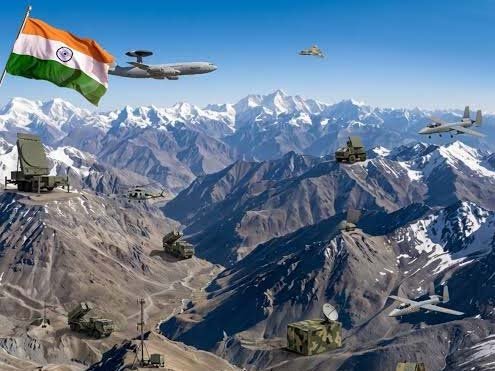
Indo-China ties are complex. Additional deployment of troops along the LAC is now the new normal. While economic ties are growing and diplomatic engagement is increasing, tensions along the border remain high. This largely flows from mistrust between the two sides. It has always been China that has taken the first negative step, and India has responded firmly, forcing the PLA to back down.
India has repeatedly been stating that “maintenance of peace and tranquillity in border areas is essential for overall development of bilateral relations.” China believes that both sides should “place the boundary question in its proper context within the overall bilateral relationship, and move forward steadily.” Both approaches are different; one primarily seeks peace, the other considers it secondary.

There are multiple mechanisms at work to resolve the border dispute. These include the Special Representative (SR) level talks, the WMCC (Working Mechanism for Consultation and Coordination on India–China Border Affairs) and military talks at different levels. In the last round of SR talks, two additional hot lines and meeting points were agreed to, in addition to five already existing.
Following India’s strong response in Eastern Ladakh, including enhanced deployment, China’s emphasis has shifted towards Central and Eastern sectors. Standoffs have been increasing in Arunachal, where China appears to be defining its claim lines
Working behind the scenes throughout is the 1975-founded China Study Group. This high-level body of experts monitors current scenarios, determines the nature of infrastructure to be developed, and helps prepare government representatives for negotiations. It also assesses every discussion and recommends future actions.
Following India’s strong response in Eastern Ladakh, including enhanced deployment, China’s emphasis has shifted towards Central and Eastern sectors. Standoffs have been increasing in Arunachal, where China appears to be defining its claim lines. Every Chinese action begins with an intrusion, which is countered and they are forced to step back. The Central Sector too will face the same.
Despite disagreements between Delhi and Beijing, there are positives. Trade continues, though tilted heavily in China’s favour as India needs Chinese products. Initiatives such as Kailash Manasarovar Yatra and participation in the BRICS summit are other positive indicators
The message flowing from China is that an un-demarcated border will be exploited. Simultaneously, they insist that they are acting within parameters of existing agreements and safeguarding their territorial integrity. In the late nineties and early 2000s, some attempts were made to exchange maps, to move towards demarcation of borders, but that too died down.

In the last round of SR talks in August, China proposed an ‘early harvest’ of resolving the border. The statement mentioned, “advance discussions on an Early and Substantial Harvest of boundary delimitation and Border Management.” Though no region was specifically mentioned, it appears that China was hinting at settling the Sikkim boundary between the two nations because they claim that the border had already been accepted in the 1890 convention between ‘Britain and China.’ It could also imply the Middle Sector (Uttarakhand), as there are very few disagreements in this region.
India has been hesitant to accept this for two reasons. First, in a complete settlement, concessions in one sector could be offered for a settlement in another. Secondly, Sikkim is close to where the Doklam standoff occurred in 2017. In case Sikkim is settled, it would open doors for China to resolve Doklam in its favour in direct negotiations with Bhutan. However, even in this proposal, a lot needs to be agreed before it even begins to see the light of day.

China has close relations with Pakistan and provides it with technology, satellite inputs, and weapons; its recent military exercise with Pakistan, Karakoram 2026, signals growing cooperation. China is also enhancing relations with Bangladesh and Nepal, exploiting Indian fault lines
Simultaneously, both sides have been giving new names to places in Arunachal. While China gives Mandarin translations for select locations in Arunachal, India provides historical names. Both disagree with the other’s action, claiming they possess the sole right to do so. India’s announcement of historical names for 27 places came a day after the WMCC meeting in Delhi. Some of the places identified by India are known for standoffs, including two recent ones. The government must insist that Indian media strictly adheres to names laid down by the Survey of India in its maps, thereby making these names permanent.
Grey Zone warfare, including supporting internal dissent and information warfare by circulating fake videos, is on the rise from the Chinese. These videos, timed with standoffs depict loss of territory as also surrender of soldiers, all of which are false. The Chinese aim is to damage reputation of the Indian armed forces while enhancing pressure on the government for its failure to defend the nation. Alongside this, they are pushing narratives that India’s global partnerships will not benefit the nation in conflict. These are exploited by anti-government groups within the country.
Despite disagreements between Delhi and Beijing, there are positives. Trade continues, tilted heavily in favour of China as India needs Chinese products, technology and investment. Initiatives such as Kailash Manasarovar Yatra and participation in the BRICS summit are other positive indicators. Meanwhile, China continues to place India-specific export curbs on machinery essential for the country’s infrastructure development. Despite promises to lift curbs, these remain. While China does seek tranquillity along the borders, it appears in no hurry to move towards resolution. It appears fixated on keeping the border tense.
While China has close relations with Pakistan and provides it with technology, satellite inputs, as well as weapons and equipment, its recent exercise with Pakistan, termed Karakoram 2026, signals growing military cooperation. It is also enhancing relations with Bangladesh and Nepal, exploiting Indian fault lines.
India needs to enhance its ability to counter disinformation flowing from China. New Delhi must also reduce its economic and raw material dependence on China by expanding its options. Whenever China blocks exports, India is impacted. India cannot continue to be held to ransom
In this scenario, what should be India’s approach? While talks linger, development of infrastructure along the northern borders must continue. India is dependent on external lines of communication, which impact the pace of mobilisation, viz-à-vis China. Developing inter-valley communication, alongside underground facilities to cater for the changing nature of warfare, is essential. Simultaneous development of military capabilities, including surveillance, is needed to meet the demands of future warfare.
India needs to enhance its ability to counter disinformation flowing from China. The same must be identified and disseminated by the widest possible means. New Delhi must look at reducing its economic and raw material dependence on China by expanding its options. Currently, whenever China places blocks on exports, India is impacted. It cannot continue being held to ransom.
As China ventures into India’s neighbourhood, Delhi has begun doing the same in SE Asia. India’s sale of weapon systems to nations facing territorial disputes with China is a positive action. It must continue. India must also look to partner nations that are in conflict with China, as this relationship would be more reliable than with powers like the US, which could be accommodating to China. Such ties could also cause discomfort in Beijing.
Finally, India must not rush into negotiations for resolution under ‘early harvest.’ It should be across-the-board or nothing. We are in no hurry and should not dance to their tune.
The writer is a strategic analyst and a motivator. He can be reached at @kakar_harsha. The views expressed are of the writer and do not necessarily reflect the views of Raksha Anirveda






