


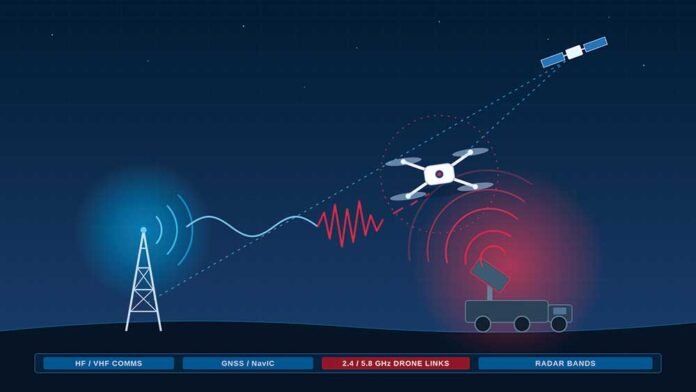
Every modern weapon system depends on something invisible. A drone needs a control link. A missile needs navigation. A radar needs clean frequencies to see. A commander needs his radios to work. All of these run on the electromagnetic spectrum, and in recent conflicts it has become one of the most fiercely contested spaces on the battlefield.
In Ukraine, both sides jam and spoof each other’s drones and navigation signals every day. Units that once relied entirely on GPS have had to relearn older methods. Drone makers keep changing frequencies, adding fibre-optic control cables, or building in autonomy, simply because the radio link can no longer be trusted.

Civil aircraft over the Baltic and parts of West Asia have faced repeated GNSS interference, with pilots seeing positions that are nowhere near where they actually are. Indian operators have reported similar problems, and our aviation regulator has had to issue guidance on it.
It is hard to build world-class electronic warfare products when you cannot easily switch them on at home
The lesson is clear. Control of the spectrum is no longer a support function. It is a warfighting domain in its own right, as important as air, sea or cyber. The question is whether our policies have caught up.
A Strategic Domain We Still Manage Like a Utility
In India, spectrum is largely viewed through a telecom lens. It is allocated, auctioned and regulated mainly for commercial use, with defence requirements negotiated alongside. That approach made sense when the main concern was mobile networks. It makes far less sense when the same bands carry drone links, navigation signals and military communications, and when an adversary can disrupt them from across a border.
This creates three practical problems. The first is coordination. When a new threat appears, such as unidentified drones over a sensitive installation, there is often no single body that can quickly decide who acts, on which frequencies, and under what authority. Decisions happen case by case, and time is lost.

The second is legal clarity. The use of jammers in India is tightly restricted to a small number of authorised agencies. Yet the people who most often need protection from drones are airport operators, refineries, power plants, prisons, police forces, and organisers of large public events. Many of them can buy detection systems, but they have no clear legal authority to act on what they detect. Detection without the ability to respond is only half a solution.
Designated frequencies, test locations and fast-track permissions would let Indian companies develop and validate electronic warfare and RF products within the country
The third is testing. Developing a jammer, a direction finder, or a resilient military radio requires transmitting on real frequencies under controlled conditions. Indian firms often have limited access to test ranges and temporary spectrum permissions, which slows development and sometimes pushes testing abroad. It is hard to build world-class electronic warfare products when you cannot easily switch them on at home.

The Dual-Use Dilemma
The technologies behind electronic warfare rarely stay in one category. Software-defined radios, RF components, AI-based signal analysis, cyber tools, satellite communication, and advanced materials all serve both civilian and military markets. That is their strength, and it is also why governments watch them closely.
India has done well to build credibility here. Joining the Wassenaar Arrangement in 2017, along with the MTCR and the Australia Group, placed India among the world’s responsible technology holders. Our SCOMET list aligns national export controls with these regimes. That credibility took years to earn, and industry has every reason to protect it.
But credibility and speed are not opposites. For many companies, the difficulty is not the rules themselves. It is the uncertainty around them. Does a product need a licence? Which category does it fall under? How long will approval take? Anyone who has worked in international defence sales knows that a delay of a few months can decide whether a deal is won or lost.
Customers in the Middle East, Africa, South-East Asia and Central Asia usually have alternatives, often from countries whose export systems move faster and whose governments actively support their industry abroad.
Dual-use licensing should be made predictable. Early product classification, time-bound decisions and wider use of general authorisations for trusted partner countries would give industry the certainty it needs, without weakening controls
There is a domestic cost too. When the export path is slow and unpredictable, investors see a smaller market and companies hesitate to commit to dual-use R&D. Over time, this weakens the same industrial base that our armed forces will depend on in a crisis.
What a Sensible Policy Could Look Like
None of this requires dramatic reform. A few practical steps would make a real difference.
Recognise the spectrum as a strategic domain. A national spectrum security framework, with a standing civil-military body, could coordinate allocations, respond quickly to interference and set clear priorities during emergencies.
Give civil agencies clear counter-drone authority. Defined legal powers and standard procedures would allow police and critical infrastructure operators to detect, jam or neutralise hostile drones, with proper accountability and safeguards against misuse.
Open up testing for industry. Designated frequencies, test locations and fast-track permissions would let Indian companies develop and validate electronic warfare and RF products within the country.
Make dual-use licensing predictable. Early product classification, time-bound decisions and wider use of general authorisations for trusted partner countries would give industry the certainty it needs, without weakening controls.
RF chips, radio platforms, antennas and signal processing hardware remain heavily import-dependent. No policy on paper can fix a supply chain vulnerability of that kind. Only sustained investment in indigenous capability can
Invest in the building blocks. RF chips, radio platforms, antennas and signal processing hardware remain heavily import-dependent. No policy on paper can fix a supply chain vulnerability of that kind. Only sustained investment in indigenous capability can.
Summing Up
Those of us who have worked with radar learn early that what you cannot see can still hurt you. The spectrum is exactly that kind of space. It carries our communications, guides our weapons and protects our skies, and it can be denied to us without a single shot being fired.
India has the engineers, the start-ups and a growing defence industry capable of competing with the best. What it needs now is a policy framework that treats the spectrum as the strategic asset it has become, and treats dual-use technology as an opportunity to be managed well rather than a risk to be contained. Get that balance right, and India will be better protected at home and far more competitive abroad.

Wing Commander Harikumar is an Indian Air Force veteran with 22 years of expertise spanning radar systems, aircraft maintenance, and aircrew. After taking voluntary retirement in 2018, he transitioned to the defence industry, leading international business development and strategic partnerships. He is currently President – International Business at BBBS Pvt Ltd with extensive global defence market exposure.





