


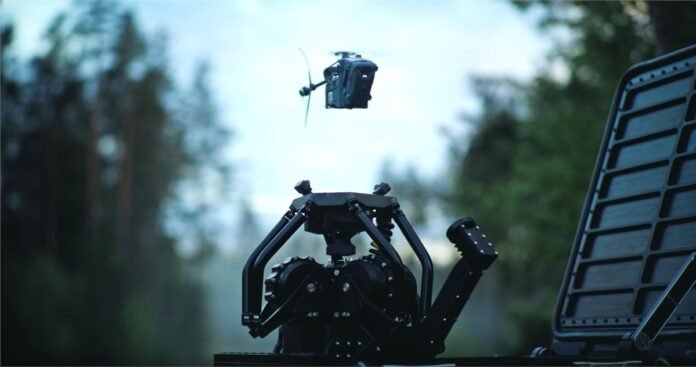
Paris. Teledyne FLIR Defense has officially launched Black Recon, an autonomous, vehicle-mounted micro-drone system designed to provide frontline armoured crews with continuous, real-time tactical overwatch without ever exposing personnel to enemy fire.
Unveiled on June 15, 2026, at the Eurosatory defence exhibition in Paris, the Black Recon represents a paradigm shift in how ground forces generate tactical intelligence. Rather than relying on external aviation support or requiring dismounted soldiers to manually launch aircraft, Black Recon integrates directly onto infantry fighting vehicles, main battle tanks, or fixed base installations.

The system functions as an automated reconnaissance hub, housing three specialised micro-Unmanned Aerial Vehicles (UAVs) inside a hardened, weather-proof launcher box.
The Three-Drone Continuous Rotation
The defining feature of Black Recon is its ability to maintain uninterrupted, 24/7 intelligence, surveillance, and reconnaissance (ISR) coverage through an automated rotational cycle. When a vehicle commander requires situational awareness beyond line-of-sight, the system initiates a hands-free operational sequence:
With flight endurances lasting 50 to 60 minutes per aircraft, this synchronised loop ensures that ground forces maintain continuous overwatch. While one drone is actively tracking threats at the frontline, a second is in transit to relieve it, and the third sits protected inside the launcher box undergoing high-speed recharging.

Low SWaP, High-Performance Sensing
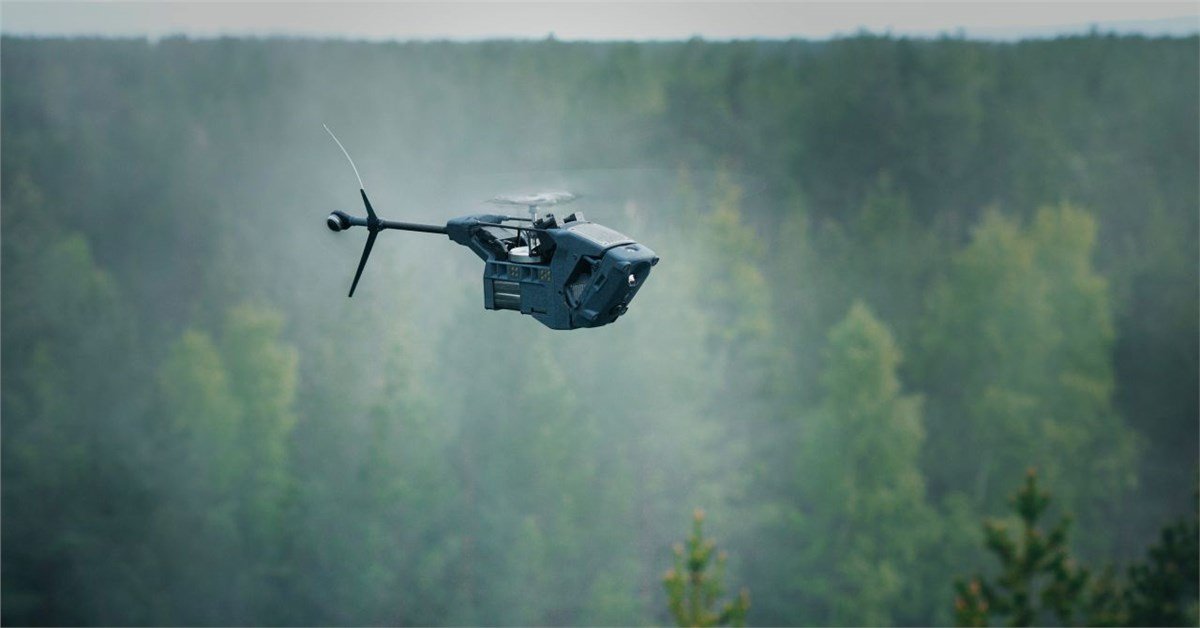
Engineered around strict Size, Weight, and Power (SWaP) constraints, each individual micro-drone weighs less than 450 grams (under one pound). Despite its remarkably small footprint, the aircraft is a rugged powerhouse, capable of reaching transit speeds up to 56 miles per hour (90 kilometers per hour) to outpace advancing mechanised columns.
On the occasion, Dr JihFen Lei, President of Teledyne Defense and Aerospace Group said, “By bringing autonomous launch, recovery, and recharging directly to the vehicle, we give operators persistent situational awareness and greater protection in high-tempo missions.”

Leveraging advanced miniaturised optics from Teledyne FLIR’s nano-UAS portfolio, the platform carries a combined thermal and visible imaging payload. This delivers highly accurate Real-Time Target Acquisition (RSTA) data directly to the crew’s internal displays, allowing them to inspect micro-terrain, detect hidden improvised explosive devices (IEDs), and verify if distant bridges are passable before advancing.
Operating Radio-Silent in Contested Airspace
Modern near-peer conflicts are defined by heavy electronic warfare and GPS-jamming. To survive these electronic environments, Black Recon utilises a sophisticated Visual Inertial Navigation system.
This enables the micro-drones to navigate, track landmarks, and accurately return to a moving vehicle platform under total radio silence, even in entirely GNSS-denied or heavily jammed environments.

The micro-drone system delivers impressive technical capabilities within a highly compact framework. Weighing less than 450 grams (0.99 lbs), each individual aircraft can achieve a maximum airspeed of 56 mph or 90 km/h (25 m/s) while maintaining a flight endurance of 50 to 60 minutes per battery charge.
To ensure operational resilience in electronic warfare environments, it features an autonomous visual inertial navigation mode that makes it fully GNSS-denied ready. Furthermore, its sensor suite is built on an open-architecture electro-optical and infrared (EO/IR) payload, complemented by a flexible 100-gram mission module for specialised gear.
Looking ahead, Teledyne FLIR has built the platform using an open mission-module architecture. The drones can carry an optional 100-gram payload expansion, with future modules in development for chemical, biological, radiological, and nuclear (CBRN) hazard detection, as well as kinetic micro-lethality options.
With commercial order books officially open, the first military deliveries of the vehicle-integrated system are expected to commence in early 2027.






