


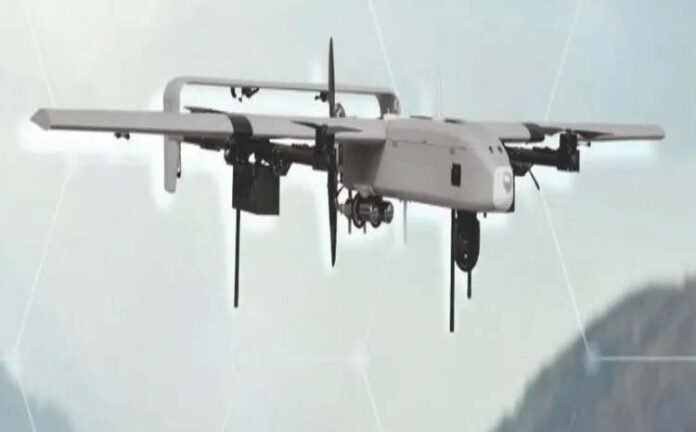
NEW DELHI. In a major boost to domestic defence manufacturing, Tata Advanced Systems Limited (TASL) and Nibe Limited have emerged as the frontrunners to bag a prestigious contract for the Indian Army’s Regiment of Artillery. The tender, valued at approximately Rs 1,600 crore, seeks to procure 840 cutting-edge loitering munitions capable of striking targets at a range exceeding 100 kilometres.
Defence sources revealed that price bids for the project were recently opened under fast-track procurement procedures. Out of the competing companies, only three vendors successfully navigated the stringent technical evaluation phase: TASL, Nibe Limited – fielding their ‘Vayuastra’ platform based on Skystriker drone technology – and A-Vision.

Following the financial evaluation, TASL emerged as the lowest bidder (L-1). Under standard defence procurement guidelines for shared contracts, the L-1 bidder is slated to secure the majority share of the order, taking on 64 per cent of the total requirement. This brings the estimated contract value for the Tata Group to roughly Rs 1,000 crore.
Meanwhile, Nibe Defence finished as the second lowest bidder (L-2). It is positioned to supply the remaining 36 per cent of the loitering munitions, an order worth approximately Rs 600 crore. The Indian Army is expected to initiate formal price negotiations with both selected vendors shortly to finalise the contract terms.
Modernising for Next-Gen Warfare
Loitering munitions – often referred to as “suicide drones” – have transformed modern battlefields by combining the reconnaissance capabilities of an unmanned aerial vehicle (UAV) with the strike potential of a missile. They can hover over a designated airspace, locate high-value targets and execute high-precision strikes on command.
The acquisition comes at a time when the Indian Army is aggressively overhauling its artillery units to adapt to contemporary conflicts. The force has begun integrating dedicated drone batteries and specialised regiments designed exclusively for unmanned warfare.

Key among these new formations is the newly raised ‘Shaktibaan’ regiments, which focus purely on drone operations, alongside specialised ‘Divyastra’ batteries. Furthermore, ‘Bhairav’ battalions have been systematically equipped with tactical drones to independently identify and neutralise hostile assets behind enemy lines.
Ambitious Indigenisation Goals
This Rs 1,600 crore tender is just a fraction of a much larger, multi-phased modernisation blueprint. Industry estimates suggest that the Indian Army plans to source close to 100,000 drones of various sizes and functionalities over the coming years to support different operational wings.

The Artillery Directorate is spearheading a massive push to induct an array of unmanned aerial weapons with strike ranges stretching from 50 kilometres up to 1,000 kilometres. Most of these acquisitions are being prioritised through fast-track acquisition channels, with inductions projected to take place within the next 12 to 18 months.
Building on this momentum, defence sources indicated that the military is also preparing to float another high-profile tender for 36 jet-powered drones. That upcoming project is estimated to be worth Rs 1,500 crore and will similarly feature a split-contract structure between the lowest and second-lowest qualified bidders.






