


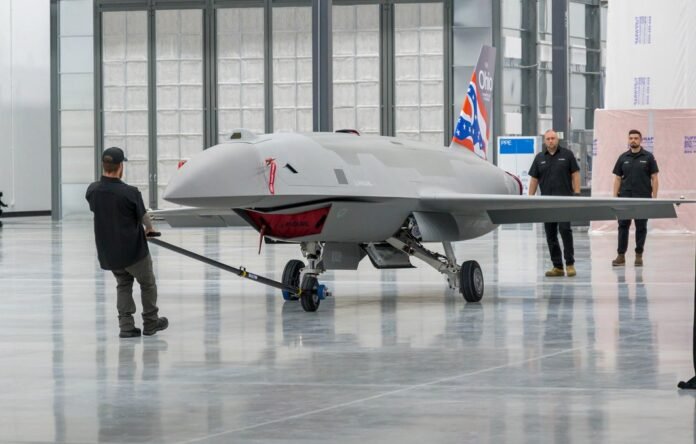
The rollout of the YFQ-44A – a missionised variant of Anduril’s FQ-44 Fury jet developed for the US Air Force’s Collaborative Combat Aircraft (CCA) programme – marks a rapid transition from facility announcement to active serial manufacturing. Completed just 557 days after Anduril initially announced plans for the Pickaway County campus in January 2025, the milestone arrived 18 months into development and well ahead of original targets. In aerospace industry, where establishing new aircraft production sites traditionally requires three to five years, completing site construction, workforce onboarding and first-aircraft delivery in under two years highlights a major acceleration in defence manufacturing capacity.
Transforming Autonomous Air Warfare
Designed to deliver affordable mass, the Fury is a high-performance, semi-autonomous jet capable of reaching speeds up to Mach 0.95. Powered by Anduril’s Lattice AI software suite, the platform incorporates open-architecture modularity that permits rapid field adjustments for electronic warfare, intelligence gathering and kinetic strike missions. Commercial off-the-shelf jet engines and modular sub-systems allow the aircraft to be manufactured rapidly at scale without overloading legacy defence supply chains.

As part of the Air Force’s broader air superiority strategy, the CCA initiative aims to field 100 to 150 autonomous jets in its first phase, with long-term operational plans envisioning a fleet of up to 1,000 uncrewed wingmen operating alongside piloted fighters. While flight execution, sensor fusion and navigation are AI-driven, human operators retain operational control over weapons release decisions.
Arsenal-1 Expansion and Economic Impact
Located strategically near Rickenbacker International Airport, the current assembly line at Arsenal-1 is configured to produce up to 150 Fury aircraft annually in its primary configuration. At full buildout, the hyper-scale facility will encompass a massive five-million-square-foot advanced manufacturing campus spanning 500 acres, equipped with direct runway access to support immediate flight testing and rapid tactical deployment.
Backed by a $910.5 million capital investment from Anduril, the facility represents the largest single job-creation project in Ohio’s history. Over the coming decade, Arsenal-1 is projected to create more than 4,000 specialised manufacturing, software and systems engineering positions in the Columbus region, providing a substantial economic boost to central Ohio.
Workforce Training and Industrial Realignment
The rapid commissioning of the facility reflects close public-private coordination between Anduril, state leadership, and regional economic development organisations such as JobsOhio and One Columbus. To ensure rapid operational readiness, central Ohio technicians and manufacturing staff travelled to Anduril’s California headquarters for specialised training in autonomous aircraft integration before returning to manage production lines in Pickaway County. Defence analysts view this milestone as a proof-of-concept for whether software-centric rapid prototyping can revitalise the Western industrial base to keep pace with global competitors, particularly in high-stakes environments like the Indo-Pacific.

Looking Ahead
With the initial Ohio-built YFQ-44A now off the assembly line, Anduril moves directly into rigorous flight test validation and system integration ahead of expected US Air Force serial production contracts. As defence demands shift toward rapid replenishment and massed autonomous capabilities, Arsenal-1 positions central Ohio at the forefront of modern defence aerospace manufacturing.






