


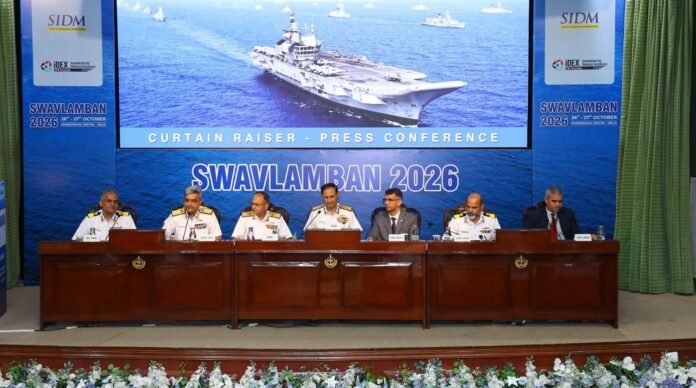
The fifth edition of the Indian Navy’s Swavlamban seminar, held at New Delhi’s Manekshaw Centre on October 26-27, 2026, placed a practical question at the centre of India’s defence self-reliance drive: how quickly can promising indigenous technology become a reliable capability at sea? The annual Naval Innovation and Indigenisation Seminar brings the Navy together with industry, start-ups, micro, small and medium enterprises (MSMEs), academia and investors. Its 2026 theme, “Strength and Power through Innovation & Indigenisation”, links industrial ambition to an operational test: whether home-grown systems can meet demanding service requirements, be produced at scale and remain dependable over their working lives.
Defence Minister Rajnath Singh framed self-reliance as more than domestic manufacture. He called for an “Aatmanirbharta 2.0” focused on advanced, cost-effective and globally competitive technologies that meet the armed forces’ operational needs. Domestic production can strengthen security, but an indigenous product is not automatically affordable, reliable or superior.

If its cost is excessive, its performance inadequate or its support ecosystem weak, local sourcing alone will not deliver strategic advantage. Singh also urged a more systematic assessment of supply-chain vulnerabilities, including dependence on external sources for critical inputs and technologies. Some dependencies, he acknowledged, may persist until domestic alternatives or resources become available; the task is to identify and prioritise the most consequential gaps.
Swavlamban 2026 connected the Navy with industry, start-ups, academia, and investors to bridge the gap between initial prototypes and reliable operational capabilities
This focus broadens the meaning of self-reliance. It is not necessarily an immediate rejection of every foreign component. Rather, it involves knowing where dependence creates unacceptable risk, developing alternatives where feasible and ensuring that supply disruptions cannot readily undermine readiness.
Critical materials, specialised components and advanced technologies may be difficult to reproduce quickly. A credible strategy must therefore combine domestic research and manufacturing with supply-chain mapping, partnerships, standards and long-term investment. Singh’s call for a “Dual Technology Roadmap” – identifying technologies relevant to both civilian and military uses – also points to a way of widening the economic base for research and production, while making clear that defence requirements still demand rigorous security and performance standards.
That emphasis marks a change in the conversation. Early indigenisation efforts understandably concentrated on generating ideas, inviting proposals and building a domestic supplier base. Swavlamban 2026 focused more explicitly on the route from a challenge to a prototype, from trials to procurement, and from procurement to sustained operational use.

The Navy’s four principles for technology absorption – scale, sophistication, speed and spiral development – capture this shift. Scale means widening participation and production capacity; sophistication means addressing complex, high-value requirements; speed means reducing delays; and spiral development means improving systems continuously through testing, operational feedback and technological upgrades.
The exhibition featured over 100 stalls highlighting breakthroughs in autonomous platforms, quantum sensing, AI, resilient navigation, and counter-drone systems
The scale of the initiative is significant. At the seminar, Chief of the Naval Staff Admiral Krishna Swaminathan said Navy-specific Innovations for Defence Excellence (iDEX) challenges had increased from 20 in 2022 to 229, about 35 per cent of all iDEX challenges across the defence sector.

He reported 41 Acceptances of Necessity (AoNs) – formal approvals indicating that a capability is required – worth more than ₹3,500 crore, and 25 signed contracts valued at more than ₹1,900 crore. The figures suggest that the innovation pipeline is producing procurement outcomes, although they do not by themselves show how many systems have entered service, how quickly they were delivered, or how well they perform.
That distinction matters. A challenge announced is not a proven technology; a prototype is not a deployable system; and a signed contract is not the same as an equipped fleet. The Navy’s innovation model must therefore be judged not only by the number of challenges, approvals or agreements, but by measurable progress through development, testing, production, integration and maintenance.
Demonstrating rapid growth, Navy-specific iDEX challenges jumped from 20 in 2022 to 229, reflecting deep integration with domestic tech developers
The Vice Chief of the Naval Staff, Vice Admiral Ajay Kochhar, stressed faster movement from concept and prototype to testing, production and deployment. His call for spiral development also recognises that military technology cannot be treated as finished at delivery: systems must evolve as threats, operating conditions and user feedback change.
The technological priorities reflect a maritime environment in which advantage may depend increasingly on networks, automation and the speed of decision-making. Admiral Swaminathan highlighted artificial intelligence, autonomous systems, robotics and quantum sensing as fields that could reinforce naval capability. These technologies have potential applications in areas such as surveillance, navigation, data processing and uncrewed operations, but their military value depends on integration with platforms, communications, command systems and trained personnel.
The seminar’s challenge, then, is not simply to encourage advanced research. It is to identify operational problems where a technology offers a genuine advantage, demonstrate that it works in realistic conditions, and make it robust enough for use at sea.
The initiative has secured 41 Acceptances of Necessity (AoNs) worth over ₹3,500 crore and 25 signed contracts exceeding ₹1,900 crore
The Navy’s emphasis on operational relevance is especially important because naval platforms operate in harsh, interconnected environments. Equipment must withstand saltwater, vibration, heat, electromagnetic interference and long deployments, while fitting into complex systems already in service.
A promising algorithm, sensor or autonomous vehicle may perform well in a controlled demonstration, yet, require substantial adaptation before it can operate safely and consistently alongside ships, aircraft and personnel. This makes early engagement between users and developers essential.
Start-ups and researchers need clear requirements and access to trials; the Navy needs honest performance data, secure systems and credible plans for maintenance, upgrades and production. Swavlamban’s collaborative format can help close that gap – but only if engagement continues beyond the exhibition and seminar.
Defence Minister Rajnath Singh emphasised that indigenous production must deliver cost-effectiveness, global competitiveness and secure supply chains
For smaller companies, turning an idea into a naval contract can involve demanding tests, certification, financing needs and production commitments. Swavlamban seeks to bring innovators closer to the Navy’s requirements, while the iDEX framework provides a channel for defence challenges and solutions. But a strong innovation ecosystem needs more than access to a showcase or a grant.
Companies need predictable procurement pathways, timely decisions, opportunities to test equipment, and clarity about intellectual property and production expectations. The Navy, in turn, must manage the risks of adopting immature systems while avoiding procedures so slow that a technology becomes obsolete before it is fielded. Speed cannot mean bypassing evaluation; it must mean designing evaluation and procurement to remove unnecessary delay.
The seminar’s growing participation signals interest in this ecosystem. The Navy chief said Swavlamban had grown from around 800 participants at its inaugural edition to nearly 3,000 in 2025. More than 100 stalls were planned for the 2026 edition, which also brought together the other services and security agencies.
Naval leadership stressed that success will ultimately be measured by how quickly tested innovations transition into active sea-going capabilities
Such breadth can encourage collaboration and expose developers to a wider set of operational problems. Yet, participation is an input, not an outcome. The ultimate test will be whether promising technologies progress into contracts, reach units on schedule, perform under operational conditions and can be maintained without creating new dependencies.
Swavlamban 2026 therefore represents both progress and a demanding agenda. The reported challenges, approvals and contracts indicate that naval innovation has moved beyond aspiration, while the Navy’s focus on speed, scale and iterative improvement acknowledges that conversion remains difficult.
The next phase must connect challenge design to realistic trials, procurement to production capacity and induction to long-term support. It must also assess cost, reliability and security alongside indigenous content. If those links become routine, Swavlamban can help build not merely a larger domestic defence industry, but a more adaptable Navy – one able to absorb innovation quickly, improve it continuously and turn technological self-reliance into durable maritime capability.

-The writer is a New Delhi-based senior commentator on international and strategic affairs, environmental issues, an interfaith practitioner, and a media consultant. The views expressed are personal and do not necessarily carry the views of Raksha Anirveda





